Friday, April 18, 2025

Managing Expectations

A reader left a link to an article at the WSJ about he stocks of the private equity operating companies like Blackstone (BX) and KKR. I'd been meaning to check in on them with a blog post because we've looked at them several times for blogging purposes. They are kind of like tech stocks as we've observed before. They tend to go up more than the broad market on the way up and now they are going down more on the way down.


Any individual name can do anything going forward of course but the odds are good that when the market starts back higher, these will once again go up more than the broad market. Ditto tech. KKR might be a little different as they might be changing to resemble a "mini-Berkshire Hathaway."

There's no shortcut to doing the work to understand the companies but just like a regulated utility stock or soda company are probably going to be much less volatile than the market, tech and the private equity operating companies are probably going to be much more volatile. This is an important thing to understand when constructing portfolios that go narrower than broad based index funds. 

Speaking of expectations, Corey Hoffstein from ReturnStacked Tweeted out the following;


Here's the link to the full thread in which he went on to discuss how their funds managed operationally during the tariff decline and why they didn't have problems with margin requirements from the leverage used by the funds. 

RSSY is 100% stocks and 100% futures yields and RSST is 100% stocks and 100% managed futures. I've have been fascinated by these but also very skeptical right out of the chute. The math checks out and while the timing for these funds to launch was simply unlucky, I can't figure how these make managing a portfolio easier. I've felt this way since before they hit their unlucky patch but where we've talked many times about leveraging up versus leveraging down, the potential utility of portable alpha (the predecessor common term for return stacking) never seemed worth the risk in the context of being an advisor for retail sized accounts. 

Part of the story these funds were built on was learning from what took down portable alpha in previous events like the GFC. Leveraging equity beta with more stock exposure was a mistake to learn from, leveraging into uncorrelated assets makes more sense, it should be safer. It probably should be safer and it really is bad luck that managed futures has done so poorly but in terms of preventing problems, I'm glad to not have to explain this to clients. To the above about expectations, tech tends to go up more and down more so it is behaving the way it pretty much always has. Right or wrong, this would not have been my expectation for RSST and RSSY. 

What about putting it all in....and forgetting about it. Putting it all in something and forgetting is always a fun conversation so what about putting it all in all-weather/quadrant style strategy funds? 


This gives us a chance to check back in on the SPDR Bridgewater All-Weather ETF (ALLW) which has done well since its launch with a 2.1% decline. You can see the S&P 500 is down 7.9% since ALLW started trading while VBAIX has dropped 6.6% (a little less than that for paying out a dividend and capital gain) along with some other all-weather and/or quadrant style strategies. I own a few shares of FIRS out of curiosity, it has an interesting take on the Permanent Portfolio.

Speaking of PRPFX, building a core around that is not a bad idea, there will be drawbacks but it is not crazy. First, it was up in 2000, 2001 and 2002 while the S&P 500 was in the process of cutting half. It was only down 8% in 2008 when the S&P 500 was down almost 40%. In 2022 it was only down 5.49%. Backtests are somewhat skewed because of how well it did in the tech wreck and GFC but in most positive years it has trouble keeping up. That doesn't have to be bad but it would useful to understand that it probably cannot keep up with a big gain for the broad market. 

I threw in AQRIX because we us it for blog posts. If you want to play around with it, remember that it used to be risk parity but they changed it several years back so shorten the backtest. From 2018 on, it has compounded 2.35% less than VBAIX but it's only slightly less volatile. HFND along with ALLW  could work in this context but it might be difficult to understand how the funds are positioned and they also change their holdings which is something you'd probably hope for but if we're talking anchoring around one of these, you might want to understand what you own a little better. 

Putting it all into one of these and forgetting it is not something I would ever do or advocate for but a little more consistent with how we look at things, what about some sort of blend? I compared the following to VBAIX.

It only goes back to October of 2020 but;


The drawdowns;


The results are interesting. It was up 5% in 2022 and this year it is down 34 basis points. With a little more time spent, we could probably come up with a couple of better choices for the constituents of this portfolio but while the overall backtest looks good, the portfolio lagged VBAIX in 2023 by more than 12 1/2 percent and I would expect similar lags in other years where the broad market goes up a lot. 

The information, analysis and opinions expressed herein reflect our judgment and opinions as of the date of writing and are subject to change at any time without notice. They are not intended to constitute legal, tax, securities or investment advice or a recommended course of action in any given situation.

Thursday, April 17, 2025

Volatility Palooza

Barron's had a short article about quality stocks struggling of late. It wasn't crystal clear what they were trying to say. The enormous hit to United Healthcare on Thursday could have been the prompt because that is in some quality indexes/funds like the GMO US Quality ETF (QLTY).

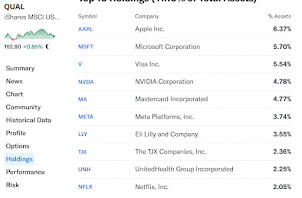
I included buybacks (PKW), Shareholder Yield (SYLD), and the iShares Quality (QUAL) with the S&P 500. Even sliding the chart to the highwater mark of mid-February doesn't change the story much, they all are close to the S&P 500 except for SYLD. I'm not sure how interesting this is but something that is interesting is the differences between top ten holdings of QLTY and QUAL.


They have names in common but QLTY appears to tilt more to value with QUAL being growthier. Same factor but some different interpretations which is worth keeping in mind if a factor interests you and you're down to trying to select one. 

The WisdomTree Putwrite ETF (PUTW) changed on April 4 to the WisdomTree Equity Premium ETF and it now has symbol WTPI. I haven't had time to dig in but the strategy appears to now be more involved than selling an index put that expires in a month which is what PUTW did. The puts sold are close to or even in the money, there's more to it than that, and they expect to have to roll forward every month which means buying back the current put and replacing it with one that expires later. 

One insane nitpick from me is in one of the presentations they refer to options being exercised when they mean assigned. WisdomTree must have a basis to believe WTPI is better than what the old PUTW did so we'll see but I am skeptical. 

Speaking of new, complex funds that sell volatility, Simplify launched two of them, SBAR and XV, which sell something called barrier puts. I've never heard the term before but the descriptions of each fund seem buffer-ish or like defined outcome-like. I'm not sure that is correct though. 

I've said many times that selling volatility is absolutely a valid strategy but the blow up factor is higher than many other strategies. I would differentiate simple covered call funds like JEPI or XLG from the types of option overlays than many of the Simply funds use. The relative returns of JEPI or XLG may or may not be satisfactory depending on the period studied but they're blowing up like an inverse VIX fund isn't a reasonable probability. A fund that sells index puts anywhere close to the money isn't like playing roulette but in the right combo of circumstances, could really get hit. 

Sizing becomes very important with these funds. XV targets a 15% annual distribution which is very high even if many of the YieldMax funds yield 60%. Assuming XV can deliver on the 15% "yield," a 5% allocation would provide 75 basis points of yield for the entire portfolio which is of course a variation of barbelling yield that we talk about regularly. If a fund weighted at 5% drops by 2/3 in a blowup, the impact on the portfolio would be felt but wouldn't be ruinous. 

One point that Dave Nadig has brought up recently about the YieldMax funds is that over the course of 2024, YieldMax was saying that the distributions were a combo of income and return of capital but then as Dave tells it, when the year ended, all of the distributions were reported as being income. This doesn't matter in an IRA obviously and it would be up to the end user whether it is important to them if used in a taxable account. 

And, why not;


The information, analysis and opinions expressed herein reflect our judgment and opinions as of the date of writing and are subject to change at any time without notice. They are not intended to constitute legal, tax, securities or investment advice or a recommended course of action in any given situation.

Wednesday, April 16, 2025

Such An Obvious Risk

The markets remembered that tariffs are a bad thing on Wednesday and got hit pretty good. 


The table tells you a lot about what happened today as news broke late yesterday about Nvidia not being able to sell its Hopper chips into China which the company estimates will cost it about $5.5 billion. Anyone overweight tech, which of course worked in 2023 and 2024, really felt it today. Actually they've really been feeling it during this entire market event. 

Something we have talked about before is that bad things happen when a sector grows to be larger than 30% of the S&P 500. It's part of the concentration story that many people warned about over the last couple of years. Before the communications sector was carved out as its own sector, most of those stocks were in the tech sector and the two added together make up about 40% of the index. 

I think I've been transparent about not chasing that heat all the way up to 30% of client portfolios because in terms of mitigating risk, this really is a very easy thing to see and avoid for a portfolio that doesn't just put it all in the S&P 500. Smaller, foreign markets are a different thing. The iShares Singapore ETF (EWS) is 40% financials for example. A US based investor isn't going to anchor around EWS. Even if someone puts 10% in EWS, ok that would count as 4% toward whatever weighting the portfolio has in financials. 

I threw the RR United States Sovereign Wealth Fund ETF into a portfolio on Yahoo a couple of days ago.


Up 1.2% today. GLDM and SH are client holdings.

Last night, a prompt from Twitter sent me down a little rabbit hole, comparing different factors, blended with managed futures in a manner similar to how the ReturnStacked US Equites and Managed Futures (RSST) leverages up with market cap weighting (MCW) and managed futures. 


I used AQR Managed Futures (AQMIX) for the managed futures component and to be clear, each one is leveraged up 100/100. MCW and Quality are far and away the best performers but also the most volatile. All of them got crushed in 2018 versus down about 4.5% for the S&P 500 and all of them were up a lot in 2022 when the index by itself was down 18%. FWIW, just sitting 100% in the S&P 500 compounded at 12.33% for the same study period. 

Putting all your money into a single 100/100 fund is not the intended use, the point was to try to observe whether managed, blended with any other factors would do something useful.  

And last, checking in permanent and permanent-ish portfolio funds. 


I own a few shares of FIRS out of curiosity. It is definitely a quadrant type of portfolio construction but with some Bitcoin thrown in. It hasn't really moved much which for now is probably a good thing. PRPFX of course has been trading forever and with gold and long bonds up today, the lift makes sense. RPAR is risk parity and quadrant-ish too but I am surprised it didn't do better today

Use these bad days and this event to learn more about any fund or strategy that you own or that interests you. This is a fantastic learning opportunity.

The information, analysis and opinions expressed herein reflect our judgment and opinions as of the date of writing and are subject to change at any time without notice. They are not intended to constitute legal, tax, securities or investment advice or a recommended course of action in any given situation.

Tuesday, April 15, 2025

New Fund Alert

Just a couple of quick hits tonight. 

Unlimited Funds just launched the Unlimited Global Macro ETF (HFGM). The interesting thing is that it is trying to be more volatile than other global macro funds. I don't know how frequently the holdings will change but looking at it today, it is short several currencies but long Australian dollar, it is long commodities and very long gold, long European equities and short Japan and it's long US equities along with a few other smaller positions. 

You can kind of make out the overall positioning as kind of a risk on plus commodities but again, it is not clear how frequently things will change. Given that macro strategies can be very idiosyncratic, I'm not sure how you buy it here other than to make a bet on Bob Elliott who runs Unlimited. That might be a great bet but as an alt, there really isn't much of an expectation of what it will do. For example, convertible arbitrage would be a horizontal line that tilts upward.

ETF Hearsay Tweeted out about a mutual fund conversion of the SIMT Liquid Alternative Fund which has two symbols; LLOAX and LLOBX. The strategy replicates the 50 largest hedge funds and 20 managed futures funds. The fund is pretty new but with a description like that, I'm going to want to hear more about it.


MERIX is merger arbitrage and is a client and personal holding. LLOAX looks like a more volatile version of MERIX but then wilted in the current market event. Replication is a valid approach based on research I've seen over the years but I think maybe it is very difficult to do? Fifty hedge funds and 20 different managed futures programs might be too much to net out into something useful.

With multistrategy, you really need to pick and choose your spots. 

The information, analysis and opinions expressed herein reflect our judgment and opinions as of the date of writing and are subject to change at any time without notice. They are not intended to constitute legal, tax, securities or investment advice or a recommended course of action in any given situation.
Sunday, April 13, 2025

Sunday Night Hedging

Man Institute wrote about how to prepare for an equity drawdown. The hedge combo they decided on, paired with 75% in equities, was to equalweight the hedge sleeve with "quality" long short, gold/silver, the ten year US treasury and long Swiss franc-short Aussie dollar currency pair. 

Many years ago we looked at long Aussie-short Swiss franc as a proxy for speculation so it is interesting that Man spun it around to function as a hedge. Here's the last five years showing how the franc has done against the Aussie.


Some of those moves are huge for currencies but obviously they are both much smaller than USD, EUR or JPY.

Here's how I built the Man Institute hedge;

Then I added that hedge in with 75% SPY along with two other hedged sleeves and then compared that to just 100% SPY.


A reminder of what is in the United States Sovereign Wealth Fund ETF which is just something I made up a few weeks ago plus 75% in SPY.


It is interesting how close the three hedged portfolios are CAGR-wise but there is a little differentiation with volatility. In 2022, SPY plus Man Hedge was down 12.94%, SPY plus US Sovereign Wealth Fund was down 13.86%, SPY plus managed futures/global macro/BTAL was only down 6.14% while SPY was down just over 18%. This year, going in the same order the portfolios are down 5.66%, 6.51% and 7.16% respectively versus a decline of 10.22% for SPY. 

Maybe the conclusion then is that the decision to hedge in the first place is more important than how you hedge. Sort of. I think there are plenty of bad ways to hedge. Obviously I am a big believer in devoting time to not only figuring out how to reduce portfolio volatility, one goal of hedging, but also how to improve the process as each event comes and goes. 

Speaking of which, as I hit the send button on this one, the S&P futures appear to be green. If I have the headlines correct, the tariff exemption was taken back or maybe denied by Trump? So I am surprised that the initial reaction is up which reiterates an important point which is that markets regularly go up when they shouldn't. Who knows if the initial reaction will carry over tomorrow or not but this is why I think it is better to hedge instead of doing a lot of selling for the times that it does go up when it shouldn't

The information, analysis and opinions expressed herein reflect our judgment and opinions as of the date of writing and are subject to change at any time without notice. They are not intended to constitute legal, tax, securities or investment advice or a recommended course of action in any given situation.

Saturday, April 12, 2025

Morningstar Weighs In On Alts

Morningstar wrote an article asking Did Liquid Alternatives Pass The Stress Test, with the context being the current, tariff induced event.


The first point that I try to be consistent with is that if you don't believe in using alternatives, don't use them, this is not a pitch, more on that at the end. 

Should gold be considered an alt? They don't list it but other than one day, it has really worked well through this event. If you own any funds that track those respective categories, your milage may vary. Long short equity is interesting because there are several different ways to implement it. 


Those are the three long short funds we use for blogging purposes compared to the S&P 500 and of course BTAL is a client and personal holding. The context we use for this space both for the blog and then for clients IRL is to hopefully smooth out the ride. That is the expectation I have for BTAL and between the other two BIVIX seems like it sort of does what BTAL does but not exactly and QLEIX can do what BTAL does but it is more of a does its own thing type of alt which can absolutely play a role in a diversified portfolio. 

Speaking of a does it's own thing type of alt, a macro that I have in my ownership universe was doing very well  coming into last week but then got cracked. This particular fund's long term track record for consistently doing well and being uncorrelated is outstanding but the combination of cross market dynamics made it a bad week for that fund, which can happen of course. It was up 4% versus down 7% for the S&P 500 from February 18th going into last Monday.

A couple of different horizontal line alts that tilt upwards have been doing what they should, one dropped 3% one day but is started to claw that back and shows down 0.3% since Feb 19. It's role is to smooth out the ride in a different manner than BTAL and I feel like unch pretty much accomplishes that objective. One of the two horizontal line alts I'm talking about is merger arb which is up slightly. 

Skipping long short on the table, other than the mention above, the worst performer was trend/managed futures. My hunch is the long short category takes in funds that are not really alts like the three noted above, and so trend to my way of thinking has been the worst of the lot. 

Obviously, I've written a ton of posts saying how great managed futures is as a diversifier but to keep allocations small because you never know when the one event will come along where it won't work. It is just funny timing that in the first real test after 2022, they're not "working." 

When I talk about diversifying your diversifiers, I am talking about a couple of different things. Yes, different strategies is one thing. If a portfolio is 55% equities, 35% long bonds and 15% managed futures, it probably hasn't gotten any protection from this decline. But I also mean diversifying expected outcomes. 

If everything is going right with merger arb, it will be up slightly with no volatility. That's great as a piece of the portfolio but may not be sufficient to protect against what the market has gone through over the last couple of months. If everything is going well for BTAL, it will be up a lot when stocks are down a lot but over a longer flatter period it might have some bleed although I would note it has compounded positively over the last ten years.

We could go on like this with all of them so I will spare everyone that but the plight of managed futures makes another point about not every strategy always working. Managed futures was heroic last time and people piled in, chasing that massive outperformance. Don't pile in to anything and don't give up on something that you have a basis to believe can work after the one time it doesn't.

And speaking of a pitch, an article from Barron's that reads like an AI-written paid placement for alts that I won't link to but one of the comments was gold. "So many real estate ALT non-traded investments put out prior to COVID are now disasters and my clients can't get out! I'ts cost me 3 accounts and $9 million in assets." I can't be certain, but I imagine whatever he is talking about resulted in a glorious payday for him. And what portion did he have in those non-traded REITs? I'm guessing a lot. 

The information, analysis and opinions expressed herein reflect our judgment and opinions as of the date of writing and are subject to change at any time without notice. They are not intended to constitute legal, tax, securities or investment advice or a recommended course of action in any given situation.

Friday, April 11, 2025

Lean Forward And Learn

This Tweet paints a great picture of craziness going on in markets being driven of course by external factors that are even crazier. 


Early this week, I referenced a comment by Meb Faber that essentially said, you did what you did to try to protect your portfolio, hopefully it's working but that this point you just need to sit back and relax. I expanded on it a little bit and noted it's not particularly relaxing but I would reiterate that this is a great time to lean forward and learn about some things in real time versus looking at a backtest from a benchmark event like the 2020 Pandemic Crash or 2022. I will say, I do think I'm pretty good at remembering cross asset dynamics from those previous events. 

The prompt is a thin article from Barron's about dividend stocks which reminded me of the people who say put it all in SCHD, the Schwab US Dividend ETF, and forget it.


The chart is from the highwater mark in mid-February. SYLD fared the worst, momentum was very close to market cap weighting and PKW which is buybacks and SCHD has been the best performer from that highwater mark. For one month, SCHD was just about the worst performer though and for five days, it was the worst by about 200 basis points. You can add 1% back in to SCHD for going ex-dividend on March 26 but that doesn't help the five day result. 

SCHD hasn't really provided crisis alpha on this go around but it did in 2020 and had a great 2022. All of the different factors have their moments in the sun. An idea from me, from a long time ago was if you want to use factor funds, you need to just stick with them. SCHD is clearly valid but it cannot be the best for all times, no factor can. 

Mid-morning on Thursday I sat in on a webinar for the Alpha Architect Tail Risk ETF (CAOS). We've look at this quite a few times. It seems to have solved the bleed issue but isn't necessarily that sensitive to broad market declines. 


Having a few things that go up on a huge down day in a portfolio that goes narrower than five or six holdings makes for good diversification. TAIL has some serious long term bleed issues. BTAL has compounded positively over the the last ten years but barely and SH too will of course erode when held long term. CAOS behaves differently. 


It has compounded at 7% per testfol.io and it has very little volatility. In watching it pretty closely for most of its existence as an ETF, I have described it before as a horizontal line that tilts upward that may or may not protect against a decline. It's track record is not perfect. 

The fund primarily invests in box spreads and then overlays long puts as well as selling put spreads. Success is contingent to some degree on what volatility does. As they acknowledged on the webinar, the mutual fund predecessor didn't really help in 2022 because of the path that the VIX took. So it could be a first responder defensive, or not. Either way, with the S&P 500 down 10% or so this year, CAOS is up 3%.

The information, analysis and opinions expressed herein reflect our judgment and opinions as of the date of writing and are subject to change at any time without notice. They are not intended to constitute legal, tax, securities or investment advice or a recommended course of action in any given situation.

Thursday, April 10, 2025

Bonds With Duration Still Stink

Hopefully Thursday's decline wasn't much of a shock. Whatever this is, we're still in the middle of it. I mentioned yesterday, thinking it's not over and while one day's reaction is too soon to be right or wrong about that, it makes no sense that it can be over. Who knows where the China part of the story will ultimately go. There was some vague news about changes to the team members overseeing the tariff policy, I even saw something, maybe a rumor, that some of Trump's staff were expecting a different card to be brought out at the April 2 event and were surprised with the one they had. 

An early read of how alts did today, is that they did pretty well other than managed futures which cannot catch a break and longer term bonds (not an alt) also got pasted again. Yahoo Finance has TLT down 5.91% over the last 5 days and TLH down 5.07%. Sized modestly like an alt, it's no big deal, just one of those things which is how I feel about managed futures during this event but it is of course more common to have a very large allocation to bonds. Long time readers are probably sick of me saying avoid bonds with duration, sitting on them right now though, yikes. 

On to some fun.

Last week I mentioned a paper from Richard Ennis in passing that highlighted the struggles of endowment funds that blames the overweight to alts for the underperformance. I found the mention of Ennis in an article at FT. This week I found the actual paper. 

Maybe I misunderstood the paper but it focused on the extent to which various alts lagged a much simpler equity and fixed income portfolio and as we discussed last week, the paper said the average allocation to alts in endowments is 65%. But what seemed to be missing is the way the various alts, including hedge funds, interact as a smaller piece of the portfolio. I built out the following with two mutual funds that are hedge fund-like. 


The two different hedge fund proxy mutual funds both lagged VBAIX over the period backtested. The funds I randomly chose don't Karl Popper refute the paper about lagging but when worked into portfolios in the manner above clearly is additive. 

Putting 40% or even 20% into one alt is never something I'm going to do but this reasonably demonstrate there is a point where can be additive and a point where they start to detract from result. Of course plenty of people don't believe in using them in any weighting but compared to 65% in alts, a little goes a long way. 

The information, analysis and opinions expressed herein reflect our judgment and opinions as of the date of writing and are subject to change at any time without notice. They are not intended to constitute legal, tax, securities or investment advice or a recommended course of action in any given situation.

Wednesday, April 09, 2025

"I Can't Top That"

A satirical account I follow on Twitter will often say "I can't top that" in the face of something truly ludicrous. Today's tariff news and all the rest, I can't top that. Really, that is to say it is all so unanalyzably stupid for how unnecessary it was, the rumor on Monday that this would happen which was denied up, down and sideways but then of course the pause did happen. Aside from being dreadful policy, the fly by the seat of their pants nature of it all is ludicrous. 

If that paragraph seems all over the place, that is what has been going on with policy and all of it is out of our control. What is in our control is how we react, that is how we do not panic in the face of crazy market action caused by even crazier external factors. You put together a strategy you think is best for you and then you stick with it. That's essentially what we are talking about here all the time. I do not think this is over but we have a strategy that I believe "works" far more often than not and so I stick with it. 

Now for a little fun. 

On Tuesday night I Tweeted out the following;


I got quite a few responses with the consensus being that it would square up at quarter end and thanks to Jeff Ptak from Morningstar who went down a bit or rabbit hole to confirm that this is the biggest decline that the fund has ever had. 

James Seyffart from Bloomberg added that the volatility has affected the Greeks of the options in the fund. I thought the options for these types of funds were customized, not traded in the open market so I didn't think the Greeks applied. 

The products seem straightforward but if BALT isn't malfunctioning than it might not be that straightforward. We looked at BALT a few times before things unraveled. I'm glad I don't have to explain what James later called a dislocation to clients. 

AQR crapped on these types of funds a couple of weeks ago and then whammy, malfunctioning or not, we had this with BALT. 

While we're on Twitter


TLT works except for the times it doesn't but at least it's very volatile. 


The idea that TLT and others are sources of unreliable volatility is alive and well. Nothing works 100% of the time but bonds with duration have caused more problems than they've solved for several years now. And if this tariff thing ends up driving the bond market in the same direction as the last couple of days, they will continue to be sources of unreliable disappointment. 

Next, let's check on Trinity, and GAA, and chill.


Both TRTY and GAA have tracked very closely to AOR which I used as a 60/40 proxy because VBAIX paid out a capital gain in March that distorts that chart a little. TRTY and GAA look similar to AOR because, I believe, of their willingness to hold longer term bonds. However, if we are in the "sell what you can" phase of this event then maybe everything looks like AOR.

The prompt to include TRTY and GAA in this post was an email from Cambria that very articulately  made a point I've been trying to fumble with, essentially saying, you did what you thought best ahead of time and now it's time to "sit back and relax." I appreciate there's nothing relaxing about events like these but the point about hedging ahead of time, when you don't need it is the important thing. Not everything will "work" in every event as managed futures is having a dreadful time but getting defensive after a large decline is a terrible strategy. However well your defense is working, what can you learn for next time because this will end and then there will be a next time in the future. 

Speaking of managed futures, here's a long thread from Jeff Malec that tries to diagnose the issues it has been having. As terrific of a diversifier as I believe managed futures to be, I've pushed back very hard on the many calls to have 20% or other high allocations to it. It's not about being right or wrong, it's about avoiding an obvious risk. Clients have a 2-3% weight in one dedicated fund plus pick up a little more in BLNDX which I also own. Bummer it hasn't "worked" in the event but it's not causing anguish in the manner a 20% or larger weighting would cause. 

I made the same observation about MLPs, REITs and gold 20 years ago (told that story 100 times, yes). I predicted nothing, I avoided a risk which is different. If managed futures was working I'd be thrilled with the weighting I have, it's not working for now but it's not painful. 

The information, analysis and opinions expressed herein reflect our judgment and opinions as of the date of writing and are subject to change at any time without notice. They are not intended to constitute legal, tax, securities or investment advice or a recommended course of action in any given situation.

Tuesday, April 08, 2025

Rough Day For Markets & Fascinating Fund Outcomes

First up, I sent this out as an email to clients about 40 minutes into the day with subject Market Up Big, So Is It Over?

The answer is probably not. John Authers from Bloomberg is calling it the end of the beginning. It is possible it's over but I would be ready for more volatility. The history of huge up days during events like this isn't great. On December 24, 2008, the Dow Jones was down 1000 points and then on December 26th it was up 1000 points but of course that market event still had several months to go. 

I think mentally preparing for volatility, as well as steps taken ahead of time in portfolios, can make enduring market volatility a little easier so I would reiterate that this probably is not over. 

The shock is attributable how the tariff policy appears to be rolling out but of course it could change. Even if you believe in the idea of reciprocal tariffs, the policy as of now establishes a tariff based on the trade imbalance between us and the other countries, not their tariff rates. 

The policy as revealed on April 2nd calls for 44% tariffs on Sri Lanka. Sri Lanka has 22 million people with a per capita income of about $15,000. There are not enough Sri Lankan rupees in existence for Sri Lanka to buy as much from us as we buy from them which is what the policy calls for as of now. So yes, it will have to change but there is no indication of when it will change or how it will change and that is the shockwave that has gone through markets. 

Before this started, the S&P 500 Index level was around 6000. As we sit here today, there is no question it will get to 12,000. absolutely no question. But we do not know the path to 12,000 and we do not know how long it will take. Maybe it goes to 4000, then maybe 7500 and then maybe back to 6000, up to 9000 and you get the idea. It will happen, but we do not know the path or how long it will take. I bet I said the same thing about 6000 a few years ago when the index was at 3000.

This sort of message reiterates the idea of conveying how things usually work. If this is playing out in a similar fashion to previous events, it helps to reiterate in real time the idea that the details might be different but the market manifestations are the same. 

The action in stocks though, after I sent that email, suggests that we do have more to go in this thing. The continued lift in yields also suggests more is coming in terms of tumult. Hopefully it is clear that my observations aren't attempts to make predictions. This exercise is more of an attempt to weigh out different things in the market to better prepare clients in case, I say in case this goes on for a while which seems likely until policy starts to turn the corner to solutions that can actually work, see above about Sri Lanka. 

Ok, now to the fun stuff. In an odd twist for ETF listings, there is now a 2x XRP ETF before there is a simpler 1x tracker. XRP is an alt coin that one Tweet I saw said there isn't much of a use case for. I don't know either way but the symbol for the 2x XRP ETF is XXRP and it was down a little over 13% versus a drop of about 6.5% for the underlying. FWIW, XRP is uncorrelated to equities and bonds but if there's no serious use case then at best it's an uncorrelated tool to gamble with. If you know of a real use case that doesn't read like the "use case" for the other alt coins, please leave a comment. 

Checking in on the STKd 100% MSTR/100% COIN ETF (APED) which if it's not clear, levers up to own 100% of Microstrategy and 100% Coinbase.


The chart goes back to the fund's inception so timing of course is unfortunate. I am fascinated by these, there are several others, even if I'm not going to use them for clients. 


The above is why I am fascinated. A small slice to insanely volatile stocks and a bunch allocated to T-bills has a very compelling result. Yes, idiosyncratic risk galore but someone who implemented Portfolio 1 on day one of APED, is down 2.5% versus about 7.8% for VBAIX. But with APED cut in half, as hard as it might be, it would be time to rebalance. Note that VBAIX paid out a dividend and capital gain in late March that was a hair above 2%. It's worth staying touch with the 100/100 stock ETFs. 

Bob Elliott had a good writeup on global macro funds that included this chart showing how the strategy does during down months. Again, the chart is down months only, not the entire time.


I have a global macro fund in my ownership universe. It was doing very well through this but got beat up on Monday and then was down a little more today. As a diversifier, it clearly works long term. It won't give growth that approaches anything that equities will typically give which needs to be understood but with the right expectations and properly sized, it's a useful holding.

The information, analysis and opinions expressed herein reflect our judgment and opinions as of the date of writing and are subject to change at any time without notice. They are not intended to constitute legal, tax, securities or investment advice or a recommended course of action in any given situation.

Monday, April 07, 2025

The Most Volatile Flat Day Of All Time

Monday had to be the wildest up 23 basis point day in stock market history. The day started down a lot, then had an insane rally that appeared to be panic buying but turned out to be driven from sort of incorrect quote attributed to Kevin Hassett and then it was moving back and forth with very big swings in very short time bursts. 

Treasury yields did something similar, ultimately rising on the day which might be surprise for anyone thinking we are in the midst of a crash (maybe this is a crash, not saying it isn't). Tech and other more volatile stocks generally did well and just about everything else, I mean just about everything else had a pretty bad day. 

The misery in managed futures continued. Gold has had a rough couple of days after a good stretch of doing very well. I saw something on Friday that talked about "banks" selling gold. I don't know if they meant consumer banks or central banks and I don't know if it's true but could account for it especially since the dollar hasn't really been a haven other than going up today.

Markets have been rolling over for a little while, accelerating on the tariff news (yes, fallacy of explanation, but it seems pretty clear). The various alts we talk about and that I use had been doing well coming into Thursday, had a glorious Thursday except for managed futures, but had a rough go on Friday and then a little less rough today. The inverse fund has been working of course as has merger arb and catastrophe bonds. 

This is a fantastic lesson. If you believe in hedging or reducing volatility in the context we discuss here, you build that part of the portfolio with hopefully a reasonable basis to believe it will do the trick more often than not and then you just need ride it out. Nothing is infallible as I say regularly. If you had a 3% allocation to managed futures and you threw in the towel in the last few days (I absolutely did not), well ok, maybe that will turn out to be right or maybe it turns out to be wrong but at 20% managed futures and feeling the same way, man, I don't know what you'd do. That is a much harder spot to be in. Diversify your diversifiers.

I won't get into too much detail for now but I've started sub-advising accounts for a couple of other advisors and in two different conversations today I said that the time to hedge a portfolio is before you need it. That is of course one of the high level themes of this blog. We're not trying to guess what could go wrong so much as trying to add in some resiliency into the portfolio and if it works most of the time, then that's a pretty good outcome. 

We did not get the kind of whoosh down I had in mind for possibly selling the inverse fund I've been using for this go around. I don't know what will happen but I feel comfortable with the gameplan I spelled out over the weekend. I would reiterate the benefit of mapping something out ahead of time is so you don't have to figure out what to do in a charged situation. If I end up having to do something, it might be a charged situation but I won't have to figure out what to do, I'll already know. 

The information, analysis and opinions expressed herein reflect our judgment and opinions as of the date of writing and are subject to change at any time without notice. They are not intended to constitute legal, tax, securities or investment advice or a recommended course of action in any given situation.

Sunday, April 06, 2025

Wake Up Call For Advisors

But first, although an insanely short period to look at, I wanted to see how some of the portfolios we've played around with here have came through the carnage of last week. Using testfol.io, the Vanguard S&P 500 ETF (VOO) was down 10.29% and the Vanguard Balanced Index Fund (VBAIX) which is proxy for a 60/40 portfolio was down 6.06%.

First batch.


Second group


This next one is interesting in terms of capital efficiency. It's 10% in NFXL, a 2X Netflix ETF and 90% in TFLO. For the last week, it was down 1.67% versus the 6.06 for VBAIX mentioned above. The backtest below goes to NFXL's inception which is not far back.


We never looked at that ETF specifically but we have played around with that concept plenty. Obviously the 10% all going into NFXL could be divided up into several different ones. I only chose Netflix because it avoids the headline risk of Microstrategy and Tesla. I'm also not sure that 10% is optimal but it obviously wasn't catastrophically wrong from day one. 

None of these seem to be catastrophic to me which if nothing else means all the related blog posts had at least a hint of productivity to them. To the old adage I used to talk about more frequently, take bits of process from various places to create your own process. Maybe by now, it's more correct to say to adapt your process versus creating it. It would be difficult to go all in on any of these strategies but I do think there are elements that can be added to something closer to a "normal" portfolio. Realistically, all the ones we've explored pull a little from the portfolio I've been managing for more than 20 years. This is time well spent even if just for me and I will continue to blog about this stuff.  

One interesting footnote is that the Fire Funds Wealth Builder ETF (FIRS) which is a Permanent Portfolio inspired ETF was only down 3.06% last week. I own a few shares of that one personally as more of a matter of curiosity.

Now something harsh for advisors. As advisors, it is times like now where we really earn our money and show our value. The thing about this is that being right isn't the most important thing. We are paid to keep our heads. I think we are paid to generally have some sort of plan, see yesterday's post, that we can easily articulate to clients. And it's ok if that plan is to hold on no matter what.

The current market event really will end at some point and the market will go up again. It's easier to endure when you realize this event is not different in that regard. My only real worry in these events is not wanting to cause more anguish for clients. In some sort of circuit breaker triggering crash tomorrow, I am a seller of SH and I will be ready spreadsheet wise to flip that into some sort of broad based index fund depending on how it plays out but that might not be easy for clients. 

If market conditions warrant any of those actions, I have no idea whether I will be "right" a month from now. To reiterate from the other day, the S&P 500 was above 6000 not too long ago, any buying done in the 4000's will be the right thing for clients in the long run but it might be the very painful thing in a month or three months from now or whatever.

If you are fascinated by markets, I am, then these are fascinating times and the focus as an advisor can in part be about how to solve this problem for clients. As I write this about 90 minutes before futures open, Bitcoin dropped several thousand dollars which doesn't have to be negative for equities but doesn't seem like a positive. Be ready for anything tomorrow. 

The information, analysis and opinions expressed herein reflect our judgment and opinions as of the date of writing and are subject to change at any time without notice. They are not intended to constitute legal, tax, securities or investment advice or a recommended course of action in any given situation.

Saturday, April 05, 2025

Making A Gameplan For Monday

 First, this.


I'm not sure that Jim is calling for a repeat of 1987 or not but what if that is what ends up happening? What would you do? There's no reason not think this out a little bit. I hadn't thought about this sort of scenario happening specifically on Monday. At this point, I don't really need to plan it out cold, I already know. 

When I retweeted Unusual Whales, I said, "If he turns out to be right, sell the hedges, get more long and then be ready to sell what you buy very quickly." The easy answer for me is sell SH. Increasing net long exposure that way isn't difficult for me. I have bought panic before but it is harder to do. 

Most likely, I would sell SH and flip the dollars into an S&P 500 ETF. If we jumped much higher very quickly, I would plan on selling that S&P ETF I just bought. I don't think that is actually how it will play out but I want to be ready. 

I think the best outcome for Monday would be to close higher than it opens as long as the moves aren't huge. Down a percent or less at the open and then closing at some higher level than that without evidence of a buying panic would be constructive. Opening down 5% and closing up a ton would be a sign of a lot of emotion still in the market. Opening 5% higher and staying up would be a buying panic too. 

I believe a couple of flattish days with a slight upside bias would be evidence of emotional exhaustion which I think would be positive. 

An important theme underlying this post is that I am not trying to predict anything. If such and such happens, what would I do? I am not planning to increase net long exposure if we get to down 15%. Over the years I've talked about down a little versus down a lot. Well, 15% is like nebulous middle ground that I guess I don't think of as being a lot. 

If from here, we trickle down slowly toward 20% and beyond, selling SH would probably still be the call for me but I wouldn't be as quick to buy. A trickle down from here seems to be less emotional which I would take as having greater risk of a large decline. 

Finally, if everything rips higher and just keeps on ripping, I'd be inclined to let SH and BTAL hedge less and less of the portfolio as the other stuff went up. 

I mentioned in passing the other day that buying panic is difficult to do. Gameplanning ahead of time makes it easier. If the right gameplan for you is to just hold on no matter what, that is valid but I would take a moment to remind yourself why that is your right gameplan to make it easier to stick with when the time comes. 

The information, analysis and opinions expressed herein reflect our judgment and opinions as of the date of writing and are subject to change at any time without notice. They are not intended to constitute legal, tax, securities or investment advice or a recommended course of action in any given situation.

Friday, April 04, 2025

This Is A Full Fledged Panic

Down 8 or 9% in two days is absolutely a panic. It might be justified or not, I don't know and I'm not trying to predict anything but this is a panicked reaction. If you want to call it a crash, go ahead although I don't know if that is the best word. My comment about panic is more about observing behavior that has repeated in cycle after cycle, it doesn't matter to me in real time whether the word is crash, correction or something else.

The selling today is far more of a washing out than yesterday. There were quite a few things on my screen that were up yesterday and that is not the case today. 

That doesn't mean it is over but the washout nature of today is better than if the market panicked higher at the open and then failed. A unambiguously down day coming after another unambiguously down day is a form of capitulation. Well known investor Mohamed El-Erian used the term "necessary and sufficient" on Bloomberg TV this morning. The signs of capitulation are necessary but what we've seen so far, may not be sufficient in terms of having any idea when this event will end. But it will end.

Wading through this sort of thing stinks but the observations in this writeup are based on how previous scary events have played out before. The details are always different. In 2008 people thought the global financial system was going to end. In 2020, people thought the world was going to end. The current event is so illogical that it might not make sense to try to articulate it yet.

Even though the details are different, the market manifestations are always the same. The market goes down a lot, scaring the hell out of people, then it stops going down maybe for no reason at all and then it starts to work its way back up, eventually making a new high. The only variable is how long that all takes.

The worst thing to do in a panic is to go along with that panic. We do not know the duration of this event but we do know the outcome. I've been writing pretty much this same email in event after event for 20 years and it always plays out the same way. It ends and then markets go back up. And I promise you that when this one ends, at some point later there will be another market event with different details but the same manifestations. 

The information, analysis and opinions expressed herein reflect our judgment and opinions as of the date of writing and are subject to change at any time without notice. They are not intended to constitute legal, tax, securities or investment advice or a recommended course of action in any given situation.

Thursday, April 03, 2025

Tough But Fair

Markets got pasted today of course. I saw where this was the worst single day drop since one of the bad days during the 2020 Pandemic Crash. Ok, so a quick reminder that bad days have happened before, obvious statement. There have probably been more truly terrible market days than any of us could possible remember.

I have no idea when this will end, I don't understand the rationale of what is going on and I have no idea if this will be a serious one or be like the one last August which turned out to be nothing. 

People who are selling into this are too late in a way. Yahoo has the S&P 500 down 12% from mid-February high. If the bottom comes down 25% then selling today would look like a good trade but what I mean by too late is that the time to put on defense is when you don't obviously need it or maybe better put, before you need it. 

To the person who sold today, what if today was the bottom? It is far easier to endure these types of events when you don't have to be correct about anything in the middle of it. I sold one stock for clients a long the way closer to election because I was concerned that threatened tariffs would really hurt because they're heavy in Vietnam. The last increase of defense was in mid-February when I bought gold.

I've had positions in various types of alts with short duration fixed income as we talk about here almost every day. Most are doing what I would hope they'd do with managed futures being the biggest let down as we've been talking about for a while and today was a rough one too. The green one is a mutual fund and that is Wednesday's price, while the rest are all managed futures ETFs.


It is empowering to put something in place and see it mostly working, you're not going to bat 1.000 but if your strategy is mostly doing what you designed it to do then you need to mostly ride it out, not that there won't be any other action, it depends on how it plays out. The tough part, arguably tougher than now, will be when to start increasing long exposure. Maybe that means selling SH or maybe it means buying something or both. I've bought panic a few times before but not every time. 

To repeat from past posts though, the mindset should not be you are buying the bottom but that you are buying low and there is a difference. The S&P 500 was at 6000. If you can buy it at 4500, that is buying low, regardless of whether it goes to 4000 before going back up. 

Nate Geraci Tweeted out that "any sort of market, economic, or political “turmoil” offers a window into your financial advisor, portfolio manager, etc…" Tough but fair. If you are an advisor, what are you doing to try to make it better for clients. Hopefully what you are doing to make it better will be effective but at least you're trying. If you're not trying, then what are you even doing? Tough but fair?

The information, analysis and opinions expressed herein reflect our judgment and opinions as of the date of writing and are subject to change at any time without notice. They are not intended to constitute legal, tax, securities or investment advice or a recommended course of action in any given situation.

Wednesday, April 02, 2025

Endowments Are Struggling?

FT Alphaville wrote a doozy about The Death Of The Yale Model that included some harsh criticism about the way endowments and similar pools of capital use alternatives. Obviously they've evolved to go very heavy into illiquid alts and from the article, consultant Richard Ennis thinks it's a very bad idea. "Alts bring extraordinary costs but ordinary returns."

"A whopping 65 per cent of the average large US endowment fund is now invested in alternatives of some kind" which might seem like a lot but it's not like this just started last quarter. For the last few years, more than half has been common from my casual observation.

The article noted that "endowments lagged 70/30 indexed portfolio." If stocks are the thing that goes up the most, most of the time and you have more than half your portfolio, or endowment or whatever in something that goes up less than stocks, yeah, performance may not be what is hoped for. 

It wasn't clear to me where 70/30 came from as a benchmark but 80% S&P 500/20% client and personal holding BTAL looks pretty good against 70/30. In the backtest below, the VOO/BTAL combo outperformed 70/30 in eight out of 11 full and partial years.


This entire concept goes back to Jack Meyer who ran the Harvard Management Company and a little more famously to David Swensen at Yale but as the article points out, most investors have not been able to replicate Swensen’s more well known results.

Alts, here the context is always liquid alternatives, are precise tools as opposed to core allocations. Most of the alts we look at here are doing what I would hope they would do which is good although managed futures has struggled due to how choppy some of the bigger markets have been. 

Twenty years ago, yes it has been that long, I blogged about not going too heavy into REITs, MLPs or gold. Then a few years ago when managed futures became popular again, I had the same message, don't go too heavy, you never know when they won't "work." When the current event ends and we move on to the next adverse market event, maybe managed futures will be the star like in 2022 and things doing well now will struggle the way managed futures has been this year. Keep allocations small and diversify your diversifiers. 


Who knows if this will carry over into the regular session tomorrow but it's probably a good time to dust of an important concept. Every now and then the stock market goes down a lot (we are nowhere close to down a lot at this point) and scares the hell out of people. Then, it stops going down and works it's way back to make a new all time high. The only variable is how long that all takes. 


As far as what is going on now and appears to be moving markets, the logic is lost on me but at some point the event ends and the market goes back up.

The information, analysis and opinions expressed herein reflect our judgment and opinions as of the date of writing and are subject to change at any time without notice. They are not intended to constitute legal, tax, securities or investment advice or a recommended course of action in any given situation.

Tuesday, April 01, 2025

Why Use Two Funds When You Can Use 18 Instead?

In the last few days, I've had the opportunity to look at a couple of different model portfolios from different places and providers that I would describe as being overly complex. I'm not going to call them out publicly or anything but I think we can learn some things. 


As you can see, there are 18 ETFs in the model and it outperformed by a hair, nothing wrong with that, but it clearly looks identical to the basic two index fund portfolio I used. Managing and rebalancing an 18 fund portfolio for an extra $404.49 for a $10,000 starting point over 7 1/2 years may not be worth the effort. 

Having 50% in one broad equity index fund and 50% in an aggregate bond fund might be too simple but 18 funds to take the same path to the same result doesn't seem like a good tradeoff. A different path, like maybe a path with less volatility, to the same result would be a different story but that's not what's happening here obviously. 

The next one is a little more fun. 


It doesn't go back very far but here is the year by year.

Their allocation works, meaning how much they put into stocks, fixed income, commodities and alts. Even the unleveraged version has done well, about 4% better than VBAIX in just eight months with quite a bit less volatility. 

With their actual model, there seems like there's an element of being too clever by half. It's different than the first example where there are 18 funds to do the same job as two funds could do. The model only has eight funds, I built my versions with six funds which I don't think is a discernable difference but most of the funds they use very complex with a lot of different things going on. 

This is one reason to spend time looking at other people's, in this case, models. There are things to learn or reiterate. When possible, keep things simple. Not everything can be simple. Relative to plain vanilla equity and T-bills, managed futures are not simple. They can be understandable without being simple. 

This second model has way too much in alternatives for me. Yes it has worked, backtest with managed futures often look great, but the consequence of it going wrong would create a mess of anguish for clients, an unnecessary mess of anguish. In this context, we've talked a lot about my preference to hedge a lot of simplicity with a little complexity. If you read about this sort of portfolio construction you might read 60/20/20, stocks, fixed income and alts, or 50/30/20 and others. 

Is 20% in alts a little complexity? That's in the eye of the end user but it is very easy read about a lot of very smart and sophisticated strategies and sophisticated applications of those strategies and go overboard with allocations to these products. I would encourage learning a lot and doing a little. 

Stocks are going to be the thing that goes up the most, most of the time. Let them do the work, let limited exposure to alts smooth out the ride a little bit. 

The information, analysis and opinions expressed herein reflect our judgment and opinions as of the date of writing and are subject to change at any time without notice. They are not intended to constitute legal, tax, securities or investment advice or a recommended course of action in any given situation.

Consequences For Excesses?

Starting out with a quick follow up from yesterday as markets went down a lot again on Friday. Oddly though, the things I follow, more of th...