Over the last couple of days I participated in the annual Basin Ops Drill, a firefighting thing. The drill is a unique interagency, interdepartmental wildland fire drill that involves putting live fire on the ground to give training to participants on how to assess, devise tactics and then actually put out the fire. For a volunteer department like ours, there will be some years where the drill is our only live fire hours so it is very important. I've been part of the planning committee for this drill since 2010, maybe 2009 and a participant since 2003.
The focus of this post is a walk the walk about healthspan to hopefully help anyone who could use the nudge to make improvements to their fitness and health routines. People who read this blog know I have strong opinions on this front so I believe it is important to hold myself accountable to what I write.
First is I still cannot tell you how fun it is for me to work on a wildfire. The two days of the drill are two of the funnest days of the year for me. I get to take a lot of pictures of fire trucks and action shots which is one way I contribute to the planning group and fight a fire or two that doesn't reasonably threaten any values at risk (that term is jargon for houses and the like).
I've mentioned this in the past but the cooperation that we have here between all the agencies like Prescott National Forest, Arizona State Dept of Forestry and the local departments is very unique across the country, it makes us a national model of how to do things which makes the Prescott area an epicenter of sorts and I, by virtue of being willing to do it for free, get a literal seat at the table. Take that as a quick plug for very actively volunteering with an organization you feel very passionate about.
We've talked countless times about the annual physical requirement to work on a wildfire which is a three mile hike on a track wearing a 45 pound vest in 45 minutes or less. In terms of healthspan as defined as being able to do what you want to do for as long as you want to do it, being able to do the hike is crucial for doing what I enjoy. At now 57, I believe I am well past the age where I could not meet the hiking requirement without exercising vigorously all year. Some my age might be able to but many cannot. Note, I am saying it is doable for people in their 50's who stay in shape, very doable I believe. We've always had guys in their 60's able to pass and this year, one firefighter is 70 and passed. We've also had guys in their 20's unable to do it though. We all lose the ability to do physical tasks without being fit at some age and that age varies.
If I want to still be able to fight fire then I must be able to do that hike in 45 minutes or less, it's that simple. There will come some year where I will no longer be able to do it but that eventual failure won't be because I was not fit. This is very high on my priority list.
When I go to these drills, I try to spend most of my time on the crew fighting the actual fire. Where this is a training opportunity, someone will have the chance to be the incident commander (IC) of the fire and then depending on the complexity there may be other positions like just digging fire line on the hand crew, engine operator if water is being used and some others. I've been the IC on more small fires in Walker than I can remember so being able to simply function on a hand crew allows me to easily maintain my FF2 status which is important and I can also help any new firefighters on what might be their first fire as was the case both days this year. Then, depending on the circumstance of the drill, maybe I can do another job as was the case on day two of this year.

Day one, I was on the hand crew and got my FF2 squared away for the year. Day two I was a division supervisor. I had 10 people reporting to me. We pulled up on scene, tied in with the IC and started digging line on the left flank of the fire known as Division Alpha. We turned a corner and started to work our way up a hill when the IC asked if I could have someone grab a bladder bag and get out in front on the chainsaw leading the line work moving toward the head of the fire.
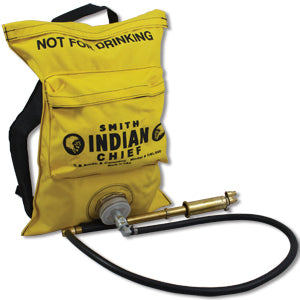
A bladder bag is a five gallon back pack that can be very effective for using a little water to go a long way. Five gallons so it weighs about 43 pounds in addition to your regular fire pack which weighs 20 pounds at the low end. Given the circumstance and greenness of my crew I decided to be the one to grab the bladder bag. So I went down to the truck, filled it up, slung it on, hiked back up the hill, out in front of the saw and the fire sort of took off right toward me. It was grass with some shrubs to it would move fast with a change in the wind which is what happened. There were a bunch of facilitators from the Forest Service near by. The fire moved so fast they had to scramble to get their UTV out of there. I was not alone out front but I became the only water source. I knocked a lot of it down as the Forest Service guys jumped to also help with digging line. So between my division coming up from the left, my squirting water at the head of this finger that was starting to get away and the FS guys coming from the right flank we all pinched it off.
The other day I talked about doing some work on the Crooks Fire a year ago that wasn't dangerous at all. What I described above wasn't that dangerous because we could have backed off to the side and let it run if our safety was in doubt but it was not riskless, there was a lot of smoke blowing at me and the experienced people here, the Forest Service crew and me, were moving with more purpose than anyone needed to on Day 1 of the drill.
It was very hard work, I was carrying a lot of weight, it could have gotten away so the stakes were real and I was having a blast! That right there is healthspan. I hope everyone has something they love doing as much as I love wildland fires. Not going out all summer like I was a 22 and working for a Forest Service crew, makes what I am talking about pretty much a hobby for as few days/yr that I fight fire. Doing that 100 days/yr, well I probably would not enjoy that but where a busy year might be 6-8 days of fighting fire, that's something I can enjoy now and hope to do for many years.
There must be plenty of hobbies/volunteer endeavors that check off the boxes for successful aging but volunteer firefighting certainly can be one of them. It requires being in shape but <very harsh comment coming> I know from doing a lot of reading and learning about the fire service this is not always the case with volunteer departments. In places where there really isn't a wildland fire component there is no pack test as described above. I don't know the prevalence of some sort of fitness standard at those departments but certainly for folks so motivated, being a fit firefighter is hugely beneficial. Even out here, technically we don't have to be pack tested but then we would not be allowed to work on fires in our area once the Forest Service showed up plus I believe there is a huge liability there.
Engaging in a fire department requires problem solving that usually differs from what you might need to do in other facets of your life, provides meaningful social engagement as opposed to meaningless chit chat at parties which isn't a lot of fun for me and the way our department is, we have some very young guys ranging up to the one firefighter I mentioned who is now 70.

Interacting with people of all ages is important. I've had that yellow shirt longer than the other two firefighters have been alive. That is not an exaggeration.
For many people, the only thing preventing them from doing today what they enjoyed doing when they were younger are just a couple of changes in habits related to diet and exercise. There are no absolutes but a lot of the maladies that inhibit middle aged people and younger seniors can be reversed much easier than you might think. Either way, there is no downside to getting in shape an eating less sugar.
And we'll close with a fire truck picture.


