Tuesday, April 16, 2024

Did I Miss A Rate Hike?

The title for this post is inspired by the following post on Threads. 


Fixed income, meaning intermediate and longer term duration, is having a rough 2024 after a meh 2023 and terrible 2022.


For most of those ETFs you can add 100-125 basis points back in for dividends. For TLTW which is TLT with a covered call overlay you can add back about 300 basis points.

The idea of avoiding or at least really minimizing exposure to intermediate and longer duration has been an evergreen topic for quite a while. My take has evolved from rates in that part of the market were way too low (extreme interest rate risk) to believing that this part of curve has become very volatile and that the volatility is unreliable making bonds ineffective for diversifying equity volatility. The front of the curve is ok and of course there are segments of the equity market that take interest rate risk but that kind of volatility from equities is fine, I don't want it from income sectors. 

We've written countless posts on this for many years. My framing of this has never been to try to predict what interest rates will do. I gave that up in something like 2010. With rates at all time lows, they were by definition more risky than they'd ever been regardless of whether there was ever going to be a consequence for that risk. Isolating the risk was easy. Knowing when it would matter was not. Similarly, recognizing that bonds are now more volatile and the 40 year bull market has ended is easy. Knowing what comes next is not. 

I don't know what comes next but just under 5% for 5-10 years does not make sense to me when we can get just over 5% for one year and in some other short term sectors, probably best accessed through funds, you can get more than 5%.

A few months ago when six rate cuts were expected, a lot of pundits said investors should go into the belly of the curve of even further, I disagreed based on the volatility first and foremost and the belief that not quite 5% just isn't enough compensation for 10 years or longer. Taking 5% for ten years when volatility dies down, eventually it could recede, might make sense but that is not where we are today. 

The information, analysis and opinions expressed herein reflect our judgment and opinions as of the date of writing and are subject to change at any time without notice. They are not intended to constitute legal, tax, securities or investment advice or a recommended course of action in any given situation.

A Blogger Looks At 58

The title to this post is a play on words from the Jimmy Buffett song A Pirate Looks At 40. This is an ongoing series that started when I was 40 with the intention of sort of updating the post at milestone birthdays. The point is to track how my views on various things might evolve or change dramatically and to hold myself accountable for any lifestyle opinions/advice I might write about. 

There's been enough going on in my life to warrant doing this every year now for the time being. Here are the previous posts from this series.

I think there is an arc to these if you care to check out the older posts. Here's where I am having turned 58 earlier this month.

A frequent topic to our lifestyle posts is the importance of figuring out what things we actually care about. We all have different priorities to pursue or maintain, the point I am making is to not waste time pursuing what turns out to be the wrong set of priorities. Owning my time, setting my own schedule is a huge priority for me, far more so than chasing a big career. I paid my dues with jobs during my 20's into my mid-30's but as I've said before, an investment advisor doesn't move to Prescott, AZ expecting to build a $1 billion practice. 

On the personal finance front, not much had changed over the 12 months. I've mentioned in other posts that in my early to mid 50's I focused on beefing up our taxable savings in case we had some sort of problem. Over the last year, I swung back to a relatively large 401k contribution. At 58, I am only 18 months from penalty free withdrawals from my 401k. If something catastrophic happened with my job as was almost the case in early 2023 (partners of old firm got in trouble) could we last on taxable savings for at least a year and a half? The next question would be could we last until I turn 62, four years obviously, until I can take Social Security early? 

If I can make it to 62 without having to tap IRAs, how much longer could we last? I've been of the same mind on taking SS when I am 70 for the simple reason that my wife is six years younger than me. If I die young, or young-ish, she'd get a larger survivor benefit. If I can hold off taking it until 70, I would encourage my wife to take her benefit at the same time, 64 and two months for her. My payout would be maxed out, hers would not. 

I think it makes sense to figure out what you would do if your hand was forced with your primary income source. I write about that a lot and we've created other income streams in case something crazy does happen and things don't work out. We have a short term rental and this summer I will take one or two training assignments as a liaison officer on large fires, both of which I've talked about many times. Living below your means will prove invaluable if you ever are in a tough spot too. 

An expression I like very much is that you never know what the future you will want to do. For many years, I've said I did not want to retire from what I do for a living realizing that is the sort of thing that I could change my mind at some point. Twenty years later and I am still in the same place, not wanting or planning to retire. At the same time though, being able to retire (we'd have to dial back some discretionary spending) is very empowering. Not worrying about money which in our case is more about living below our means has made our life much easier. 

When I talk about doing favors for the "future you," I'm well past the point of starting reap the benefits of a couple of simple decisions we made when we were much younger related to living below our means and continuing to exercise. Your 40's, 50's and I'm guess 60's can be a great period if you've got some independence with a little money in the bank (not necessarily wealthy) and can still get it done physically. Hopefully that applies to all ages from here. 

Exercise and diet continue to be huge parts of my life. I stay in shape for several reasons. First is for me in order to be able to do what I want to do (health span) and do what I need to do. For my wife, I figure she would prefer I am able bodied forever which is probably a clunky way to say it. She works out with me now so maybe she feels the same way. Also, I am setting an example at the firehouse on a couple of different levels. I got a nice compliment from a FD colleague who said I very much lead from the front. Being able to get it done physically is important. I try to set an example for the firefighters close to my age that they can be fit and also for the young guys, showing that fifty whatever doesn't have to be old. When I first joined the department in 2003, there were "older" guys who set the same example for me that I am trying to set that example forward. It would be nice to give up being fire chief in a couple of years or so, I'm 12+ years in and 15 years seems like a good term. I hope to continue being a firefighter until I'm holy shit, how old is that dude

We have some intermediate term planning/spending needs and we've started in on them. We upgraded our 4runner. We had a 2003 and upgraded to 2023. That's kind of a big expense of course but it is now behind us. We have a bunch of smaller projects on the house that we are knocking out this year.  Eventually we'll have to replace the Tundra too. Our ATV, used for plowing snow, will also need to be upgraded. Plowing snow beats the hell out of ATVs but our road is not county maintained so it is something we have to do. 

I write often about unexpected, unbudgetable on off expenses. Over the last few years, we've been less lucky on this front. We had a septic issue that cost about $3000 before it was hopefully solved.

It is interesting to see what beliefs are staying generally the same even if evolving slightly like not wanting to retire, my ongoing involvement at Walker Fire and my devotion to staying fit. I am also aware of a couple of quirks that are also evolving. My interest in self-sufficiency has increased. I've talked about this, I am not any sort of doomsday person but the chances for inconvenience appear to have increased. We saw this on a societal level at the start of the pandemic. That was a corner I was able to look around as I wrote about back then, just by getting a couple of weeks ahead of our food needs and Costco paper goods. 

I've talked about the grid here being fragile and old which is why we added solar awhile back. We've had three, week-long power outages since we've lived here. The grid itself is old and while the power company has gotten better about fixing outages much quicker, some sort of problem again leading to a long outage seems plausible. They also announced a plan to cut power in the face of expected wind events during fire season. It's not like I'm wading into creeks and catching fish barehanded, I just want to minimize the hassle. 

From 57 to 58, I don't feel any great enlightenment. I'm  grateful to be healthy and happy and I'll add another one that I read something about in the Wall Street Journal a month or so ago which is not having anything to prove. I probably haven't had anything to prove for a while but I've never articulated it that way to myself before. 

The information, analysis and opinions expressed herein reflect our judgment and opinions as of the date of writing and are subject to change at any time without notice. They are not intended to constitute legal, tax, securities or investment advice or a recommended course of action in any given situation.

Sunday, April 14, 2024

Learning From Someone Else's Mistakes

Over the weekend we had the Basin Ops Drill which is the annual inter-agency wildland fire training exercise in the Prescott area. The drill is an unusual thing in the wildland fire world in terms of bringing together red trucks (city fire departments) and green trucks (Forest Service) In different years we've also had participation from AZ Dept of Forestry and the Bureau of Land Management. I've talked about this before that the inter-agency cooperation in the Prescott area was very unique but I believe other areas are now doing similar things. I've been part of the planning group for this event since 2010.


Prescott is an epicenter of wildland fire thought leadership and my willing to volunteer has allowed me to have a seat at the table of this epicenter. Literally. This is a point I've made many times before in arguing to very actively volunteer with some organization that interests you. 

But the point of this post is leadership and the learning experience we had on day one of the drill. The way it is run is that all the departments participating go to a briefing for the day. After briefing they all go back to their trucks to wait to be dispatched out to a small prescribed fire lit by the Forest Service (training for them). Usually, engines from 3-4 departments will be dispatched to the prescribed fire, then when traffic is cleared for the first incident, the Forest Service will light off the second fire and the next 3-4 department vehicles will get dispatched to that one and then a third if there are that many participants.


The idea is to have personnel from different departments work together on these little fires. The training opportunities range from first exposure to live fire up to being the incident commander (IC) with a couple of other things in between. 

This year we knew what trucks we were going to be dispatched with so after briefing we got together to preplan our response. The downside of this is it is not realistic to preplan a response but that's ok. We wanted to figure out who would be IC. The logical choice would be someone who has a "position task book" open for IC Type 5 or IC Type 4. No one in the group did. In our group we had one Battalion Chief from another department and me as Fire Chief of our department. I was asked if I wanted to be the IC, I said that I could but that I would feel like I was stealing a training opportunity from someone. Plus it would have been better for the guys I came with to work more closely with them. For one of our guys, this was his first fire, another guy was in his second season and the third guy has been with the department a few years but as more of weekender doesn't have a lot of fire hours.

One of the four engines in our group was from one of the big departments here and the captain of that truck voluntold one of his guys to be IC because he had expressed interest in taking the captain's test. As we all started walking together back to our respective trucks, it was clear from his comments that our IC had zero idea how to do this. I might guess that he'd never had the training.


When we got back to our trucks to wait for our dispatching, I warned our guys that the IC didn't know what he was doing. That doesn't have to be a bad thing though. In theory, the engine captain could/should know how to IC a very small wildfire and function as a mentor. That's legit. I came to conclude though, that the actual captain himself did not know what to do and put this other guy in the hot seat to avoid having to do it himself. 

It unraveled right away. The IC's engine was listening to the first fire on the radio, we were told we'd be the second fire, and they missed our dispatch out to our fire. There's a radio process for this which includes pertinent information. In the picture of me, I am holding the incident action plan (IAP) that has all the communications info as well as other information. They missed it all and we sat in staging near the briefing area before someone told them we'd been dispatched which delayed us for 15 or 20 minutes. There was confusion on their part about where to go. I joked in our truck to just keep driving until you get to a fire. 

The IC told us to stage (wait) and then a couple of minutes later told us to tie in with another truck. There was a long list of things the IC does on a "initial attack" that were not done. For any fire people reading this, no mentions of LCES, leader's intent and we never heard the sizeup. At one point very early on, I was asked for our location and I said "we're near your truck on what I presume is the Zulu side of the fire" and from that point forward we had an Alpha division and Zulu division. Establishing divisions is something the IC does for small fires (operations does this if the fire is big enough). 


When you roll up onto a wildfire, you're supposed to position your vehicle in such a way as to make it easier to drive out if it becomes unsafe. In LCES above, the E is escape route. It was a very narrow road and as is often the case, our escape route was the way we came in. The road didn't lend itself to turning around to face out on the road but there were spots off the road to back in, making a quick exit easy, we wouldn't have to put the truck in reverse to leave. We were the only one of the four to position correctly. I am not sure if the IC is actually responsible for that, although his truck was pointed the wrong way too, but I would have mentioned it to each truck. 

The fire was an acre at the most and we got a line around it very quickly, spraying water on it as we went. It was very short and we got it done easily. We worked great with the other department also assigned to Division Zulu and had a lot of fun. We succeeded despite not having a competent IC. After the fire was out and we were waiting for our after action review (sort of a debrief), our little group talked about how bad the IC was and what a great learning opportunity it was to see someone flounder like that. I think our guys will benefit from the IC's mistakes. 

If you're wondering why I didn't say or do anything about this. There was a guy on the other truck assigned to Zulu with more experience than me and he didn't do or say anything either. The reason has to do with maintaining chain of command. If you understand what your assignment is and with a small fire on flat ground the assignment is pretty much always going to be to anchor and flank (jargon for what we did starting to dig fire line), spray it with water, improve the line and then mop up, and you feel safe, then just do your job. Additionally there were Forest Service personnel all over acting as facilitators and available to jump in if things got too spicy.

It was very productive for us, despite how this might read it was a lot of fun and I got to take pictures of fire trucks which is sort of a hobby of mine. 

Thursday, April 11, 2024

The Power Of Owning Something That Frequently Goes Down In Price

There have been some engaging reader comments lately. One pushed back on the logic behind using the AGFiQ US Market Neutral Ant-Beta ETF (BTAL) in client accounts. It is a personal holding too. The commenter said that per Yahoo Finance it has a negative return and it is expensive. As far as being expensive, selling stocks short is expensive yes and the fund bears that expense. The listed expense is not all management fee. The following makes the argument for why I use it. It's simple and it is either compelling to you or it isn't but it is simple. 


I do find it compelling obviously. We can build in much higher gross equity exposure and dialing in to essentially the same standard deviation, the BTAL blend gives an extra 221 basis points of compound growth despite the fact the BTAL goes down more often than not, down eight out of 14 full and partial years. Portfoliovisualizer shows the annual decline at 1.55% but taking out 2018 when it was up 15% and 2022 when it was up 20% and it would have been noticeably worse. Here's the year by year.


Obviously, the BTAL blend held up much better in 2022. The fact that is frequently goes down is an example of line item risk. What matters is the blend. The BTAL blend did lag 100% equities by 334 basis points compounded but 100% equities had a much higher standard deviation. The idea is that it improves versus 60/40 but should not be expected to keep up with 100% equities over anything other than very short periods. 

Now lets explore the same concept using managed futures. AQMIX is the AQR Managed Futures Fund and RYMFX is the Guggenheim Managed Futures Fund. I used RYMFX during the financial crisis, back then it may have been the only managed futures mutual fund. Since then, I would say RYMFX has been poor performer relative to the other managed futures funds and AQMIX appears to be one of the better funds in the space. 

If you've done research on managed futures then you've probably read what a rough decade the 2010's were for the strategy. I've read some theories that say the extremely low interest rate regime reduced the opportunity set for managed futures. I'm open to that possibility but not completely sold. Maybe it's as simple as equities went up a lot but either way from 2010 through 2019, RYMFX negatively compounded at 2.07% and AQMIX compounded annually at a positive 77 basis points. Blending 70% S&P 500 with 30% in each of those managed futures funds in that lost decade compares as follows to 60/40.


Not great but not bad. The performance of both is right in line, the standard deviation was noticeably higher but with the opportunity to go up more thanks to increased gross exposure to equities and they avoided the interest rate risk embedded in VBAIX all those years. The 2020's have not been lost for managed futures so the same portfolios from 2020 onward.


Much higher returns here and the managed futures blends had noticeably lower standard deviations than VBAIX for this period. The managed futures blends were close most of the time except when investors really needed the tracking error in 2022. The managed futures blends' worst years in this study were 2011 when they were down slightly versus up 4.31% for VBAIX and 2018 when they were down 5.5%-6% while VBAIX was down 2.84%.

I have long been convinced that both BTAL and managed futures can add tremendous value in terms of smoothing out the ride over the longer term. I don't discount having been lucky to have found RYMFX pretty much right after it started trading and for selling it some time in 2011. 

The real world application as I say in every post about these is smaller allocations to each than what we modeled for the blog post. I want the attributes they can give but without being overly vulnerable for an instance where they don't "work."

The information, analysis and opinions expressed herein reflect our judgment and opinions as of the date of writing and are subject to change at any time without notice. They are not intended to constitute legal, tax, securities or investment advice or a recommended course of action in any given situation.

Wednesday, April 10, 2024

Is There An Extra $1 Million In Your Portfolio That You're Forgetting About?

Allison Schrager wrote an article for Bloomberg last week that Wall Just Doesn't Get It On Retirement. I shared on Facebook noting that Schrager suggested better and cheaper annuity products and that given how undersaved we collectively are, it may come to more annuity products. Saying that people may be forced to try their luck on longevity pools does not mean I am now an annuity guy. I also quipped that people forced to work in "retirement" should not be penalized having to pay more income tax on their Social Security payout. 

I've mentioned the LifeX fund suite from Stone Ridge a couple of times. Alan Roth wrote about them and he is favorably disposed for the most part. Basically an investor can buy the fund that corresponds with their birth year. Once they hit 80, they cannot sell it. Hopefully the funds will pay out more along the lines of how much annuities payout when the time comes. It is a longevity pool so people who live longer get a larger accumulated benefit than people who die young. When the age cohort hits 100, the assets are divided among the holders still alive. 

Where regular annuities are very expensive, these are merely not cheap. Roth makes the case that despite appearing to be not cheap, the fee is not unreasonable. There is of course the unpleasant reality that some number of people buying in will die right after the cutoff to sell getting nothing or almost nothing out of it and surrendering their investment. I haven't looked close enough to know if their is any sort of grace period on this. If the cutoff is exactly 80 and someone dies two months later, would they let the family get the investment back? That's a good question to ask if you're interested in these. 

These are an evolutionary step and I think they are an improvement over what most annuities do and cost. The space will continue to evolve and I think it would short sighted to not keep tabs in case it evolves into a product that improves your retirement income.

Let me be crystal clear, I am not saying buy annuities. What I am saying is let the space for annuity-like products evolve and keep tabs on that evolution. 

The Best Interest Blog (via Abnormal Returns) made a couple of interesting points about Social Security. These are points we've made in various posts but there is value as a refresher or if this is new to you. With regard to the possible cut in payouts coming in the middle of the next decade, I am convinced that no one who is at least 55 now will face a reduction unless they impose means testing which is a different thing than a simple, across the board cut. The odds of means testing reductions are pretty high. I seriously doubt anyone who is now 50 will face an across the board cut ex-means testing. Best Interest didn't say he doubted cuts would impact everyone, that's me saying that, he said it would only be 20% which is not that bad. 

Would 20% be bad? I think they're talking about 23%, would 23% be that bad? Regardless of whether you think that is bad it might be happening and if it does, how will you work around it? I said today's 50 year olds probably won't be impacted but that could be wrong. Regardless of your age, what is your work around?

He also talked about how to value Social Security working backwards with the 4% rule. If you have a combined $40,000 benefit, that's like having another $1 million in your portfolio. Best Interest didn't say this but I think this also applies to other income streams like some sort of side hustle or real estate income.

The relevance ties into asset allocation. In this context, a $1 million Social Security "portfolio" is considered fixed income. Real estate income and side hustle income are as well even if they are less permanent than Social Security. Keeping it simple, if someone has a $1 million Social Security "portfolio" and a $500,000 IRA allocated at 60/40, what they really have is a 20/80 allocation. The $300k in their IRA is 20% of the whole pie, the rest is "fixed income." Even if all $500,000 is allocated to equities, that's only 1/3 in equities. In that example, an investor almost has to have the entire IRA in equities. Is that realistic? Probably not but it is useful information and justification to uptick the equity exposure some even if not to 100% of the IRA. 

Last one, Barry Ritholtz listed out his investment philosophy in ten bullet points, the original post is from 2022. It's not that I strongly disagree with items on his list but there are things that wouldn't make my top ten if I wrote something like this out. I also think the way a couple of them are framed isn't quite right.

Number 2 on Barry's list is that market timing is hard. The description seems to have a very short term focus. Yes, guessing what the market will do over the next short period of time is difficult, it is a guess. There is a different context here that is far more useful that I've done a few times but of course any time I have done this I realized I should have done so with more conviction. Occasionally, the stock market goes down a lot. After a large decline, buy more. If you buy, down 20% or 25%, you are buying low. It may go lower, no question. 20 or 25% is just an example and I have not done it every time but a few times yes. In my case, this has included selling an inverse fund into panic to increase net long exposure but it is the same effect. Accept you won't nail the timing and buy a little more after a large decline. That is hard to do emotionally, it means buying when everyone, including you maybe, is scared. Latch onto having bought cheap, not bottom-ticking, you won't do that very often. 

He says we are oblivious to our own cognitive shortcomings. I think this can be worked on and improved. Improved may not mean solved, it probably doesn't but improvement is possible. I just identified one of my shortcomings in the previous paragraph. Identifying any of our shortcomings is the first step. 

The list is good but not too many of them would get top priority as my investing philosophy. I will try to work on a similar list for a future post. 

The information, analysis and opinions expressed herein reflect our judgment and opinions as of the date of writing and are subject to change at any time without notice. They are not intended to constitute legal, tax, securities or investment advice or a recommended course of action in any given situation.

Tuesday, April 09, 2024

The Importance Of Diversifying Your Diversifiers

Bob Elliott who runs the Unlimited HFND Multi-Strategy Return Tracker ETF (HFND) wrote a blog post that could be summed up as diversifying your diversifiers but anchoring your alts bucket around managed futures will get the best result. He referred to the non-managed futures alts at "diversified alpha" but never specified what strategies to include with managed futures.

This has sort of been my positioning. Diversify your diversifiers certainly, although if Bob was saying to anchor around managed futures, my preference is managed futures being one of potentially a few alts.

Mutiny Funds put out a paper on the hows and whys of using alts for The Cockroach Portfolio that they manage and that we've looked at a few times. It is very worth reading with a couple of points really standing out to me.

The Cockroach has a 25% target allocation to equities inspired by the Permanent Portfolio (PP) but also because over longer periods than are typically studied, they have found the "greater probability of loss a and lower returns over 30 years than commonly believed." They studied 1841-2019 and I am sure they are looking at the data correctly. I've seen other studies that go back further than any reasonable definition of modern times. I don't put stock into data sets that include the 1900's. It is fun history to look at but I can't get to the point of applying lessons from the banking crisis of 1878 to investing today. Fun note, the 1878 banking crisis was mentioned in an episode of Deadwood. 

One fascinating point looked at getting great market returns later in your accumulation period versus earlier. This is in the neighborhood of sequence of return. Picture retiring in 2010 versus 2020. The S&P 500 was down 22% for the 10 years ending 1/1/2010 while the ten years ending 1/1/2020 it was up 189%. Getting that 189% between ages 50 and 60 will be far more impactful than between 25 and 35.

Mutiny makes a point that I've been writing about and have embedded into my process since 2004. Their wording, "investors should not only aim for strong compounding growth but also seek to mitigate large drawdowns and periods of low returns." 

This is what 75/50, getting 75% of the upside but only 50% of downside, is all about. Actually achieving 75/50 is no easy thing but the idea has influenced my process for 20 years and apparently Mutiny for the years they been around (less than 20 years). When you avoid the full brunt of large declines, your recovery doesn't have to be as big to get back to trend. 

Both Cockroach and PP are built around having at least one thing doing well no matter what is going on in the world. This is important. If everything goes up together then it is likely to go down together too so you might have diversified issuer risk but not market risk. As we say all the time, whereas stocks are the thing that goes up the most, most of the time in the modern era I would want more than 25% in equities for anyone needing normal stock market growth for their retirement plan to work. A 50 year old with $10 million happily living a $150,000 lifestyle might not need more than 25% in equities but that's not most people. 

Mutiny makes heavy use of managed futures (trend) and while I don't know the extent that Bob Elliott does, his post above certainly focused on it. The S&P 500 is off to a good start this year and interestingly so too are most managed futures funds.


The negative correlation between the two has been pretty reliable, I don't take for granted it is infallible, so this year is just one of those things maybe. I think fixed income continuing to trend lower in price and commodities continue to do well is helping the space. ASFYX is a client and personal holding. Looking back, 2014 is the only year (available to backtest) where equities and managed futures were up similar amounts. Every other year, 2011 forward, the returns were pretty different with the negative correlation standing up more often than not. 

Tying it back to diversifying your diversifiers, I think the way to do this is to understand the correlation and volatility attributes of various diversifiers. Obviously you also need a basis to believe the strategy will work. The short lived Simplify Tail Risk ETF (CYA) was an example of one that didn't work. 

Portfoliovisualizer has a correlation tool that is very handy in this context.


There's all sorts of information here. The range here of correlations is pretty wide along with different volatility profiles. There are expectations embedded in these numbers. Merger arbitrage has been a pretty reliable way to reduce portfolio volatility and act like how investors hope fixed income will act. It's not going to go up a lot when stocks drop a lot. There is use for MERIX' combo of attributes as long as you have the right expectations. MERIX, PPFIX, BTAL are client and personal holdings.


BTAL goes long low beta and short high beta. That has the effect of not looking like the stock market very often, the correlation has been reliably negative. It is up 6% this year though and was up for much of 2018, taking a different path to a similar result before tailing off in October of that year. If stocks are up a lot, BTAL could go down a lot is the right expectation to have.

I've been consistent about wanting to use diversifiers in small doses for the hopefully rare occasions that a specific strategy doesn't work when it is most needed. Markets can whipsaw faster than the signals that most managed futures funds use. We saw that in March, 2023. That was not calamitous but it did make for a tough year for the group. Abrupt changes in interest rates can impact other alt strategies in other ways. With most funds being free to trade, or almost free, there's no need to make a disproportionately large bet on just one alt strategy. 

The information, analysis and opinions expressed herein reflect our judgment and opinions as of the date of writing and are subject to change at any time without notice. They are not intended to constitute legal, tax, securities or investment advice or a recommended course of action in any given situation.

Monday, April 08, 2024

Not All "Inflation" Funds Work

Dave Nadig posted a question on Twitter asking if you had a client who was very concerned about inflation, regardless of whether they were correct, what would you recommend? Then he mentioned a few symbols. The following chart is tough to look at but it includes most of the symbols he mentioned along with a few others that I am aware set to 2022 when inflation spiked pretty hard.


Some of them did ok in the context of going up a little or not going down anywhere near as much as the broad market or 60/40 proxies like Vanguard Balanced Index (VBAIX). I did not include short term TIPS funds but those weren't great, down high single digits. Not great but much better than the AGG for whatever that is worth. 

Long dated TIPS funds got hit very hard. They may have inflation protection but they also assume interest rate risk. I used to own TIP but then figured out the interest rate problem back in what I am guessing was about 2013. The Quadratic Interest Rate Volatility And Inflation Hedge ETF (IVOL) is a tough one to figure out...as in I can't figure it out. Yahoo had it down 17.01% in 2022 (add back about 4% in distributions). The fact sheet talks about protecting against the sort of things that happened in 2022 but it was down a lot. Maybe I have it wrong but this seems like another example of a fund not meeting the expectation it sets.

IWIN from Amplify looks like it owns the right things including commodities, mining stocks, yet it was down 20%. RAAX, INFL and PPI all finished 2022 very close to unchanged which is a win in a down 17% (for VBAIX) world. Client holding PAVE was down 5% or so and I lucked out with client holding  XME being up 10%. 

That leaves us with ProShares Inflation Expectations ETF (RINF). I've known about this fund but didn't realize it has been around so long, back to 2013 despite only having $20 million in it. In 2022 it was up 3.70% per Yahoo. It was actually more than that, it paid a little over 1% in dividends that year. Yahoo shows the yield currently to be 5%. 

Back to Dave's question about a client being concerned about inflation. I think 2022 showed that for the most part, the market dynamics that year of stocks and bonds falling a lot was a bigger driver for most "inflation" funds than actual inflation. More succinctly, inflation products couldn't overcome a serious drawdown. 

Commodities are supposed to be inflation hedges and in some cases yes for 2022 but some cases no as IWIN showed us. Managed futures is sort of commodities and of course had a very good year in 2022. Maybe more important that owning a fund with the word inflation in the name, is owning one or more funds that are reliably negatively correlated to equities or maybe a low correlation is good enough.


That's just a sampling of the funds from the chart above and I highlighted their respective correlations to the S&P 500. If you're worried that stocks might go down because of inflation then protection with a low to negative correlation is going to be better than something with a high correlation or at least I would have that expectation. PPI and INFL did pretty well to be flat but their respective correlations are kind of high. TIP was down a lot and its correlation is surprisingly high and RINF is quite low and it did pretty well. 

The very simplistic primer of what RINF does is it goes long 30 year TIPS and short long dated bonds. When inflation was nowhere to be found, RINF went down and in the last few years as inflation came back, RINF has been going up. 


The above backtest is consistent with other tests we've run. RINF sort of allows for leveraging down to increase the equity allocation but you can see in the first 2/3 of the back test the RINF blend lagged when inflation expectations were nonexistent. There were a few very good years for the RINF portfolio, no relative stinkers but it did lag a few times but in 2022 it was down 10%, much better than VBAIX but not as good as the managed futures blend. 


Putting it all together with a 5% weighting to RINF we see the CAGR is much higher than VBAIX with just a modest boost in standard deviation. I think those numbers make for a good tradeoff especially since Portfolio 1 was down less than half VBAIX' 2022 decline. Maybe not during crashes like 2022 but plain vanilla equities tend to more than offset inflation over longer period so probably no need to dump equities if you're expecting higher inflation. 

I am satisfied that RINF adequately implements the inflation breakeven trade. It is harder to say how often we might need that exposure going forward but I think it can keep helping when inflation expectations are high and be a drag when inflation expectations are low which is in line with what the fund should do. If there is any value to adding RINF (I'm not there at this point) I think it would be in small doses. I think there would be diminishing returns from going too large. 

The information, analysis and opinions expressed herein reflect our judgment and opinions as of the date of writing and are subject to change at any time without notice. They are not intended to constitute legal, tax, securities or investment advice or a recommended course of action in any given situation.

Sunday, April 07, 2024

Does Return Stacking With Managed Futures Work?

Let's have a little fun with a difference of opinion about how to incorporate managed futures into a portfolio between to big proponents, Corey Hoffstein from ReturnStacked ETFs and Andrew Beer who runs the iMPG DBi Managed Futures Strategy ETF (DBMF). There are two relevant links, Andrew was on a podcast and talked about return stacking between minutes 47 and 52. He's not a fan of the idea, calling it a niche product most likely to be used by younger, more aggressive advisors who might have something to prove. The other link is a Tweet storm from Corey rebutting much of what Andrew said. You can check out both to see which argument is more persuasive. 

Both of them talk about how to add managed futures to a portfolio. You could take some from stocks, some from fixed income or both. Return stacking adds it on top of the whatever stocks/bond mix being used so you don't have to take it from anywhere. Leverage used in this manner is not that new but maybe sort of new with retail accessible funds although I would note PIMCO has done this in mutual funds since at least 2008. 

This "where do you take from" is not really a dilemma for me. They frame it as a tracking error issue but we've looked at that before, I don't really find the tracking error problem to be a problem at all. And as we'll see further down in this post there can no guarantee that stacking an alternative on top of stocks or bonds in one fund will be additive to performance. 

They appear to disagree over how beneficial it is for managed futures that T-bills now yield 5%. Most of a managed futures fund is held in cash, usually T-bills, which collateralizes the futures used and interest is earned on that cash/T-bills. For a little while now, cash has been yielding 5% while a few years ago it was yielding zero or close to it. This is something I've tried to explore with different people over the years. How much extra benefit does that extra 500 basis points give to managed futures, better worded, how meaningful is it? Anytime I've asked anyone who knows more than me about it, they've said it doesn't mean much. I can't get to that conclusion. It's an extra 450 or 500 basis points, for now, that these funds weren't getting a few years ago. 

Corey then devoted several Tweets to the tradeoff between bonds and cash that I didn't entirely follow but Corey said "if you follow Andrew's logic, you'd have to ask yourself 'wait, why do I own bonds at all?'" You might recall from previous posts, I don't own bonds, haven't in quite a while. Some portfolio managers might very well be constrained that they have to own bonds, chances are you are not constrained in that manner. Part of what I've said about the ReturnStacked products is that the decision to buy them has to include that you want the bond exposure they have. I do not. 

To Andrew's point about multi-asset funds that use leverage being a niche product, well yes, of course they are. Relatively plain vanilla managed futures is a niche product space. Absolute return is a niche space too. I think these are all niches and I do not think that is a slight. 

Corey thought that Andrew was overly focused on line item risk which is the behavior of worrying more about how a couple of holdings are doing (the trees) versus how the entire portfolio is doing (the forest). It didn't sound that way to me but either way, actual line item obsession is a problem but it might be a close cousin to the effort needed to make sure something is meeting expectations that the fund company is setting. If stocks are up 20% in a year and most managed futures funds are down 5%, then worrying that your managed futures fund is down 7% is an example of what line item risk is about, worrying about the wrong thing. If in some environment most managed futures funds are up 7-11% and your fund is down 8%, that is worth digging in to try to figure out if there is a problem and then deciding what to do if there is a problem. Even in that example there might not be a problem but I would spend the time to figure that out. 

Here comes some harshness. I have mentioned a predecessor fund the Corey (or Corey's company) managed, the Newfound Risk Managed US Growth Fund which recently closed, it had symbol NFDIX. It was a 75/75 stocks/bonds fund. Because it is closed it is tough to find charts but I found one site that still charts it, portfolioslab.com. 


This chart compares it to Vanguard Balanced Index (VBAIX) which is a proxy for a 60/40 portfolio. When NFDIX closed, VBAIX was up about 80% for the same period. Even if the 75% to bonds created a serious problem for 2022, NFDIX should have outperformed 60/40 up until that point if nothing else and it didn't.  

The ReturnStacked Bonds & Managed Futures ETF (RSBT) now has one year of track record to look at. You can see what I'm comparing to. Not included but AQMIX is up 11% in this period. 


It's only a year but how different is it from NFDIX' first year? I mentioned PIMCO up above. They have a suite funds that travel in this circle. I believe the one that is most widely known is the PIMCO StocksPLUS Long Duration (PSLDX) which is 100/100 stocks/long bonds. 


I think Portfolio 2 replicates 100% into NFDIX and the time period is adjusted to capture the same period as the portfolioslab chart. Again you have to want the bonds it owns, 2022 was a dreadful year for it of course, but the comparison looks like what I'd expect. Portfolio 2 here was up 107% versus 17% for NFDIX in the same period. NFDIX traded for a decent period of time and RSBT has traded long enough to make a first impression. Is there something that isn't right with their process? I don't know but I feel like it is a reasonable question at this point. 

So maybe the PIMCO funds work better. There are other capital efficient funds that might work better than the ReturnStacked funds. This is exactly what I mean when I talk about a fund setting expectations, being very cautious about complex funds/strategies and only taking bits of process that appeal to you from various sources to create your own process. 

Part of the fund expectations is our ability as potential end users to understand the strategy well enough to know where to poke potential holes. I feel like I've had good luck with that. Caution or even skepticism about complicated funds is an important trait. I've described client portfolios as simplicity hedged with a little bit of complexity. Here's a table that might look familiar, it's an old one of the ReturnStacked 60/40 Absolute Return Index.
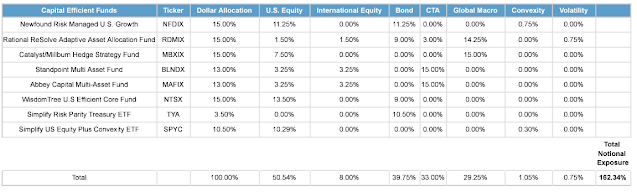

It is an extremely complex portfolio. There is influence here and things to learn but no, not my cup of tea. The influence for me that we've talked about many times is using a couple of negatively correlated assets to add a little more equity exposure without increasing standard deviation. It's a form of leverage, gross equity exposure that is a little above target without actual leverage. Another point of influence is that I believe smaller allocations to complex funds can reduce volatility and correlation if that is the objective, it is for me.

I hope the ReturnStacked funds, the other two appear to be struggling as well per their Q1 report (scroll down to page 15), turn it around. This is interesting work they are doing, it is beneficial to me even if I draw different conclusions, they are generous with their work and it is fun to sift through their research. 

The information, analysis and opinions expressed herein reflect our judgment and opinions as of the date of writing and are subject to change at any time without notice. They are not intended to constitute legal, tax, securities or investment advice or a recommended course of action in any given situation.

Friday, April 05, 2024

Cliff (and Meb) Notes

Meb Faber interviewed Cliff Asness in a podcast format. There was plenty of great stuff of course, this post covers some points made that stood to me as worth expanding on and exploring.  

They talked about when a potential investor, the context is a large institutional investor, talks about investing a small amount to see how it does for a while. Both Cliff and Meb agreed that whatever this person has in mind for "does for a while" is going to be too short a timeframe to draw any useful conclusion. This is along the lines of what Ken French has said in this regard, that one year is not enough time, three years, maybe even five years is not enough time to assess a fund or strategy in this context. 

I partially agree but there is a different take to consider. Certainly, a few months to draw a solid conclusion about some sort of long only, better returns than the market strategy is too short a time. Value has lagged for ages. I wouldn't necessarily expect a value fund/strategy to outperform market cap weighting (MCW) when value in general is far behind MCW and growth too for that matter. It could happen of course but not a realistic expectation. 

Occasionally I will mention that I am test-driving a fund for possible inclusion in my practice. Right now I am test driving QQQY and ISPY. I've had QQQY for almost seven months have haven't concluded anything. Defiance who runs QQQY set an expectation that they believed it would trade like a covered call fund. So far, that is pretty close but there has not been a drawdown large enough to expose whether its strategy could have a problem. I'm content to hold it and reinvest the dividend. Similarly with ISPY, the hope with this one is it tracks much closer to the MCW S&P 500 than covered call funds that sell monthly calls, and do so with a much higher yield the MCW. After not quite four months, I don't yet know if it will do what I hope. Nothing bad has happened but too soon to draw a firm conclusion.

The thing I am looking for with this is to understand what expectation the fund company is setting for a fund, like I mentioned above with QQQY, and then whether the fund can meet that expectation. One fund that has since closed that I said I didn't understand the expectation being set was the Noble Absolute Return Fund which traded with symbol NOPE. I said a couple of times that I had no idea what the fund was trying to do. Those first few months it looked nothing like an absolute return, then it did but drifted lower and finally closed. This sort of result is a useful example of a fund not meeting expectations.


Later on in the podcast, Cliff made a comment so brief it was almost in passing, about the combination of trend and carry being a very good portfolio combination. The word momentum was included here so I built the following.


Portfolio 1 is 100% to Vanguard Balanced Index Fund (VBAIX) which is a proxy for a 60/40 portfolio. There used to be a currency carry trade ETF but I can't find it anywhere now so maybe it closed. Portfolio 2 goes long the Aussie dollar and short the yen which is one version of a carry trade. Portfolio 3 uses Vanguard Market Neutral as a substitute for carry and you can decide if it works or not. 

The pursuit here is whether we can create a proxy for a 60/40 portfolio that avoids interest rate risk and the increased volatility that intermediate and longer term bonds have had lately and I believe still do have.


As is the case with many of the portfolios we build in this context, the momentum, trend and carry portfolio tracks 60/40 until 2022. Portfolio 2 was down 69 basis points in 2022 and Portfolio 3 was up 1.99% that year. 

Toward the end of the podcast they tried to pin a number on how much should be allocated to alternatives. The conversation sort of drifted to a number which I will get to in a moment. By Cliff's reckoning, if you do the spreadsheet work, you would find that the optimal strategy is to pretty much do the typical thing with stocks and bonds and then leverage up a lot to add alternatives on top which of course sounds a lot like what the ReturnStacked ETFs do. 

I think Meb generally agreed but they both conceded that most investors aren't going to do that. They drifted into 20-25% being a realistic number even if not optimal. Cliff said that only doing half of what is optimal and sticking to it is better than going to the full optimal amount but not sticking with it and by extension, I would say going halfway in is better than nothing. To be clear, I don't think they were implying 40-50% is optimal.

A realistic way to implement 20-25% to alts in my estimation is when you have small slices to several strategies that mostly replace longer duration fixed income. We've written countless posts about ways to use alts in this manner to allow for increasing equity exposure but reducing volatility versus 60/40 and avoiding the full brunt of large declines. 

The information, analysis and opinions expressed herein reflect our judgment and opinions as of the date of writing and are subject to change at any time without notice. They are not intended to constitute legal, tax, securities or investment advice or a recommended course of action in any given situation. 

Thursday, April 04, 2024

Be Careful With Backtesting

We have a lot of fun here with backtesting portfolios. The process can be informative but not definitive. If you are going to include backtesting in your investment process, it is important to understand the limitations beyond the boilerplate that past performance doesn't guarantee future results.

There was news going around that Daffy.org was adding Bitcoin in 5% or 10% weightings to a couple of its portfolios, presumably to improve returns for otherwise "normal" looking portfolios. Along the lines of Taleb's barbell strategy of getting most of a portfolio's return from a narrow slice of the portfolio and putting the rest in very conservative holdings, I wanted to model in Daffy's 5-10% weighting idea to try to get a market equaling result with just a small allocation to risk assets. 


You can see Portfolios 2 and 3, Portfolio 1 is just 100% Vanguard Balanced Index (VBAIX) which is a proxy for a 60/40 portfolio.  


The results are thought provoking but, and there is a big but, it is built on a couple of phenomenal years for Bitcoin. In 2017, Bitcoin went from about $1000 up to $5000 and in 2020 Bitcoin went from about $9000 to $34,000. That could happen again of course but building a portfolio modeling that sort of gain, without realizing there might be unrepeatable is one flaw of modeling. It is important to understand at least some of what drove returns. An uncharacteristically great year can throw off the entire backtest.

If Bitcoin had traded exactly like  T-bill then Portfolios 2 and 3 would have compounded below 3%. The way to deal with this IMO would be to allocate a little less to Bitcoin and have at least some exposure to plain vanilla equities. If Bitcoin does go up 5-fold in one of of the next ten years, great, but if it didn't, the portfolio could have a decent CAGR even if it was less than VBAIX.


Making the above changes, replacing the AQR fund with VOO and shaving Bitcoin down to 2% gave a CAGR of 8.16% versus 8.13% for VBAIX but the standard deviation was 5.59% versus 10.10% for VBAIX.

I saw a reference to Meb Faber's Ivy Portfolio which I believe he first published in 2011. It allocates as follows.


It looks like a derivation of Harry Brown's Permanent Portfolio which allocates 25% each to equities, long bonds, cash and gold. Here's a comparison of the two along with 100% in VBAIX.


The Ivy had the lowest return and the highest standard deviation. I don't doubt whatever work was done on the front end to create the Ivy but if I wrote about it when the paper first came out, I would have bagged on it pretty hard. I have never been a fan of the huge percentages into real estate and commodities that some folks swear by. For a while in the 2000's, REITs did very well and there were a lot of calls to put 20-25% into REITS and commodities too for that matter. That felt like a terrible idea to me back before the crisis and then all the way through. 

People hope REITs will offer protection against equity volatility. The history of that isn't very good. In 2008, Vanguard REIT ETF (VNQ) was down 37% and in 2022 it was down 26%. Having exposure to a REIT or two, sure, why not if there is one or two that you like but a huge percentage just isn't going to work out. I believe commodities do offer some protection against equity volatility because the correlation is low to negative. A point we make here all the time though is that if equities are the thing that goes up the most, most of the time, why would you want a huge allocation to something with a negative correlation to the thing that goes up the most, most of the time? 

Some exposure to negatively correlated assets should smooth out the ride, yes but Ivy is more volatile for having too much in commodities, IMO. This gets us to another flaw of modeling which is tunnel visioning on how something should work versus the real world. I don't know if my belief in small exposures to diversifiers is necessarily forward looking, it is from the standpoint of trying to avoid being over exposed to future calamities but I just had not seen REITs offer the protection that some people thought they did back almost 20 years ago which was backward looking. 

Backtesting and modeling are useful tools but don't lose sight of the forest when you're looking at the trees. 

The information, analysis and opinions expressed herein reflect our judgment and opinions as of the date of writing and are subject to change at any time without notice. They are not intended to constitute legal, tax, securities or investment advice or a recommended course of action in any given situation. 

Wednesday, April 03, 2024

I Ran The Numbers And They Work!

Cliff Asness from AQR wrote a quick post titled Cognitive Dissonance that listed out contradictory ideas that investors have. There were two that I think tie right in to conversations we regularly have here.


Part of his point in these is line item risk, the tendency to be overly focused on the holding that is lagging even if it is "supposed" to lag. A holding that is supposed to lag could be some sort of diversifier that is held for its low to negative correlation to equities. I've frequently said that if gold is your best performing holding, then chances are things in the world aren't going so well. It is similar with managed futures or client/personal holding BTAL. They tend to have a negative correlation to equities. We could say the same thing about merger arbitrage, convertible arbitrage and other absolute return vehicles. A 5% year for absolute return sounds pretty good to me but would be considered only up a little for equities. 

I've told the story about being very early to buy the Standpoint Multiasset Fund (BLNDX) many times. The fund is a combo of equities and managed futures. I had enough previous experience with managed futures to understand the concept would work. Part of how they positioned the concept before the fund launched was a chart similar to this one. 


The 2010's was a rough decade for managed futures in nominal terms. The S&P 500 was up 244% and managed futures went nowhere. Standpoint was empathetic to the emotion of a holding not doing much for an extended period but blending the two, equities and managed futures, together in one strategy delivered a very good result.


You can see that 60/40 equities/managed futures stayed close to 60/40 equities/bonds at a time when managed futures was doing poorly and then pulled ahead in recent years including going up 3.25% in 2022. Looking at AQMIX on your statement kind of going nowhere for 10 years could be difficult but clearly a portfolio with the allocation in Portfolio 3 would have kept up just fine and if they had focused on the bottom line number and not the line items, it would not have been difficult. 

This brings us to a short paper from Man Institute that makes an argument for using leverage to incorporate managed futures kind of along the lines of the ETFs from ReturnStacked. By Man's work, the optimal mix would be 90% in 60/40 and put the remain 10% into managed futures but leverage the 10% 4X so essentially 90% 60/40 and 40% managed futures. We can model this on Portfoliovisualizer. 


The differences aren't that big here though. 90/40 had a higher CAGR than traditional 60/40 but lower than 60% equities/40% managed futures in Portfolio 3. 90/40 had the lowest standard deviation by a decent amount too. The advantage that both managed futures portfolios had over traditional 60/40 is how well they did in 2022. 90/40 was down 1.56% and Portfolio 3 was up 3.25%. Someone retiring on Dec 31, 2021 being all in on traditional 60/40 had a real problem from an adverse sequence of returns. Someone retiring on Dec 31, 2021 with one of the managed futures-heavy portfolios had no such problem. This reiterates a point we've been making for ages, alts currently to a better job than bonds at protecting against equity volatility. 

I said you could model 90/40 in Portfoliovisualizer. With the Wisdomtree US Efficient Core ETF (NTSX) you could actually implement 90/40. As a reminder, a 67% weighting to NTSX equals a 100% weight into VBAIX. To replicate 90% in VBAIX you could allocate 60.3% into NTSX and the remainder into managed futures. It only back tests to 2018 but here's what you get.


The result is similar to the above backtests. The managed futures blend stays reasonably close and then avoid the decline in 2022.

This is all compelling stuff but there is risk to going 40% into any alternative strategy. Managed futures might do what it is "supposed to do" in 59 out of 60 years of your investing lifetime but if the one time it doesn't is a year like 2008 or 2022 and it drops 25%, then you have a big problem. There might never be a consequence for the risk of 40% into one alternative strategy but that doesn't mean you didn't take the risk. 

The real world takeaway for me is to diversify your diversifiers because they can work better than bonds. 

The information, analysis and opinions expressed herein reflect our judgment and opinions as of the date of writing and are subject to change at any time without notice. They are not intended to constitute legal, tax, securities or investment advice or a recommended course of action in any given situation. 

Tuesday, April 02, 2024

More Retirement Doom

Northwestern Mutual published a report about the state of retirement and of course all the numbers are grim. You can read about at Yahoo and Bloomberg. Their survey says that Americans believe they will need $1.46 million to retire, up about 50% from 2020, while the average retirement account balance is $88,000. Bloomberg had a generational breakdown of balances and for Gen-X the average was $108,000 and for Baby Boomers it was $120,000. 

The gap between those averages and the expected need is monstrous. The "average" number in all these surveys are always flawed for not taking into account someone starting a new job, funding a new 401k which will have a low balance, yes, but the same person could easily have a larger sum from an old 401k that they rolled into an IRA. 

Let's forget about the averages though. The amount you have is what matters. Also, regarding the $1.46 million, do you think that number is close to what you need? Do you need more? Do you need less? Do you even have an opinion about how much you need? Should you even worry about how much you think you need?

I've been pushing back on the idea of have a number, a retirement number, for a very long time. The odds that some number that you get from an app, or an advisor or doing your own spreadsheet work when you're 35 or 40 staying relevant until you're 60 or 65 or 70 are very low. Additionally, let's say that at 40, you determined you needed $1,025,000 to retire at 65 and then you get to 65 and you've ended up with $880,000, then that $1.025 million number means absolutely nothing. If you have $880,000 regardless of what your goal was, then the $880,000 is the only thing that matters, that would be your reality. 

The context of these comments assumes a decent savings rate from some young age to whatever you think of as being retirement age. Coming up $145,000 short would be a bummer but not catastrophic. If someone thinks they need $1.46 million and only has $120,000, then yeah, they are in a very tough spot.

However much you end up with, again assuming a decent savings rate for many years, it will generate an income stream. A 4-5% income stream is very likely to be a safe and sustainable income stream. Maybe you were counting on 4% of $1.025,000 but if you have $880,000 then your income stream will be $35,200-$44,000. Maybe you could delay withdrawals for a year and be lucky enough for your account to go up in that year. Maybe in that year you get an 8 or 9% bump bringing you closer to the $1,025,000. Or maybe not.

If you've been reading my posts for a while you know I am big on looking at the expense side of the ledger. In the last couple of years we cut several expenses which in the context of a post retirement budget could add up. Landlines are almost completely obsolete. We were paying $65/mo, $780/yr when we turned our off a couple of years ago. Our cell phone bill is $100/mo but I see those commercials for cheapy services that are $25/mo. Last year we cut the cord with Directv in favor of streaming and cut our expense in half. We invested a good bit of money into solar and minisplits which has dramatically lowered our propane bill, we still have one but it is pretty cheap. In our circumstance, propane is much more expensive than electricity, 

Those are small things but if your fixed monthly expenses are modest, ours are, then a few hundred dollars is a decent percentage. The big things though relate to health. According to Barron's, Type 2 Diabetes will cost $109,000-$120,000 on average, out of pocket for retirees. That same article said that cardiovascular disease will cost $263,000-$315,000 out of pocket for retirees. The article didn't put cancer in that same context but I can't imaging it would be cheaper than CVD. What about kidney disease or various -itises that are expensive to manage? 

I say this all the time to anyone who will listen (more people listen than you might think), lift weights and cut carbohydrate consumption. There are volumes of research showing the benefits of both. There is literally no medical condition where low carb diets haven't been studied. I'm not saying low carb fixes everything, I am saying it has been studied in conjunction to any malady that you or someone you love might have and it is worth learning about. Explore this list I made on Twitter to learn more. I believe the combo of lifting weights and a low carb diet is miraculous. The body is very forgiving and many issues can be reversed. And the financial benefit is obvious. 

One final point back to both articles was the same quote by the Northwestern chief strategy officer about most people not realizing their withdrawals could be taxed at "20-30%." This is important, moreso if you live in a state with high income tax. It is unlikely that my federal tax bracket will be higher than 22% assuming today's brackets, certainly not 24% which goes up to $383,000 married filing joint. Arizona is a low tax state. It is easy to take a reasonable picture for your situation. If you have $1 million in your IRA and that is your only asset, you're not at much risk for falling into the 35% tax bracket for federal unless you spend it all in two years. 

I've said quite a few times that there are a lot of potential mistakes to be made involving taxes when Social Security taken, still working if you've taken SS early, the order of which account types you withdraw from even Medicare. Mistakes can be very costly. To the example above where someone comes up a little short at $880,000, a $5000 mistake related to inefficient tax management can compound the problem of not quite having enough. If you are going to do this on your own, spend the time learning this stuff so you get it right. 

The information, analysis and opinions expressed herein reflect our judgment and opinions as of the date of writing and are subject to change at any time without notice. They are not intended to constitute legal, tax, securities or investment advice or a recommended course of action in any given situation. 

A Portfolio To Make You Throw Up

I was intrigued by the comment from Eric Crittenden that we shared yesterday about using very volatile managed futures. With that in mind, a...