Monday, July 22, 2024

Bonds Are A Source Of Unreliable Volatility

Man Institute had an interesting research paper that fishes into the same waters we do here. The first line from their paper was "the reliability of bonds as a defensive diversifier was brought into question in 2022, particularly in light of the inflationary environment." Their use of the word reliability amuses me because that is the word we've been using, bonds have become a source of unreliable volatility is how I've worded it most frequently. I mentioned work from Man Institute back in April. The current paper looks at a strategy they call the Yieldy Put and how to blend it in with a 60/40 portfolio.

Yieldy Put is 50/50 trend (managed futures) and long/short quality stocks. The rationale is that "both (strategies) historically performed well in equity crises yet had positive carry in the good times. Hence the ‘yieldy put’ moniker in the title of this paper. Further, the two strategies are complementary to each other, with L/S quality often capturing the sudden ‘flight-to-quality’ effect that can potentially derail trend-following strategies." They compare the following allocations. 


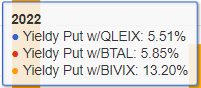
The sweet spot is 50/50 into a 60/40 portfolio and the other half into Yieldy Put. I modeled it with three different funds for the long/short piece, AQR Long Short Equity Fund (QLEIX), client/personal holding AGFiQ US Market Neutral Anti-Beta Fund (BTAL) and Invenomic Institutional Fund (BIVIX) that we looked at in May. They each do very different things. QLEIX tries to smooth out the ride, BTAL has a pretty reliable negative correlation to equities and 60/40 and BIVIX swings for the fences with a very high standard deviation. 

The rest of these models allocate 30% to iShares All Country World Index ETF (ACWI) because that's closest to what Man used, 20% to iShares Aggregate Bond ETF (AGG), 25% to AQR Managed Futures (AQMIX) and the last 25% to the respective long short fund mentioned above.


In the same period, the Vanguard Balanced Index Fund (VBAIX) which is a proxy for 60/40 compounded at 8.56% with a standard deviation of 11.63%. The QLEIX version is not night and day different, it has a somewhat lower but still adequate CAGR. The BTAL version shows that 25% to that fund is probably way too much. And the BIVIX version is of course interesting but a fund that can go up a ton, it was up 61% in 2021 and up 49% in 2022, can also go down a ton. That's more a rule of thumb than a comment specifically directed at BIVIX.

I remodeled these swapping floating rate in for AGG. The differences were much less than I would have guessed.


However, the TFLO versions did considerably better in 2022 than the AGG version. 


As a reminder, in 2022 VBAIX was down 16.87%.

We've gone through essentially this same exercise 100 times. Today's post was just a different variation on the same theme. Yieldy Put, the way we constructed it, is pretty solid but I wouldn't want to be caught with 25% in BIVIX in case it ever does go down as much as it went up in some of those years. I would also want to diversify the risk of so much into two alternative strategies. As we always say, nothing can work 100% of the time and diversifying your diversifiers mitigates that risk and in my opinion is worth the basis points that might be given up for that peace of mind. 

The paper referenced a well known sports cliche. "Attack wins games, defense wins titles." I'd never thought of this in terms of how I try to manage portfolios but of course it fits whether we're talking about smoothing out the ride or the concept of 75/50 (75% of the upside with only 50% of the downside) or something else. 

Participating in markets can be whatever you want but I think of it as a long game. My nephew was asking me all sorts of market related questions over the weekend at a family function. He's very new at it so I tried to gage my answers accordingly. I said the S&P 500 is it 5500 right now. It will go to 11,000, no question. If it only takes four years, that would be great. If it takes 20 years, that would be pretty weak but it will happen. Maybe, it won't take that long but maybe it goes to 2750 on its way to 11000. 

As long as you understand your time horizon and have the right asset allocation, you're (my nephew) account will do exactly what you need it to do. Knowing all that, leads me to wanting to smooth out the ride, have a little defense on at all times and "win the title."

The information, analysis and opinions expressed herein reflect our judgment and opinions as of the date of writing and are subject to change at any time without notice. They are not intended to constitute legal, tax, securities or investment advice or a recommended course of action in any given situation.

Sunday, July 21, 2024

60/40? I Can't Even

Vanguard senior investment strategist Todd Schlanger made the rounds in two places over the weekend, Barron's and Yahoo Finance trying to defend the 60/40 allocation. 

From Barron's, "Sticking with the 60/40 strategy still makes sense...Despite steep losses in 2022, when stocks and bonds both fell, a 60/40 portfolio has returned over 20% since then, which should portend continued strong future returns." And in Yahoo, "It's a very diversified strategy and we think it's poised to do very well in the future."

The reason I am bagging on this, well there are quite a few reasons but first is there is no sort of forward looking anything, actually no sort of assessment of current conditions either. In both articles he offered a tweak of 60/40 in terms of incorporating foreign exposure as follows.

It doesn't back test very far because of BNDW. I tried to find an older Total World bond fund and struck out so please leave a comment if you know one that is older. Here are the results.

That the foreign blend lagged, doesn't matter because foreign equities have lagged by a lot lately. Foreign exposure is valid of course, but any portfolio heavy in foreign had lagged domestic only for the last few years so that is fine. This issue here is that there's no differentiation. They correlate closely. Someone who wants 60/40 stocks bonds and wants to include foreign? Then it's a fine portfolio.

But as we've looked at countless times, bonds no longer offer the diversification benefits they once did. I'm not sure they ever did actually because all the data that we can look at is skewed by a 40 year run where bond yields went from 15% down to a low of 58 basis points on the ten year US Treasury. That cannot be repeated. Whether 2022's bear market was a reversion to some sort of mean or something else, that event broke the 60/40 portfolio as it's commonly applied because it changed the correlation relationship between stocks and bonds. 

Mark Rzepczynski touched on this in a very short blog post, he said;

A switch from a -.5 to +.5 will double the volatility of a 60/40 stock/bond mix based on historical data. Think about it. You will see your portfolio can move from single to double digit risk while keeping the allocation the same. There will still be a diversification benefit from bonds, but you will have to live with more risk. Back to basics, the correlations across assets matter. 
Diversification can be thought of as a management of correlations and understanding when correlations change, all the better if you can understand why they changed.

As opposed to bonds being thought of as the diversifier to equities, they are maybe better thought of a diversifier. What's one thing we always say? Diversify your diversifiers. Equities are the thing that go up the most, most of the time. Asset class diversification can help ease the volatility of equity exposure as well as make a portfolio more robust when equities get pasted or otherwise struggle. 

This really isn't that 60/40 is dead, more like 40 into bonds is a bad idea. 60% stocks, maybe 10% bonds, 10% managed futures, 10% in an absolute return strategy that looks like what people hope bonds look like and 10% into some sort of diversified macro strategy is better? That's just an example, I don't have anywhere near 10% in bonds with any sort of duration but in the context of not all diversifiers can work all of the time, 10% in bonds isn't the end of the world just because they are not working. Maybe they will work again? If yields go down to 3%, then bonds will do well but taking that on with 40% of a portfolio doesn't make a lick of sense to me. 

So let's try that, 60/10/10/10/10 using Todd's equity idea.


The return stream isn't that differentiated, except when you needed it to be. 


No one needs diversification, until they need it if you take my meaning. 60/10/10/10/10 looks a lot like 60/40 every year except 2022 when it was down 7.19% versus 16.87% for VBAIX. Some of the portfolio stats really stand out too in favor of 60/10/10/10/10 despite 10% in what I think is about the last place you want to invest these days, bonds with duration. Replacing AGG with floating rate would increase the CAGR by 54 basis points and lower the standard deviation by 46 basis points with a smaller decline in 2022.

Yes, I've been harping on this bond thing for ages, since long before 2022. Ten or 15 years ago it was more about yields not compensating for the potential volatility, then it became more about yields at all time lows only being able to go up even if I didn't know when or if that would happen and now it is about bonds being unreliable diversifiers. This is a theme that has played and evolved over the course of many years. 

Who knows if ten or 20 year paper could ever get to 8% again. Although I think that is unlikely, all of the volatility and risk that bondholders might have to put up with to get 4% now, might be worth it at 8% or maybe 7%. There is some level, we all need to decide for ourselves what level, where the volatility would be worth it but not at 4%, 5% and probably not 6%. We can reassess if we ever see 7%. 

The information, analysis and opinions expressed herein reflect our judgment and opinions as of the date of writing and are subject to change at any time without notice. They are not intended to constitute legal, tax, securities or investment advice or a recommended course of action in any given situation.

Wednesday, July 17, 2024

Gnarly Regime Change Underway?

What the hell is going on in markets? Small caps and equal-weighted S&P 500 (which skews much smaller than market cap weighted S&P 500) have come to life while the mega tech that has accounted for all the S&P 500's return is getting hit. 

Is this a reversion to the mean, a regime shift? I don't know obviously, that can only be answered in hindsight. It might just be a quirky week or two or some sort of meaningful transition. Unless you were overweight mega tech before or overweight small cap now, your returns are somewhere in the middle. Chances are your returns for just over six months are pretty good even if they don't look like the S&P 500 or the recent parabola in small cap and equal weight.

It feels like this is a pivotal point where investors could make mistakes chasing something. Zoom out a little bit. Where do you stand? Is your portfolio doing what you need it to do? Netting out the things doing well, one of the tools I use to hedge is up almost as much as the S&P 500 go figure, against the things that make you want to puke, as Jason Buck said, if you're diversified you have a couple of things that make you want to puke and I certainly do, two names really struggling, where do you stand?

Taking that perspective can maybe make it easier to endure whatever is going on right now. Watching stock market television or otherwise engaging in markets all day long probably makes it more difficult to avoid chasing heat in some sort of reactionary way. I don't know that the media outlets are trying to get people to trade more than they should but I can't refute the argument either. 

We look at all sorts of different types of portfolios here that "win" over the long term. Not even that long necessarily, even just over a few years but that lag frequently for shorter periods. If you read this site regularly, how many times have we looked at some portfolio that outperforms over the long term but year to year only outperforms a little more than half the time, exactly half the time or even less than half the time? We see that in just about every portfolio study.


Over the last ten years, the Vanguard Balanced Index Fund (VBAIX) has about doubled. If you are trying to track closely to VBAIX then your return might be a little ahead or a little behind that performance. If you tried to smooth out the ride for some reason, maybe related to tolerances, having enough or income needs then you chose to not look too much like VBAIX over the last ten years. Either way, through all the market good times, scary corrections you do remember and other ones you don't (remember the crash in December 2018?) there were periods where you lagged and periods where you outperformed.

Looking forward, you could pretty much repeat that last paragraph. There's no way to know what VBAIX will do over the next ten years. If you're able to construct a portfolio that has done what you needed it to do thus far, then it is a good bet the portfolio will continue to do what you need it to do as long as you stick to your process and in the context of this post, avoid chasing heat. 

A great quote attributed to Jack Bogle is "don't so something, stand there!" That's a good guideline for knowing how to not avoid reactionary mistakes. 

The information, analysis and opinions expressed herein reflect our judgment and opinions as of the date of writing and are subject to change at any time without notice. They are not intended to constitute legal, tax, securities or investment advice or a recommended course of action in any given situation.
Monday, July 15, 2024

Let's Talk About Replication

On Sunday and Monday, I went down a bit of a replication rabbit hole. Replication is pretty much what it sounds like. Usually a replication strategy will build a portfolio based on reported hedge fund holdings filed on a 13f or in the case of managed futures will sample maybe the ten biggest futures markets believing they can get 90% (or some high number) of the full effect, do it for cheaper such that the cost advantage ends up being the difference in performance. 

Some of the managed futures funds we've mentioned in previous posts are replicators and some are the full strategy. Alpha Simplex has one of each. There used to be an ETF that replicated hedge fund portfolios based on 13f filings, the Alpha Clone ETF (ALFA). It closed due to low AUM but the performance was fine. 

There's been plenty of research on replication. It definitely is valid. It may or may not be optimal, but it is valid, there is research that concludes replication is superior to the thing being replicated but that's not the point of my post, I can't say that it is or isn't but I can say it is valid, repeated for emphasis. 

I looked at three different portfolios to take a stab at replicating. Some of the holdings used are pretty good fits and one or two of them really are not but that's ok, it's just a blog post. First up, the Harvard Endowment which posted the following asset allocation. 


The private equity piece isn't great. I used PSP. Some of the names have done phenomenally well and others not. Modeling with PSP evens that issue out and I also compared using all public equity. 


If you pick the right hedge fund proxy, then the results are compelling. I just considered multi-strategy not absolute return or managed futures. I would want to divide that sleeve up more if this was any sort of real portfolio I was going to implement. The standard deviation of the version with PSP is quite a bit higher. Here's an article at theStreet.com from 2007 where I bagged on PSP. Average returns with high volatility. The version with VOO was down a lot less in 2022 and only trailed VBAIX in 2023 by 89 basis points.

Then I looked at Dartmouth.


Like all of them, a lot of private equity but it appears to be a little simpler.


Again, the replication with VOO appears to be superior.


In 2022, the VOO version was down less than half of VBAIX and it also outperformed in 2023.

Arguably neither one is very close in terms of how it replicates but borrowing the asset allocation from the top down yields what I would call a valid result. The weighting to QDSIX in each is way more than I would ever put into just one alternative which I am also repeating for emphasis. 

One more to look at is the Destra Multi-Alternative Fund (DMA) which is a closed end fund. I saw a Tweet about it and I was intrigued by the name. I'd never heard of it before Monday. Here's their allocation.


And my attempt to replicate it. 


JAAA and PPFIX are both in my ownership universe. 


And again using VOO instead of PSP delivered noticeably better results here but not dramatically so. In 2022, the VOO version outperformed VBAIX dramatically but lagged by about 8% in 2023.

The actual closed end fund backtests much shorter and has been far more volatile than our attempt to replicate it due probably to the fund eroding to a huge discount to NAV. 

One obvious flaw to remember to this whole process is that the strategies we're replicating are not static but the backtests are. The asset allocation ideas are no less interesting to learn from it's just that what we've done is replicate a recent snapshot, we haven't tracked the portfolios. 

The information, analysis and opinions expressed herein reflect our judgment and opinions as of the date of writing and are subject to change at any time without notice. They are not intended to constitute legal, tax, securities or investment advice or a recommended course of action in any given situation.

Saturday, July 13, 2024

No One Wants Multi-Asset Funds?

Just a few quick fund hits today.

On Tuesday we took a look at the Simplify Hedged Equity ETF (HEQT). I've mentioned that although many Simplify funds don't appear to work very well, this one does. A reader commented that HEQT is an "implementation" of the JP Morgan Hedged Equity Fund (JHEQX). I'm not sure the details of any sort of affiliation but eyeballing the prospectus and comparing it to our breakdown of HEQT on Tuesday, the reader has to be correct. 

There's a slight performance difference but JHEQX has a much longer track record to help understand what to expect from various conditions. In 2022 it was better than the S&P 500 by 10 percentage points, falling 8% versus 18%. In the 2022 Pandemic Crash JHEQX only fell 5% to March 31 month end versus 20% for the S&P 500. It only has half the standard deviation of the S&P 500. 

The tradeoff is that in the period available to backtest, it compounded at 8.20% versus 12.82%. For some people, 8% with a much smoother ride is a valid answer but that will not be right for everyone. It's important to know what group you fall into. 


The above comparison of JHEQX to Vanguard Balanced Index Fund (VBAIX), a proxy for a 60/40 portfolio, is interesting. JHEQX outperforms slightly with a considerably lower standard deviation. There have been stretches where it has lagged and will be again I imagine but the more important idea is staying with a valid portfolio that meets your needs during the inevitable periods that it will lag. 

Katie Greifeld, host of ETF IQ on Bloomberg has an occasional newsletter that she sends out. The latest one very quickly mentioned very little investor interest in multi-asset funds without naming any names. I fished around for any such funds that I hadn't heard of and found the Leuthold Core ETF (LCR). It's a 5 Star fund of funds in the tactical allocation group. 

Here's the allocation as of 3/31 but it has latitude to range 30-70% equities and fixed income.


The holdings have some interesting things too. Looking at the equity hedge portion, as of Friday it had a 3.63% allocation to the Direxion Daily S&P 500 Bear 1X Shares, so inverse but not leveraged. It also owns the Simplify MBS ETF (MBTA). Like many of the Simplify funds, it uses leverage and interestingly it is a very new fund, less than one year. There are also some noteworthy sector decisions in LCR including zero exposure to utilities or staples presumably because of their interest rate sensitivity and on the fixed income side it is a couple of years shorter in duration than the aggregate index. It also has small exposures to a couple of foreign currency ETFs. I don't know if there's anything that prevents it from owning bitcoin but the fund seems to be go anywhere and anyone who is interested in replicating LCR could probably slide some bitcoin in or go heavy in LCR with a little bitcoin outside of the LCR holding. 

The go anywhere nature of it makes the fund intriguing and the only reason to mention bitcoin is that bitcoin is about as go anywhere as it gets. That the fund is willing to be such a new ETF in MBTA also speaks to its willingness to be innovative. 


It goes back a little over four years and there clearly is some differentiation from VBAIX but the correlation between the two is 0.97. To its credit though, LCR was down less than half of VBAIX' decline in 2022 so not surprisingly it has lagged every other year it has traded. 

ETF Hearsay Tweeted out a filing for the Brookmont Catastrophic Bond ETF which is proposed to have symbol ROAR. These are a form of reinsurance or sometimes called risk transfer and there are a couple of different levels of catastrophe that can be packaged into bonds like this. There are the really bad ones like hurricanes and tornadoes and lesser ones like maybe hail storms or certain kinds of floods. There are a couple of mutual funds with this exposure and this would be the first ETF.

This is an area of the market worth learning about. The way funds invest in these are they have very small positions in a lot of different bonds, really a lot. A secondary reason to own them is that they are uncorrelated to just about everything. They are legitimately an uncorrelated return stream which we've talked about many times lately. A huge question to be answered with this fund will be liquidity associated with ETFs. Cat bonds are said to be very illiquid. There are plenty of ETFs where the underlying is less liquid than the ETF wrapper and I am not aware of any liquidity driven blowups unless Volmageddon was a liquidity event. If I am missing something on this front please let me know but there are concerns about the cat bond market as being unique here in a bad way. 

The prospectus says it will invest at least 80% in cat bonds but just about every prospectus says invest at least 80%. There is a reference to "event linked swaps" and a couple of other things that sound like bespoke products that might be a little more expensive in terms of spreads but they would be more liquid. Maybe 5% in T-bills could help with liquidity or if the swaps are derivatives, the fund would be able to have exposure and plenty of cash for liquidity needs. I will be curious to see if it actually makes it to the market and how they get the exposure. 

A pivot into a personal finance item related to our homeowners insurance. We live in an area that is very difficult to insure. People get canceled all the time. I'm the fire chief here, have a 2500 gallon tank with hose and a pump all for the specific purpose of fire suppression and we got canceled a few years ago but found another insurer. In the last few years our annual premium has gone from $900 to $1800 to $2400 last year and this year it will be $4500. I can try to shop but finding coverage is very difficult and the big number being a 4 or a 5 is consistent with what people here are being charged these days. 

Imagine the scenario of someone who retired in 2019. Based on my numbers their insurance might have been well under $1000 and now it has more than quadrupled. A $4500 bill up from triple digits so quickly is easily game changing. It's about 7% of our known expenses (monthly fixed and annual one-offs like property tax).

We're lucky we can just bite the bullet but at the rate it's been going, it will be more than $10,000 in two years. At some point, people will start to pivot to not having the coverage. If we get to the point where we throw in the towel on this, the bullet we bite might be investing in a metal roof and making a full time job out of raking pine needs and other forest litter away from the house. 

The information, analysis and opinions expressed herein reflect our judgment and opinions as of the date of writing and are subject to change at any time without notice. They are not intended to constitute legal, tax, securities or investment advice or a recommended course of action in any given situation.

Thursday, July 11, 2024

Asymmetric Extremes

Bloomberg reported that the Skybridge Capital hedge fund that focuses on crypto has gated withdrawals despite the crypto space having generally done quite well. I'm not too interested in the story but toward the end of the article there was a breakdown of the asset allocation as of the end of Q1 and I am fascinated. If reported correctly, the fund is certainly crypto-heavy but it doesn't just invest in cryptocurrencies. The allocation at the end of Q1 was 57% crypto, 21% in multi-strategy (presumably hedge funds), 7% in equities and 15% in structured credit.

We talk all the time about allocating a percent or so into something like Bitcoin or other assets with asymmetric potential. The Skybridge fund obviously does the opposite which is not a bad thing in that, I'm sure that's what they're selling and what their customers want to buy. 

I was curious to model out what this might look like. For purposes of this post, I wanted to model out the crypto exposure with a broad based fund and the only one I am aware of is the Bitwise 10 Crypto Index Fund (BITW). Portfoliovisualizer doesn't have this one in its database but the backtesting tool from Arch Indexes does. The allocation is 57% into BITW, 21% into AQR Style Premia Alternative Fund (QSPIX), 7% into Vanguard S&P 500 ETF (VOO) and 15% into iShares Treasury Floating Rate (TFLO).


The backtesting tool has nowhere near the info that Portfoliovisualizer has but this is what we've got. The numbers are obviously wild. The Skybridge replication was up 5.5x despite enduring an 80% drawdown along the way.


You can see how rough it has been and how big some of the rallies have been. There is a skew though at the far left of the chart. When BITW first started trading, it rocketed to massive premium to its net asset value. Going from memory, the NAV was in the 20's but the market price went up to the $180's. Removing the early skew is maybe a more accurate picture but not radically different. 


I filled out the rest of the portfolio with what I thought were close approximations to how the fund was reportedly allocated but there might be better ways to built out the rest of the replication. It's just an interesting thought exercise is all. 

With regard to replication, you will find differing opinions about whether it "works" or not. There is data that draws both conclusions. If nothing else, trying to replicate a portfolio with retail-accessible funds can be a good way to look at cross asset blends that might not have otherwise occurred to you which is a learning opportunity. 

Kind of a related idea, an insane idea really but it occurred to me that allocating one half of one percent of a portfolio to something with truly asymmetric potential could be thought of as being riskless. Almost literally. 


I used Bitcoin but pick whatever you think could be asymmetric to work through this idea. I set this to not rebalance. Put in 0.5% and let go to the moon or let it fail. I've said one or two other times, I think total failure for Bitcoin would be more like a 99.9% decline but not literally zero. If the allocation to asymmetry does grow into a life changing piece of money, sell it and let it change your life. If the 50 basis point allocation does disappear, I don't think anyone would miss it and maybe not even notice. If Bitcoin went almost to zero, Portfolio 2 would be equal to Portfolio 1 less $50. 

If this resonates, where is the cutoff to where this does matter? A 10% allocation that goes to zero might not be ruinous but that feels to me like setting money on fire, that would certainly be too much for me. A tiny allocation growing into a 10% weight is a different story though. Deploying 5% this way feels like a lot to me too. Do you have $1 million in your IRA? Can I interest you in setting $50,000 on fire? 

I usually talk about allocating 1% to asymmetry but I acknowledge that is more conservative than what most people talk about. Two percent is probably ok too but I personally don't know that I would start at greater than 2%. 

The information, analysis and opinions expressed herein reflect our judgment and opinions as of the date of writing and are subject to change at any time without notice. They are not intended to constitute legal, tax, securities or investment advice or a recommended course of action in any given situation.

Wednesday, July 10, 2024

Frustrating Nuisance or Outright Calamity?

We've had quite a few conversations lately about the importance of uncorrelated return streams. The concept is not new to the blog but the phrasing is. Portfoliovisualizer's correlation tool is very handy to grab the numbers but I think there needs to be some measure of why return streams are uncorrelated. Doing this between many different return streams (alt strategies) may not be plausible but a few should be. 

This leads us to yet another uncorrelated return stream, the CNIC ICE US Carbon Neutral Power Futures ETF (AMPD). The fund is a little over one year old and has just under $5 million in assets. In looking at the website for the fund, I didn't see anything to indicate that this provider has other funds which leaves me wondering how long this fund can hang on. If this company had a $1 billion fund, that could provide enough revenue to carry smaller funds for a while, but it is still an interesting idea in the context of researching uncorrelated return streams.


It is legitimately uncorrelated. AMPD did well in the context of being and alternative strategy in 2023 and has gone almost straight down this year. When I've ever looked at anything remotely similar to this, they always seemed to be procyclical which would be a knock against it being a diversifier in the manner we are looking for. It is possible that given more time it would prove out as being more correlated than it has previously been. 

If the fund survives and continues to be uncorrelated, as I sit here today, I have no idea why it is uncorrelated to so many other strategies. Why did it go up last year and why is it down this year? Is it overly vulnerable to politics. Was the market it tracks pricing in that the Presidential race would go to the left in 2023 and now it is pricing in it going to the right? I don't know but that seems like a good question. We are not going to have a political debate in the comments. 

This is useful though for isolating process. An idea with compelling numbers, so why not look a little closer? I don't know why it went up, I don't know why it is going down and I don't know why it is uncorrelated. If this interests you, why not try to learn more? I will probably leave it alone but this is a good example for ruling something out. 

A friend sent an article from Seeking Alpha called The Case For Alternative Assets with a joke asking if I wrote it under an assumed name. That was a good one-liner and sure enough, it makes several identical points that I've been making here for eons. The common ground between our conversation and the SA post related to the ineffectiveness of bonds, understanding what to expect from negatively correlated assets and the bigger theme of patience. 

As we've looked at before, managed futures went years without what could be described as "good" returns but as the SA article and I pointed out previously, the thing with a negative correlation to equities, managed futures, was struggling as stocks went higher. That seems like a reasonable outcome, you don't want you diversifier to be your best performer. It's a little different now that the cash held to collateralize the futures contracts is now earning 5%. 

I've referred to the 2010's as a dark winter for managed futures. It was a long slow event that weighed on returns. A short term even that can be problematic for managed futures are whipsawed markets. There was a violent but quick reversal in the treasury market last year that punished managed futures. 

These sorts of things can happen to any type of alt. This reality doesn't mean they aren't effective diversifiers. Nothing can always work which is why you diversify your diversifiers and look for uncorrelated return streams as we've been discussing recently. In yesterday's post, I backtested a portfolio that was 60% equities and 40% managed futures with the caveat that I would never put that much into managed futures. The academic back testing for managed futures works. The academic back testing for style premia as discussed in the SA article works. Same with other diversifiers but any of them can get hit hard out of the blue, maybe for a long term event or maybe for a short term event. Diversifying your diversifiers with uncorrelated return streams will likely be the difference between a strategy that unexpectedly blows up being merely a frustrating nuisance versus an outright calamity. 

One final point from a comment on the SA article. Always read the comments. The reader backtested utilities as an alternative type of asset class and it "worked." Looking at the combination of returns and volatility it looks for all the world like a form of diversifier.


NEE is client holding Next Era Energy and XLU is the Utility Sector SPDR. NEE has become by far the largest holding in XLU. XLU and any other sector fund that has been around for a while has benefitted from a performance by NEE that cannot reasonably be repeated. The tests that the commenter ran were skewed by NEE's monstrous returns.

When I talk about trying to understand why something happens or a strategy setting expectations or understanding cross asset dynamics, this is a good example of why. This one is an easy one to understand why utilities would backtest so well but not all of them are this easy. 

The information, analysis and opinions expressed herein reflect our judgment and opinions as of the date of writing and are subject to change at any time without notice. They are not intended to constitute legal, tax, securities or investment advice or a recommended course of action in any given situation.

Tuesday, July 09, 2024

Deconstructing Options Funds

Finomial wrote about replicating multi-strategy hedge fund ETFs with 40-50% in plain vanilla equities and the rest in cash. The two multi-strategy hedge fund ETFs they studied were QAI which has been around for a long time and HFND which has been around for a couple of years or so. Both have very low volatility and very low returns. Read the post if you want to learn more about what Finomial found but the bigger idea of replication or as I've preferred to call it, proxies, is something we've looked at countless times with countless funds and strategies. I think this sort of study helps to better understand how different exposures blend together. 

Thinking about what I believe QAI and HFND are trying to do, I thought about the Simplify Hedged Equity ETF (HEQT). And if we're going to look at that one, we might as well look at the Simplify Equity PLUS Downside Convexity ETF (SPD). I've bagged on the Simplify funds pretty hard. Most of the ones we've looked at, don't appear to "work" very well but a couple of them absolutely do, or at least they have so far. HEQT appears to work and SPD does not seem to me like it works very well. It's interesting because the strategies are fairly similar. 

2022 says it all to me, SPD was down a lot more than the S&P 500 and HEQT was down much less.


SPD owns the S&P 500 with a put option overlay as follows. The positions as of July 9th.


I tried to color code the put spreads and then in addition to the three put spreads, there is a simple long put position struck at 4880. Looking at the spread highlighted in yellow, the position will stop protecting if the S&P 500 goes below 5000. Without being able to look back, I wonder if 2022's poor result was because the market kept falling past the short leg of the spreads used. You can see the green colored spread expires at the end of next week. That spread is so far out of the money that it's more like tail risk than downside protection. The index wouldn't have to fall all the way down to 4230 for the long leg of that spread to start going up in value but I don't believe that option would move in the face of a more mundane 5% pullback and not that much if the index fell 10% in that time, if you know differently please leave a comment. The puts expiring on July 15 have a better chance of moving if the market dropped 5% for the rest of the week.

HEQT buys put spreads and sells call options.


I paired off the spreads based on expiration dates. The first thing I notice is that HEQT uses much wider spreads. This makes the spreads more expensive in nominal terms versus SPD but maybe that expense is offset by selling the calls. The calls that expire next week have capped about 1/3 of IVV's gains since the S&P hit 5290 back in mid-May. These options settle for cash so they can let the calls expire and take the hit that way or try to roll them forward to what I am guessing would be October but in eyeballing the option chain, rolling forward looks like it would be done at a costly debit. If the S&P 500 keeps going parabolic then the same thing could happen with the August calls.

If my look through is correct, I'll be curious to see what happens next week with HEQT's price.


As I said, I think HEQT generally has worked but SPD has not. Any sort of fund that hedges with options will have to endure a cost for that hedge whether that is the cost of the puts or giving away appreciation above the strike prices of the covered calls. So how much upside can you get and what sort of protection do you get? In 2023, HEQT had 61% upside capture and in 2022 it had 44% downside capture. Framing that it in terms of 75/50, 75% of the upside with only 50% of the downside, it got close in two individual extreme years. Over the entire period HEQT was 87/50. So that is interesting. 

Tying it together, you can see the portfolio comparison below that is also interesting.


HEQT has a 0.95% correlation to VBAIX which in this case is a positive. HEQT isn't a diversifier, the exploration here is whether it could be a proxy for 60/40 or somehow part of the solution in creating a better proxy for 60/40. The time period is very short but for now the answer isn't no and maybe it evolves into being yes. Just to qualify something, I'm never putting 40% into managed futures, it's just a blog post. 

A final point, I used a lot of options jargon without defining it. I'm glad to answer questions in the comments but I didn't want to subject readers to a 4000 word technical paper. 

The information, analysis and opinions expressed herein reflect our judgment and opinions as of the date of writing and are subject to change at any time without notice. They are not intended to constitute legal, tax, securities or investment advice or a recommended course of action in any given situation.

Monday, July 08, 2024

Conversions and Correlations

A couple of quick follow ups from the last few days. 

Our first follow up is on the search for uncorrelated return streams. RCM Alternatives included the following table in a blog post to help sort out different types of alternative strategies.

The table gives an indication of what to expect from these strategies being more or less suited to crisis periods for example. I don't know how they are differentiating pure trend versus managed futures but my experience with what I have thought of as managed futures through two different calamites, the Financial Crisis and then 2022, is that managed futures does offer crisis alpha but you should draw your own conclusion. 

The table made me curious about the correlations of the four strategies. I just search for mutual funds that and hopefully Google had it right. The following correlation matrix is still useful regardless of the quality of the search results. 


The first three after VOO and VBAIX are funds we frequently talk about for blogging purposes, QGMIX is a client and personal holding and the last four are funds I don't know about, I just found them while searching. You can see the first four differentiate from plain vanilla VOO and VBAIX but they also differentiate from each other for the most part, not so much between EBSIX and AQMIX but the others, decently so. The correlation of DNAVX seems very close to VOO and VBAIX while the others are not as close, I believe they are too close to be considered truly differentiated. 

Not all of them have to have a correlation of -0.50 to be useful, that's not what I'm saying but it is worth knowing the extent to which an alternative strategy does diversify against more plain vanilla exposures. You don't want to find out after a large decline that a fund with the word macro in the name that you bought as a diversifier had a 0.90 correlation to your portfolio and offered no diversification benefit when you needed it. DNAVX was down 14% in 2022. That was a decent relative result but not a differentiated return stream.

Yesterday's retirement roundup, talking about inheritances and the rest, got me thinking a little about Roth conversions. Generally, I haven't seen too many situations where converting made sense in terms of expecting a future tax rate to be more than the tax rate while still working. Yes, some people expect that tax rates will be adjusted higher, but I'm talking about people making so much more in retirement that it pushes them into a higher bracket. Tax rates themselves could get raised one way or another whether that is sunsetting the temporary cuts enacted a few years ago or something else. 

Certainly, crunch your own numbers but for now, the 22% bracket married filing jointly ranges from $94,301-$201,050 and the 24% bracket married filing jointly ranges from $201,051-$383,900. Of course the effective tax rates will be less. The effective tax rate for married filing jointly for a $200,000 income is 14.26%. Yes there is state tax and FICA but you wouldn't be paying FICA after you retire. 

How likely are you to be making so much more money after you retire that it nudges you up into another bracket? For what it's worth, there is no reasonable scenario where I'd be making more money. While I would consider myself fortunate to still be doing this when I'm 75, that would be my preference, my practice is likely to be much smaller at that point and so my income would be much lower. 

In previous posts, we've talked about conversions in years where earned income is zero or very low. Ages 50's and 60's seem like a plausible time if someone retires but holds off on starting Social Security or has their hand forced out of work for some period of time. With no earned income, this paves the way to converting small portions of a traditional IRA for little to no tax. 

An income/conversion of $25,000 is below the standard deduction and has an effective federal tax rate of zero. A $50,000 income/conversion an effective federal tax rate of 4.47%. Such a low, effective federal tax rate is probably compelling for many people. The scenario I am describing of no income for a time, the federal tax rate is could very well go up once Social Security starts.

That's all ground we've covered before. The new wrinkle could be from an inherited IRA that isn't needed for a financial plan to work. A few years ago the law changed on inherited IRA withdrawals. The account has to be emptied out no later than ten years after it was inherited. Repeating for emphasis, you have to take it out. 

So the scenario is a 60 year old who is on track with their own retirement plan inherits a portion of a parent's IRA of $70,000. The $70,000, which has to be taken out over the next ten years, could go a long way to covering the tax owed on a series of small conversions. Yes, numbers would need to be crunched with respect to effective tax and so on, work with your accountant on that, but with a $600,000 IRA account, the $70,000 inherited IRA could pay the tax for converting half of the $600,000 over the course of several years.

There is also a bit of mental accounting with this idea but if someone has enough in their own plan that the inheritance is unneeded, this creates a use for it which, relating the story about my father from yesterday, would have made him very happy. Pulling this off would be threading a needle of sorts so consulting an accountant is very important. 

The information, analysis and opinions expressed herein reflect our judgment and opinions as of the date of writing and are subject to change at any time without notice. They are not intended to constitute legal, tax, securities or investment advice or a recommended course of action in any given situation.

Sunday, July 07, 2024

We Learn Everything We Need From Our Grandmothers

A whole lot of retirement focused articles to hit on today. 

First is The Money Habits I Learned From My Parents-for Better or Worse. This is very interesting to me on a personal level. I was somehow aware of how bad my parents were with their money when I was very young and I've described it before as having benefitted from my parents mistakes. 

The comments were interesting. Always read the comments. There were several that echoed my experience as well as people who agree that they picked up their parents' habits. One other interesting comment was essentially what I parrot from Nassim Taleb they they learned about finance from their grandmother. 

As children, we hear at some point very simple but very important rules to live by. Related to finance, save for a rainy day or don't borrow too much money and so on. Related to health habits, exercise and don't eat too much sugar. I realize that just because we hear these things as kids, it can be difficult to do as adults. As one commenter said, sharing insight from his father, "you're gonna get old. You can be old and rich or you can be old and poor. You don't want to be old and poor." 

My spin on this point has been to think in terms of doing favors for your future self. Your 50's, and I'm sure I will say the same in my 60's, can be great time of life and much easier when you have a little money in the bank and you are at least moderately fit. Great if you can learn productive lessons from your parents, even if what not to do, but the drive for moderate success, financially comfortable enough to able to withstand the occasional unexpected, expensive one-offs and the ability to still get it done physically has to come from within. Getting to that point and maintaining it takes work which is underscored by the Joe Moglia quote that no one will care more about your retirement than you. 

Next up is an article about companies auto-enrolling employees into the 401k at a 6% contribution rate. Richard Thaler is the expert on nudging (his research says it works) but there is also research that says it doesn't. I can buy into the idea that starting the habit with a first job makes it easier to contribute until retirement and then maybe adopt the mindset of increasing the contribution rate with every raise. The sooner you can start, obviously the easier personal finances become in middle age. I've long described my approach as socking it away like I was desperate to retire last year. I think this mindset creates optionality for future self in case ten or 15 years down the road you decide you want to do something completely different than happens to pay a lot less. 

Yahoo had an article on an incredibly touchy subject, having the money talk with parents. The primary context was about inheritance issues but this can be broader than that. The comments were interesting, always read the comments. A lot of them focused on the amount of money parents have being none of the kids' business. There was also the point that some parents fear telling their kids they will get some large pot of money will zap their ambition.

I have conflicting thoughts and no great insight into the nuances of this. When my dad died, he had about $20,000 in a bank account and another €4000 in a drawer in his apartment. Long story short, my dad moved to Spain in 1980 and I was the only one of my siblings who had a relationship with him. The Nusbaum family dynamics are awful, there's no way to sugarcoat it. He figured out how to live the life he wanted on Social Security, the Spanish equivalent and what amounted to side hustles. The money inherited pretty much covered the cost of two trips over to see him at the end and the expense of bringing his remains back to be buried in in a VA cemetery which was very important to him. He would have felt awful if I'd have had to pay for any of that which is maybe something other people can relate to but other than a small delay, I didn't have to pay. He'd visit us in Arizona every so often and would never let us buy a meal. He knew we had more money than he did but there was no way we were going to pay so in this context he died very well.

People do frequently expect an inheritance, they often plan on it, I get it but that can be very risky. Beyond the vagaries of family dynamics changing, some sort of expensive medical event can radically alter an inheritance picture. It's not unrealistic for people who are quite well off, so not extremely wealthy, merely quite well off, to be late 70's and healthy with high six-figures or low seven-figures that they aren't really using and intend to split between two kids. A $500,000 inheritance sounds like a meaningful chunk of money to me but then 7 or 8 years later one of the parents needs some sort of expensive care in a facility and they are able to live much longer at the facility than the average duration. This scenario could easily take the vast majority of that wealth and maybe each kid getting $500,000 turns into each kid getting $135,000. A plan that is overly reliant on getting the $500,000 will be left having to scramble, maybe desperately so. 

A completely different layer is potentially slight cognitive impairment that leads to bad investment decisions if they are managing their own money like putting 25% into a lottery ticket biotech that craps out or the susceptibility of being swindled. 

There is probably a way to have conversations very early that strike a balance between maintaining privacy for instances where that is a priority but allow for credibility to raise the subject later. "I don't need to know how much you have but if you're managing your own money, just keep it simple, put most of it in a couple of broad based index funds." Or, "remember, the IRS will never call you, they will always send a letter."

The most interesting article was part of a series from the WSJ where they profile five people who've retired in similar situations. One article was five profiles of people with about $1 million, five people with $5 million and the one today, Here's What Retirement With Less Than $1 million Looks Like. The article is actually from March but I just found it today.

This was my favorite of the series in large part because it confirms a point I've been making from my earliest blog posts which is that people who are undersaved will figure it out because they have to. I would see that regularly here in Walker before a real estate boom changed our socioeconomic structure. 

When you read articles comprised of what I'll call self-reported anecdotes, there will be some things that don't make sense and this article is no exception. The first profile is a couple who are 75 and 70 respectively. They each have health issues. The thing that jumped out at me is that they spend only $350/mo on food. Unless they are OMAD, one meal a day, eating hamburgers from Walmart, there is no way they can eat healthy for that little money. There is research connecting their respective maladies to poor diets. That doesn't mean their diet specifically caused their problem, I have no idea but research has been done. Eating that cheaply, if the article is correct, implies they eat a lot of processed food high in seed oils or carbohydrates or both. 

You can make fun of my comment about just eating Walmart hamburgers but again, there is a mountain of research saying that if nothing else, just eating red meat is better than a bunch of processed food that is high in seed oils, carbs or both. Diet is the last thing that should be sacrificed. Even cutting the gym should come before sacrificing your diet. A couple of kettlebells from Facebook marketplace, a couple of five gallon water jugs, a jump rope and some ingenuity is all you need to work out at home and stay very fit. 

One of the profiles was a 70 year old woman who spends most of her time in Florida and a little time in Canada near her grandkids. She has $240,000 and says she spends $38,000/yr. She collects Social Security and money from the Canadian equivalent. She talked about being flexible and resilient, having a Plan B and if needed a Plan C and D which are all things we talk about here frequently. She made about $5000 last year freelancing in her pre-retirement field and hopes to dial that up a little bit this year. They also mentioned that she may get a small inheritance from her mother who is 99. Where as the couple I mentioned above has health problems, this lady apparently does not. He mother is alive and harsh comment coming, she appears to be thin. Not skinny frail but thin. Between her mother being alive and not having gotten big in middle/older age, the odds are high she will live for a long time. 

I have no idea if her body composition comes naturally or she exercises a lot but aging is much easier when you have the body composition you had at a young age regardless of whether it just comes to you or you have to work your butt off. Obviously nothing is guaranteed, this is all about putting the odds in your favor. This may be naive but who wouldn't want an easier life and eating right, exercising and living below your means is a short cut to an easier life and easier retirement. 

The information, analysis and opinions expressed herein reflect our judgment and opinions as of the date of writing and are subject to change at any time without notice. They are not intended to constitute legal, tax, securities or investment advice or a recommended course of action in any given situation.

Friday, July 05, 2024

Should You Be 100% Trend?

That question came up in a podcast with Meb Faber and Jerry Parker. Parker is a very well known and long tenured trend (managed futures) manager. He's been in the space as a hedge fund manager since the early 80's but has transitioned to the ETF wrapper with the Blueprint Chesapeake Multi-Asset Trend ETF (TFPN) which started trading a year ago and more recently, tying up with Meb to manage the newly listed Cambria Chesapeake Pure Trend ETF (MFUT).

Meb is a huge believer in trend. The Permanent Portfolio-inspired Cambria Trinity ETF (TRTY) allocates 35% to trend. Saying TRTY is Permanent Portfolio-inspired is my impression, I don't know that Meb has ever described it that way. 

If you do some digging, you will find research that says yes, we should allocate 100% to trend. Part of the logic is that by owning what is in strong trends and shorting what is in weak trends, you avoid disaster. Occasionally, there are disasters in stocks and bonds and trend programs should be able to sniff that out. Often they do sniff that out. Meb said that one reason trend did so well in 2022 was that it was short bonds. Jerry said that his money is entirely allocated to trend but he wouldn't tell anyone else to do that not because he doesn't believe in it but because he doesn't think most people can handle the periods where it will lag. This is an important acknowledgement of something we repeat here all the time which is that no strategy can always be best, that even great strategies will struggle at times.

We've gone over the extent to which the 2010's were by and large terrible for managed futures. Could such a terrible run repeat? Probably not but there are plenty of instances where that has been the case including Japan, value stocks and Cisco and Intel are both trading below where they were 24 years ago. 

One question I started asking about managed futures years ago, back when I was side-gigging at AdvisorShares, was how much of a drag, zero percent interest rates were. Most of the actual assets of these funds are in T-bills. A zero percent yield means zero return of course and 5%, like T-bills are paying now, means a lot of return. Anytime I've asked that of people that probably understand the strategy better than I do, they said no. The first person I asked was Kurt Voldeng who kept HFRI data and ran a hedge fund replication ETF for AdvisorShares and I swear I think he thought I had rocks in my head for even asking. 

So maybe the 2010's were a coincidence. This question of "yield on collateral" came up very briefly in the podcast but they didn't address it. I can't tell whether Meb thinks it might be a real factor or not but that it came up means I am not the only one to have raised this issue. 

Managed futures did have a couple of fine years in the 2010's in the context of being a diversifier which is how we view the strategy here. It doesn't have to have high rates to offer diversification but currently collateral is earning 500 more basis points than it used to. 

Meb cited what I think he called a fascinating stat and if he didn't use that word I will. According to Katie Kaminsky at Alpha Simplex, 95% of the assets in managed futures are from institutional investors. It made me feel even luckier to have stumbled across the strategy back in 2007.

So should we be 100% trend? For me the answer is an easy no. I believe it is a fantastic diversifier. Even through the 2010's when it mostly struggled, I repeatedly blogged that it has a negative correlation to equities and equities continued to go up. Meb mentioned the possibility of a reversion to the mean for equities and that is of course possible, maybe it's even probable but equities continue to be the thing that goes up the most, most of the time which is of course a trend in its own right. 

Circling back the Cambria Trinity, it allocates 25% each to equities and bonds, 35% to trend and 15% to alternatives. I've said before that I think that is not enough exposure to equities and the 25% to bonds takes more interest rate risk than I want to take but I like the concept and we can learn some things from the strategy. 


Tweaking the Trinity idea as portfolio 3 above does, gives a competitive return versus 60/40 with a standard deviation of only 8.25 which was even lower than Trinity. In 2022 Trinity was down 3.32% and our spin on the idea was only down 3.51%. Our Trinity tweak also went down quite a bit less than Trinity in the 2020 Pandemic Crash. I used ACWI in the back test because Meb is has a pretty heavy weighting to global stocks in TRTY. BTAL is a client and personal holding.

TRTY has a little over 1% in a Bitcoin ETF which I think is interesting. My guess is that Bitcoin would be part of the alternative sleeve but regardless of which sleeve, you could also call it an allocation to its own sleeve, asymmetry. I've owned Bitcoin for a while for it's asymmetric potential. It also fits into the discussion earlier this week about uncorrelated return streams. Bloomberg had the following chart.


Aside from the asymmetric potential of maybe going to zero or a bazillion, I also believe it is an uncorrelated return stream. I think the chart supports the idea. It does its own thing. A few days ago, Jack Mallers the CEO of ZAP and very much a Bitcoin evangelist said on Bloomberg that he thinks Bitcoin will go to somewhere between $250,000 and $1 million "over the next 12 months or so." That sort of carnival barking makes me cringe and think the odds of zero are higher than I previously thought. It wreaks of "we need more suckers." I'm still in for the asymmetry but this prediction is absolute nonsense. 

The information, analysis and opinions expressed herein reflect our judgment and opinions as of the date of writing and are subject to change at any time without notice. They are not intended to constitute legal, tax, securities or investment advice or a recommended course of action in any given situation.

Thursday, July 04, 2024

Tom Petty Had Thoughts On Portfolio Diversification

Let's continue yesterdays discussion about uncorrelated return streams. Yesterday, we talked about Ray Dalio's investing utopia of blending together 15-20 uncorrelated return streams in pursuit of a beefed up version of his more commonly known All-Weather portfolio. I included the following matrix of various alts and a few fixed income funds that have low to negative correlations to equities and low and negative correlations to each other. 


The matrix goes a long way toward true diversification as opposed to some other ideas/portfolios/funds whose idea of diversification is to own a lot of long and intermediate term bonds. Dalio's All-Weather allocates 55% to long and intermediate term bonds. 

If something is supposed to diversify equity exposure with a negative correlation and the stats back that up, then it is easier to understand why it lags when the stock market goes up a lot. When something is supposed to have a very unvolatile, fairly consistent but low return then it is easier to understand why it lags when stocks go up a lot. Same with something that is truly uncorrelated, it just does its own thing, irrespective of what the stock or bond market is doing. Alt 3 and Alt 4 in the matrix are examples of that. Bitcoin might fit into this description too.

I thought it would be useful to look at some example of diversification attempts that maybe don't work out as well on the matrix below, I blocked out the names of funds that are doing poorly, piling on is not the point.


All of the funds look to offer an enhancement on a balanced portfolio or otherwise be a core portfolio holding. They all blend different assets together with some sort of strategic goal. The timeframe is short because a couple of the funds are newer. While the products are well diversified, maybe HEQT not so much, the diversification is arguably not very effective for the three unnamed funds. 

Something like the Permanent Fund (PRPFX) does look different than VBAIX but the performance is close, I'd say that if it was lagging too, and it has a lower standard deviation. PRPFX is supposed to be a substitute for VBAIX and it meets that expectation. It will not always outperform of course, nothing will but it works. 

The three unnamed funds are trying to do the same thing but somehow they are coming up short. There is a lot of academic research shows large allocations to longer duration bonds leads to very good results and the three unnamed funds have that idea embedded. I frequently talk about the importance of fully understanding something before deviating away from it. The context is usually the 4% rule for retirement withdrawals but it also applies to the research that concludes we should be heavy in long bonds. Any research done on this includes a 40 year period where interest rates went from the mid-teens down to zero. This cannot be repeated. That is a simple observation to make, portfolios will not get a tailwind from bonds that is anywhere near was it was from 1981-2021. The correlation of fixed income to equities has become more volatile and less reliable. It really is that simple. 

In a way, this makes portfolio construction more difficult but to the extent it is more difficult, the ETF and mutual fund industry are offering more accessible sophistication to address the issue. The difficulty is more like being able to sift through the funds that don't quite get the job done in favor of the ones that do. It is important to understand why successful funds are successful.

I write all the time about the effectiveness of using AGFiQ US Market Neutral Anti-Beta (BTAL) to help manage equity volatility.


The two portfolios have identical standard deviations but the blue line allocates 79% to equities versus just 60%, it compounded 291 basis points better than 60/40 and in 2022 it was only down 10.07% versus 16.87 for 60/40. It only takes a little bit of work to find these. As Tom Petty might have said, the sifting is the hardest part. 

BTAL is a client and personal holding. 

The information, analysis and opinions expressed herein reflect our judgment and opinions as of the date of writing and are subject to change at any time without notice. They are not intended to constitute legal, tax, securities or investment advice or a recommended course of action in any given situation.

Did An Autocallable ETF Just Malfunction?

We have called out the ProShares S&P 500 Autocallable Income ETF (ACSP) as being more volatile than many of the other funds in the space...