Tuesday, May 06, 2025

Closing Complexity

Simplify announced it is closing four ETFs including the Simplify US Equity PLUS QIS ETF (SPQ) and the Simplify Macro Strategy ETF (FIG).

Despite the firm's name, they've bundled a lot of very complex strategies into ETFs. While I have been critical of quite a few of their funds and have found a some that appear to work well, I have to tip my hat at their willingness to try a lot of very different ideas. 

QIS is short for quantitative investment strategies and Simplify has ETF QIS that is devoted to quantitative investment strategies with $97 million in AUM so SPQ combined 100% S&P 500 with a 50% overlay of the QIS fund. If you look at the QIS holdings info, I think some of the things would be recognizable like calls and puts on equity indexes and currency positions but also plenty of things that would not be recognizable unless you know what MSSIQUA1A is. Generically, quantitative investment strategies do work as differentiated return streams but I don't know if it can be packaged into an ETF. Testfol.io has the QIS ETF compounding negatively at -2.95% since its inception in July, 2023.

SPQ, the fund that combines the S&P 500 and the QIS fund has lagged far behind the S&P 500 of late. It tracked sort of closely for a while but started falling further behind late in 2024.


I threw ReturnStacked US Stocks and Managed Futures (RSST) in there because they do something similar. They both leverage up to add exposure to an alternative strategy on top of 100% equity. Maybe in a different type of market event, SPQ could have had a better run but without anything else to go on, it simply becomes a datapoint for the difficulty of bundling equities with an alternative using leverage. 

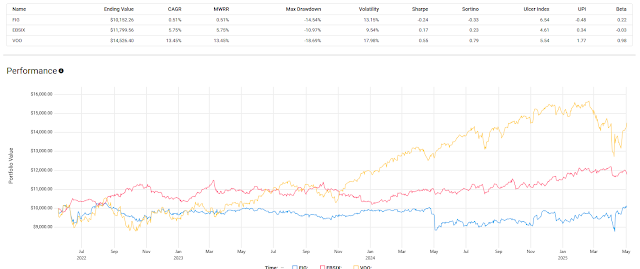
We've looked at FIG a couple of times before. It's not necessarily that it has done poorly but maybe it just hasn't done anything? 

The chart is helpful. EBSIX is a fund we use occasionally for blogging purposes and is in the macro realm. The FIG literature talks about it seeking a differentiated return stream. Eye of the beholder whether FIG has been differentiated enough to be helpful but it is much easier to make out EBSIX as being differentiated a meaningful amount of the time. The idea is not to keep up with equities, equities are the thing that goes up the most, most of the time so a differentiator like macro shouldn't be expected to keep up with equities. FIG only shows $11 million in AUM so maybe that figure and the return profile was enough for them to close it. 

It is fun to look at these types of funds when they come out and to try to track them but as another reiteration, a lot of these funds will turn out to not be very useful. Part of the story here could be that they are too complex. As interesting as these are, they are best used in small doses. A lot of simplicity (plain vanilla stocks) hedged with a little complexity.

The information, analysis and opinions expressed herein reflect our judgment and opinions as of the date of writing and are subject to change at any time without notice. They are not intended to constitute legal, tax, securities or investment advice or a recommended course of action in any given situation.

Monday, May 05, 2025

The Solution To Unreliable Volatility?

 The following from the CEO of Bitwise with a slight modification from me. 


Trying to improve on 60/40 is literally my hobby but the data from Charlie is not a clarion call to add more Bitcoin and crypto. Own a little, sure, why not but the solution to unreliable volatility now embedded in bonds with duration is not an asset class with even more volatility that is even less reliable. 

That brings us to a paper from Alliance Bernstein that looked favorably at portable alpha. As a reminder, portable alpha typically uses leverage to blend together plain vanilla beta with some sort of alpha (alpha being a source of outperformance). The original expression of this was stock picking added on top of indexed exposure which got hurt badly in the Financial Crisis. Lately the conversation as pivoted to using the leverage to add an alternative that might not by itself be an alpha source but when combined with beta does yield outperformance (alpha).

The paper seemed to being saying several different things about how to build a portable alpha strategy. First was " they should seek alpha in less-efficient and less-exploited market segments—such as small-cap and EM equities—where the opportunity is richer," which is obviously equity beta like they did in the financial crisis. But then "our research suggests that long/short equity strategies can be a strong alpha source, with many hedge funds outperforming even the best long-only managers." There was also talk of market neutral so the conclusion while clearly in favor or portable alpha, I don't know what they think was the best way to build it.

I wanted to play around with the long short part of their idea to look at leveraging down, not using any leverage and leveraging up.


Before using ProShares 2x S&P 500 (SSO) I looked at the 20 years one by one versus SPY and in 20 full and partial years, there were only six years, where the dispersion was greater than 1%, only two of which came in the last ten years but one of the two was the widest at 370 basis points favoring SPY. Most specifically, I compared 25% SSO/75% CASHX to 50% SPY/50% CASHX. The two should be the same and you can decide whether that is close enough but it certainly is for blogging purposes. 

The leveraged version of course was the top performer with the trade off being much more volatility and some drawdowns that were much larger than VBAIX. Interestingly the drawdown this year was only slightly worse than VBAIX. 

There are two aspects of portable alpha that are potentially interesting to me which is probably why I spend so much time on it. I have zero interest in leveraging up but the idea of getting essentially the same result while having a bunch of cash set aside, like the leveraged down version, is very effective for managing sequence of return risk. And more of an intellectual curiosity, the idea of getting a disproportionate amount of the return from a narrow slice of the portfolio fascinates me. 

Part of the Alliance Bernstein paper that seemed nonsensical was idea of picking or isolating top quartile managers for the alpha seeking portion of this. It reminded me of the old joke about wanting to get rich, ok so first go get $1 million dollars....their comments implied the exact opposite past returns not ensuring future results. 

This is fun stuff and while I believe my process has been influenced slightly, this is a very difficult path to go all in on.

Since it is sort of related, I want to touch on managed futures very quickly. The space had a great Monday in a down tape. I'm not claiming victory with that statement because this may just be one of very few good days this year mixed in with a lot of stinkers but more of a reminder that when managed futures does well, even a small weighting (which is what I have) can have a big impact on the bottom line of the portfolio. It's worth taking the time to play around with the numbers. 

The information, analysis and opinions expressed herein reflect our judgment and opinions as of the date of writing and are subject to change at any time without notice. They are not intended to constitute legal, tax, securities or investment advice or a recommended course of action in any given situation.

Sunday, May 04, 2025

Warren's Wisdom

By now you've heard that Warren Buffett plans to step down at the end of the year. 


We talk frequently about the stock market's ergodicity, the natural inertia to go from the lower left to the upper right despite some bumps along the way. The more someone trades, the more they are fighting that natural inertia other than proper asset allocation targets and mitigating sequence of return risk when relevant. Of course mistakes get made so those need to be corrected and company fundamentals change too for better or worse which may need to be addressed too. 

I try to hold on to companies and the narrower ETFs for very long periods, forever if it works out. I have quite a few names for clients that I've held for more than 15 years.


The names don't matter. The chart captures three ETFs and two common stocks with the Dow 30 in pink (leftover from another chart I was using for something else). The purple line went through a nasty drop in 2022. The best performer has had several nasty declines. I haven't sold through any of those drawdowns. 

Buffet said the last "45 days, 100 days" was nothing in the context of long term investing and holding on to strong companies and included in my chart, narrower ETFs. I don't agree it's been nothing necessarily. For anyone who made a serious behavioral mistake and did meaningful selling in early April, this was something. I can see the dip last August being one that most people forget about but I don't think that will be the case with the Q1 into April 2025 event. 

But, however long this lasts (maybe it's over, no idea), it will be one of those retracements just like the others on the chart that happened on the way to higher prices. When you look back at a chart of some stock that is up a bazillion percent in 20 or 30 years and think I wish I woulda, chances are that 20 or 30 years included at least a couple of eye-watering declines. 

There are countless, valid approaches to portfolio management but if you pick the right stock or niche, the fundamentals don't unravel and it continues to do what you'd expect it to do, why would you get out of the position? Maybe you trim a little for risk management but that is different than getting out completely. 

Pivot to Rick Rieder from Blackrock being interviewed by Barron's. Several of his comments echoed the conversation we've been having here for a long time. I don't know whether these have been long held by Rieder or recent opinion changes. 

People used to view bonds, particularly long-end interest rates, as the ballast for and protection engine in a portfolio. Then we lived through almost a full decade of things like negative interest rates in Europe and Japan and zero interest rates in the U.S. Now, though, people are rethinking their fixed-income allocation. They can get 6% or 7% yields in quality assets, without having to go out on the yield curve. That can serve as a great stabilizer in a portfolio.

I don't know why an individual investor would want the volatility associated with the long end of the bond market without some serious compensation above prevailing money market yields. Eighty basis points is nowhere near enough compensation.

I just don’t think being a hero in fixed income makes a lot of sense. My view is: diversify. I call it, “Make a little bit of money a lot of times.”

Diversify into different income market segments to avoid being done in by some random malfunction somewhere in markets. The Financial Crisis broke the commercial paper market and a product called auction rate securities. Commercial paper came back but auction rate securities did not. Getting caught with 5% in the next auction rate securities, if something like that ever happens again, would suck but would not be ruinous as opposed to maybe 20% in a segment like that. 

The information, analysis and opinions expressed herein reflect our judgment and opinions as of the date of writing and are subject to change at any time without notice. They are not intended to constitute legal, tax, securities or investment advice or a recommended course of action in any given situation.

Saturday, May 03, 2025

Stagflation Is Coming. All-Weather?

You've probably heard or read predictions calling for a lost decade. Barron's just this weekend talked about lower returns coming. Torsten Slok from Apollo says that stagflation is coming. Will we have a lost decade? Is Slok correct about stagflation?


I have no idea whether stagflation is coming but as usual, I am more interested in if he is right, then what? Slok tells us that stocks should go down and rates should go up. Interest rates going up doesn't worry me from a portfolio perspective, I pretty much don't have any interest rate risk in the portfolio. If something somehow broke or malfunctioned though, there could be unexpected fallout in some random income market niche. That's not a prediction, more like a reiteration to diversify across many fixed income or bond proxy segments in case something crazy does happen in one pocket. If longer bonds went way up in yield, that would be something to consider, 7% for ten years is a lot more interesting than 4.4%.

What about equities going down? Over the last couple of days, I've seen a lot of opinions expressed implying the market event is over and that people worried and panicked for nothing. Panic selling is always a bad idea so that's not what I am talking about here but no one knows whether the event is over or not. Woe is me four weeks ago was just as unproductive as gloating that it's over now because no one knows. I've been talking for months about positioning to be less volatile that the market as opposed to wanting to do any meaningful selling. 

Nothing has changed for me on that front at this point but right here, right now, but anyone who felt they got caught wrongfooted a few weeks ago but managed to hold on, maybe now is a time to make changes?


The 7.2% is from the high watermark. Since April 2nd, the S&P 500 is actually up ever so slightly and YTD, the index is down 3.3%. Fortunately, I don't feel wrongfooted from the last month or couple of months or whatever but, looking forward, what if anything should we start to think about for a lost decade or stagflation? 

My first thought is to think about the all-weather attributes of Permanent Portfolio-inspired, quadrant investing. The Permanent Portfolio allocates 25% each to stocks, gold, long bonds and cash. So I don't necessarily mean copying that but maybe taking influence from the idea. If Slok is correct about rates going up, 25% in long bonds implies a lot of pain. 


2022 gives a good test for stagflation as Slok sees it because rates went up and stocks went down. Client and personal holding BLNDX bills itself as an all-weather strategy. Blending it with PRPFX could be interesting, it would only have 12.5% +/- in long bonds so it might be interesting to see if a smaller weighting would be problematic to the bottom line of the portfolio. In 2022, that blend was down 89 basis points so some drag (PRPFX did worse than BLNDX that year) but not problematic. 

Portfolio 3 is sort of close to what we blog about regularly. We had a lost decade from 2000-2009 but there were several years that stocks went up kind of lot. In 2003 the SPY ETF was up 28%, up 10% in 2004 and 15% in 2006 which is why there is a decent weighting to equities. I would expect broad commodities to get a tailwind in a stagflationary environment, they did better than gold in 2022 but maybe gold would be the better choice going forward. In the real world, a portfolio could have both. I threw in convertible arbitrage for being bond like but without interest rate risk. However that's not to say it couldn't be vulnerable to something malfunctioning. Also in the real world, I wouldn't go anywhere near 30% in one alt. 

The backtest is also useful for showing BLNDX finally struggling, it is down this year as equities and managed futures are both down. While there is something intellectually appealing about getting all done with one or two funds, it really is not a great idea. 

The information, analysis and opinions expressed herein reflect our judgment and opinions as of the date of writing and are subject to change at any time without notice. They are not intended to constitute legal, tax, securities or investment advice or a recommended course of action in any given situation.

Friday, May 02, 2025

Shots Fired In The Portable Alpha ETF Space

Anytime I've ever made a joke about an ETF going to eleven or melting my computer, well this new one really does go to eleven. The Defiance Leveraged Long + Income MSTR ETF (MST) checks a lot of buzz word boxes. It targets 150-200% exposure to Microstrategy and sells weekly call spreads for income. The literature talks about the fund also being a play on Bitcoin. 

Long time listener, first time caller, I own Microstrategy, REX Bitcoin Corporate Treasury Convertible Bond ETF, two different Bitcoin ETFs and I just bought MST for a little income. Am I diversified?

Shots fired in the portable alpha ETF space.....I might be overreacting. The ReturnStacked ETFs invoke a strategy called portable alpha which as we have discussed before, uses leverage to combine beta (plain vanilla exposure like an equity index) with alpha which these days typically means some sort of alternative strategy. 

Harbor Capital, fairly new to the ETF space I believe, filed for an Alpha Layering fund which will leverage up stocks and managed futures to offer 75% to each, 150% overall. The proper name will be Harbor Alpha Layering ETF with the proposed symbol being HOLD. I could swear there was a cash proxy ETF at one point with that same symbol but either way. 

Speaking of which, the ReturnStacked guys have another paper out in support of their funds. I would encourage giving it a read. I've been very skeptical of course but there is always plenty to learn or study. The title of the paper is "Finding The Right Match." I put together a portfolio using a variation on their idea to try to find a different match. 


The way Microsoft is added in, I am replicating 5% in MSFL which is a 2x long Microsoft ETF with a short track record. I picked Microsoft for being growthy but without crazy-CEO risk. Portfolio 2 leverages up Microsoft the same way and the S&P 500 with a small exposure to SSO. 

Where portable alpha funds might use S&P 500 futures, there can be friction embedded in the futures pricing based on interest rates. I've seen theories that a similar thing can also impact SSO. I'm not entirely sure but where the futures might be a little off from perfect tracking so too might SSO so if you're willing to own futures then you might be willing to own a little SSO too. Portfolio 3 is intended to be the same as Portfolio 2 but without leverage. 


The unleveraged version does lag the two leveraged versions but with less volatility. Also, the unleveraged version outperformed VBAIX by 169 basis points with less volatility while leveraged versions clearly did better but with more volatility. Not surprisingly, the unleveraged version consistently had small drawdowns. 

I will be curious to see how the Alpha Layering fund does. It should land in the middle of RSST and client/personal holding BLNDX but we'll see. For now though, I just can get there with the leverage. 

The information, analysis and opinions expressed herein reflect our judgment and opinions as of the date of writing and are subject to change at any time without notice. They are not intended to constitute legal, tax, securities or investment advice or a recommended course of action in any given situation.

Thursday, May 01, 2025

Stocks Should Not Be Going Up!

But they are. For the last eight sessions anyway.

In a recent post, I asked if it was over making it crystal clear that I had no idea and I still have no idea. There is always a working list of pros and cons to weigh out in trying to assess risk. No matter how bad things may appear there are always at least a few positives. Sometimes though, markets go up for no reason at all. 


Microsoft did a lot of the heavy lifting on Thursday as I think this table captures. SPXT is the S&P 500 excluding technology. The Invesco S&P 500 Equal Weight ETF (RSP) was down 14 basis points today. 

I had a quick phone call with one of the higher ups at my firm today and he asked if I had any opinion about what was going to happen with all the current drama underway. He probably didn't love my answer but I told him that I don't know and that I happy being less volatile than the market and felt fortunate that the expectation I had set (being less volatile) was playing out as intended. 

My hunch is that this is nowhere close to being over but client outcomes are not relying on that hunch being correct. Mark Mobius made the rounds on Bloomberg earlier in the week for sharing that his fund is 95% in cash. Figuring out when to get back in from that sort of cash position will be very difficult to get right especially if there is no sort of woosh down. Down 30% from the high would bail out someone sitting on 95% cash, that would be buying low even if it goes lower. 

If from here, the market rocketed higher, then what does he do? What if it jumped 10%, he got back in and then it fell 30% and then traded sideways? There is no reason for any of us to try to thread that sort of needle.


The chart is the S&P 500 going back 40 years. Other than having the proper asset allocation and addressing sequence of return risk when relevant, I would not want to get too aggressive, like selling 95% of my stocks, trying to fight that inertia.

BTAL and SH make up just mid-single digits of the portfolio. Gold and CBOE which have chipped in with defensive attributes also combine to mid-single digits but CBOE clearly has equity beta and managed futures, also a small weighting, simply isn't helping during this event. Yes I sold one stock six months ago, Nike, but my typical approach is to try to avoid selling a lot of stock as opposed to trying to offset the declines with holdings that should go up. BTAL, SH and the others should go up but they may not always work (SH as an exception). Managed futures has done fantastically well in previous events but clearly not this one. 

To the extent you even believe in any of this, a little goes a long way. If you don't believe in any sort of volatility management, the 31000% gain in the above chart supports your belief. 

The information, analysis and opinions expressed herein reflect our judgment and opinions as of the date of writing and are subject to change at any time without notice. They are not intended to constitute legal, tax, securities or investment advice or a recommended course of action in any given situation.

Wednesday, April 30, 2025

A Long Runway To A Successful Retirement

Christine Benz wrote 4 Key Decisions for Early Retirement.

  • Will you continue to work?
  • What lifestyle changes do you plan to make?
  • How flexible are you willing to be with your spending?
  • How do you feel about lifetime spending versus leaving a bequest?

Really though, the word early could be removed from the title of her article because they are relevant questions for any retirement age. These are not the only decisions obviously but I agree they are important to sort out for yourself now at 50 or 60 or whatever but then also to be cognizant of any changes later in what you believe you want to do. 

Maybe you've always thought you'd take Social Security at 62 but then you hit 60 or so and view it differently. Or maybe you always thought that you'd "hard stop" any work at all but then take a different view of the finality of never working again. 

There's no single right path or template for retiring. I believe the questions/decisions can be common like putting in a little work to understand Social Security and then pick when you think is best for you to take it or assessing whether you want to live somewhere else or maybe downsize close to home. With Social Security I try to be consistent in not saying everyone should wait or everyone should take it early. I share my thought process for my wanting to wait, my wife is 6 years younger so she would get a larger survivor payout if I die young but I would encourage her to take it as soon as I do (64 years and two months for her). 

Will you continue to work is a question to ask or maybe a better one is what will you do with your time. Maybe you will work, maybe you'll volunteer, do hobbies, hopefully you'd want to do something but I realize not everyone does. 

I've been big on cultivating income streams like from monetizing hobbies, monetizing volunteer work or some sort of post-retirement career that is more aligned with your interests. This sort of path provides purpose and relieves some of the burden off of the portfolio which can help with Christine's third question about flexibility. The less reliant a retirement plan is on an investment portfolio, the less need there is for flexibility. 

All the articles about the 4% rule and whether it can be nudged higher or not, presume that the majority expenses will be covered by taking 4% from the portfolio. Four percent is of course very reliable but not infallible. I might be the only one who has ever said this and it has been a while, but I don't believe the 4% rule is just about taking 4% in perpetuity. Part of it is sustainability in the face of the occasional, expensive thing that comes along. I don't mean an annual vacation or tires for the car but more like a new roof or some other once (hopefully) in a lifetime expense. I'm saying the 4% rule is about paying for that big thing but still maintaining the same regular withdrawal rate. I say that because the math in most simulations and with several IRL clients, is they die with a lot of money leftover. 

A retirement plan that starts out with $600,000 right before a 30% decline in the broad market that then coincides with a $100,000 catastrophe might never recover. This is exactly why I've been preaching for so long about playing a long game to cultivate income streams to build up some resiliency for a retirement that starts out with some insanely bad luck. 

I've been cultivating incident management work (fire related) for a while and have worked on a couple of large incidents but I had to change this up. I have a little more going on with my day job (a positive development) so being away on a fire, despite access to the internet all day, doesn't make a lot of sense. The team for which I have been an alternate on said they will still call me when they get assigned to a fire local to the Prescott area which was the end goal and which I will still pursue. When something happens locally, I would like to be able to help, I don't want to be away from home for four months going from incident to incident which some of the guys do. One full two week assignment (close to home) would pay about $14,000 which relative to our annual spending needs would be a lot of money if I was somehow not otherwise working. Something that pays $14,000 like that would be the equivalent of having another $350,000 in the portfolio ($14,000 is 4% of $350,000).

The other one I've been cultivating for a much shorter time is having been a research volunteer for the Del E Webb Foundation. Early on with this, I said there was a chance to become a board member which is a paid position and I have been invited to do so and I said yes. It will pay a little more than what I spelled out above for incident management work. Relative to our spending needs, this would be a lot of money if I was somehow not otherwise working. The difference between volunteer and board member is about an hour a week and having a vote on who gets awarded funding. 

I should note that this opportunity came about from people who know me from volunteering with the fire department. I do believe I really have cultivated these opportunities which is why I write about this path so much, play the long game, it can work. 

Neither income stream is a lot of money by themselves but would be meaningful in the context of a $100,000 lifestyle (we don't spend anywhere near that much) that relies heavily on an investment portfolio. 

We don't spend a lot of time here on having money leftover to bequeath to kids or grandkids. This is a high priority for some people and zero priority to others. But along these lines I recently talked about small inheritances covering the tax on Roth IRA conversions. Are you likely to inherit any money? Counting on an inheritance might be risky but a little bit of planning in case you get one makes sense. There may be the intention, but sometimes life gets in the way. End of life care, assisted living and other types, can obviously be very expensive and you don't know whether you'll need it until you need it. I can't stress enough what a bad idea I think it is to count on an inheritance. 

The more time put in to planning retirement, the better the odds that retirement is successful in whatever manner you define success. 

The information, analysis and opinions expressed herein reflect our judgment and opinions as of the date of writing and are subject to change at any time without notice. They are not intended to constitute legal, tax, securities or investment advice or a recommended course of action in any given situation. 

Tuesday, April 29, 2025

Just Don't With The Defined Outcome Funds

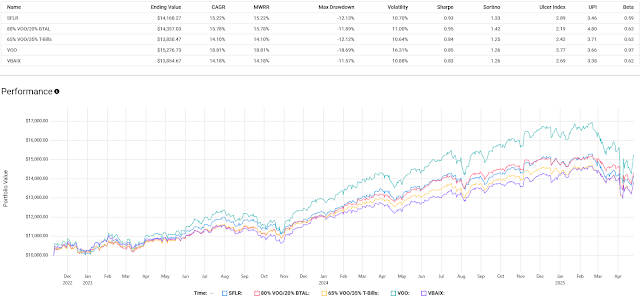
I received an email to my work account promoting the Innovator Equity Managed Floor ETF (SLFR). It's a defined outcome fund that uses collars, an option strategy that sells calls and buys puts, that charges 0.89%. The fact sheet lists the beta at 0.71 and the standard deviation at 10.18% versus 1.00 and 14.04 respectively for the the S&P 500.

A common criticism to these funds and one that I believe in and have written about is that whatever you're trying to achieve with one of these funds you can get the same effect cheaper and simpler a different way. I put that to the test as follows.


First, for the cheaper part. 80% VOO/20% client and personal holding BTAL would cost 55.6 bp, 65% VOO/35% BIL would cost 68.5 bp, VOO is 3 bp and VBAIX costs 6 basis points. For VOO plus BIL you could just leave the 35% in cash or maybe a cheaper T-Bill ETF but I went with BIL because we frequently use that one for blogging purposes.

The two models I built get pretty close to what SFLR is trying to do in terms of beta and standard deviation and the returns are not that far off. And all three of them are close to VBAIX by those measures. 


There's not a ton of differentiation between the two models and SFLR in the year by year numbers although this year, 80% VOO/20% BTAL is about 100 basis points better than SFLR but VBAIX has done the best this year. 

Just own less equities was the conclusion from an AQR paper a few weeks ago. All of the ideas above have drawbacks. SFLR will cap the upside based on the strike prices of the calls sold. There can be no assurance that the VOO/BTAL combo will work every time but it has been pretty reliable. IRL, I wouldn't go anywhere close to 20% in BTAL. If equities rip, then 35% to T-bills would cause the 65% in VOO to lag. 100% VOO will at times be a very difficult ride. Anytime bonds do poorly, VBAIX will do poorly too. 

I can understand the argument that the defined outcome funds are convenient for doing the work for you so if that is high enough on the priority list then use them but zooming out just a little from the argument above, defined outcome funds fight against the market's natural inertia, its ergodicity, to move from the lower left to the upper right. 

The information, analysis and opinions expressed herein reflect our judgment and opinions as of the date of writing and are subject to change at any time without notice. They are not intended to constitute legal, tax, securities or investment advice or a recommended course of action in any given situation. 

Monday, April 28, 2025

Step 2: Fix It

Bloomberg TV on HULU doesn't have regular commercials. During commercial breaks they show short clips from recent interviews and from recent panel discussions (like at conferences). There was one this morning from some conference where a woman said the only way to solve the retirement gap is through public/private partnership. I might be paraphrasing but you get the idea. 

If she is correct, it's from a top down context whereby somehow they need to fix the system. 


She may very will be correct but how long has there been a problem and it still hasn't been fixed. However long you believe it has been a problem and it hasn't been fixed, you are that many years older. It seems like this has been an issue forever. We're all 20 years older or 30 years older, whatever but it still hasn't been fixed. Arguably retirement readiness has gotten much worse. 

This will be a short post to reiterate a point from before. I think it is a mistake to expect them to fix it whether the it in question is retirement, healthcare or anything else. 

If someone is relying on nothing but Social Security for retirement, even if the dollars they are entitled to can work, what if something crazy happening with SS? Something crazy at this point shouldn't be completely dismissed. If someone is relying on Wegovy or Mounjaro to solve any and all health issues, even if the meds work, what if something crazy happens with pricing or access? Something crazy at this point shouldn't be completely dismissed, repeated for emphasis.

If they ever get to work trying to fix any of the problems you think we face, what is your best hope for an outcome? What are the odds that whatever they come up will actually make it better?

Maybe I am too cynical but I don't expect them to fix anything, I certainly wouldn't rely on anything getting fixed. 

Anything we might do to prevent or solve our own problem may work or may come up short but if nothing else there is virtue in the effort although despite how this post reads, I am very optimistic about people solving their own problems when they put in the work. 

The information, analysis and opinions expressed herein reflect our judgment and opinions as of the date of writing and are subject to change at any time without notice. They are not intended to constitute legal, tax, securities or investment advice or a recommended course of action in any given situation.

Sunday, April 27, 2025

"Why Own Bonds?"

Wells Fargo put out a report titled Why Own Bonds? From the title, I guessed it was going to confirm my biases about bonds (with duration) and talk about avoiding bonds (with duration). No sir. I took the report as actually being pro-bonds (with duration, I'll stop including that from here but that is what I mean going forward, with duration).

Some of the points made in supporting their argument are worth exploring. 

In fact, in a relatively elevated interest rate environment, a well diversified bond portfolio may provide positive returns. 

Great news! Returns might actually be positive! There's obviously some CYA in that one but it's not exactly a ringing endorsement for bonds. 

We think over the next several years fixed income investors should anticipate a return that is near or slightly below the longer term historical average fixed income return.

Um ok, I mean who wouldn't want that? 

From March 9, 2009 through December 31, 2019 equities were up more than 498% and bonds returned 54% while cash alternatives realized little return.
Earlier in the piece they talked about rates having gone up and later they touch on the yield curve so yes, of course cash alternatives had very low returns. 

Do you want to increase your concentration in an asset class that historically exhibits great volatility in the search for return.

That was the last one. Their analysis is obviously very binary, there can only be bonds in their world to diversify equities. A quick comparison;


I didn't even use something very long dated as the example for what not to use. AGG's duration isn't that long. The struggles for AGG have been prolonged of course but it is also important to mention that MERIX, SRLN and ARBIX all got hit hard in the 2020 Pandemic Crash so they are not infallible but the snap back was quick and the hit was no where close to that of equities. I excluded it for being a shock caused from outside the world of capital markets and economics. MERIX is a client and personal holding.

My long time thesis of course has been that bonds no longer function as reliable diversifiers, they've instead become a source of unreliable volatility. Looking back at long data sets doesn't make sense if the diversification characteristics have indeed changed. We now understand how volatile bonds can be. Wells Fargo is apparently ok with that volatility but the question is, are you ok with it? We explore plenty of ways to get the effect that people hope to get from bonds without the volatility that now goes with owning bonds.

The information, analysis and opinions expressed herein reflect our judgment and opinions as of the date of writing and are subject to change at any time without notice. They are not intended to constitute legal, tax, securities or investment advice or a recommended course of action in any given situation.

Saturday, April 26, 2025

The Importance Of Going Down Less

Quick hit Saturday.

Matthew Tuttle made an interesting comment on Twitter about liking to use put options on the ARK Innovation Fund (ARKK) for hedging purposes. There is an inverse ARKK ETF that trades with symbol SARK. Can SARK play a role in volatility management in a way that is similar to ProShares Inverse S&P 500 (SH) or any of the other inverse, broad index funds? SH is a client holding. 

And the year by year;


Tuttle is onto something here. SARK has benefited of course from a really dreadful and prolonged run for ARKK. Of course the reason anyone cares about ARKK is how fantastically well it did for about a four year run starting in early 2017. The risk to using SARK would be that the underlying ARKK once again rips higher like it once did, even worse if that potential rip higher occurred during a serious drawdown for the overall market. 

Barron's wrote about the impact on Federal workers from the current job cuts that appear to be happening. The context of the article was in terms of people in their late 50's, into their 60's possibly having their hands forced into retirement.

A couple of interesting points were made but I wanted to touch on the following. Craig Copeland from EBRI is quoted as saying “Once you get into your late 50s, early 60s, it’s really hard to get another job, and certainly a comparable job.” 

While that isn't a new idea to the conversation we have here, it is yet another call prioritize resiliency and optionality. I think the easiest path to resiliency is living below your means so you can maintain a high savings rate. A relatively simple path to optionality is having varied interests that could be cultivated into income opportunities if ever needed. The way these ideas marry together is that the high savings rate lets people off the hook when as Copeland says, they can't get a comparable job which I take to mean a comparable income. 


Friday night, my wife and I went to Whiskey Off Road which is an annual pro mountain bike event here. There are mountain bike races on Saturday and Sunday and Friday night there is the men's and women's criterium that the pros ride in through the downtown. 

I ran into a buddy who I worked with 30 years ago. We keep in touch on Facebook, he works at a large investment advisory but I am not clear on what he does other than he is up the management chain somewhere and may play a role with investment strategy. 

We chatted for about 10 or 15 minutes and he shared his concerns about what is going on right now, the extent to which external factors appear to be influencing capital markets and a little about what the firm is suggesting its advisors do. 

I didn't really respond so much as acknowledge what he was saying. They may turn out to be totally correct about this getting much worse. It wasn't clear to me what they had done in portfolios but I think the thesis involved making predictions. Again, they could be completely correct but I don't know and that is the point. As opposed to embedding predictions into the process and overly relying on being right, I think it is much simpler to continually assess where the risks lie and hopefully mitigate those risks early on. Maybe those risks will have consequences or maybe they won't but client outcomes aren't driven by getting predictions correct. This a bit of process I take from John Hussman, weighing out the risks. 

Most of the following are repeats but I bought SH for clients right before the election, expecting Harris to win and thinking there would be some sort of J6 repeat but then decided to hold on to it. Right after the election I sold Nike which I'd held for 17 or 18 years believing the company was the most vulnerable to tariffs in the portfolio. A few weeks ago I sold BKLN in case this correction/bear turned into a credit event. BKLN wasn't the only source of credit risk that clients owned but removing the fund significantly reduced the credit risk they were exposed to. 

None of these trades were a reaction to price declines. None of the trades when placed had any sort of immediate impact on the portfolio and for now, the BKLN sale hasn't proved out as being needed and if there is no credit event that comes from this, that sale would have been unnecessary. Necessary or unnecessary, there's no way to know at this point. I perceived the risk of a credit event had escalated and so I wanted to mitigate that consequence before it mattered.

I believe this approach takes some of the emotion out of the process and better facilitates going down less when markets go down which I think is vital component to long term portfolio success.

The information, analysis and opinions expressed herein reflect our judgment and opinions as of the date of writing and are subject to change at any time without notice. They are not intended to constitute legal, tax, securities or investment advice or a recommended course of action in any given situation.

Thursday, April 24, 2025

Interesting Use Of Someone Else's Strategy

Late Wednesday I sat in on a finance committee meeting for the animal rescue where my wife has been active for 20 years and has been the president for an extended period. They have a piece of money managed by a local advisor who came to gave a presentation about maybe changing the investment policy. I can't be the one to manage it for several reasons that all make sense to me. I said no to managing it five years ago before they really understood why it shouldn't be me, even for free.

Without going into too much detail, it was a bad meeting. All I'll say is stop loss orders and buffer funds but not really buffer funds, more like structured products that do essentially the same thing but which I assume are more expensive than an ETF. 

But we can have some fun with their asset allocation idea. I disagree with their opinions about what to own but the allocation is interesting. They proposed a strategy with three "buckets," short term, medium term at 3-5 years which would be "conservative-moderate" and long term/aggressive which they peg at 5-10 years. The respective weightings proposed were 15%, 44% and 41% (rounded numbers). 

Using funds we often use for blogging purposes, I built out the following for each bucket;


They didn't get specific about what funds would be included with the structured products. To be clear, the above are funds I chose to build their allocation. Then blending them altogether in the "Whole Thing;"

In real life, the short term bucket would have individual issues; T-Bills and the like. When blended altogether, the weightings aren't so big that I think the risk is undue. MERIX, BTAL and USFR are in my ownership universe. And the result;


The line for short term makes sense, that should be a cash proxy. In addition to T-Bills, having some of it in an equivalent to SWVXX at Schwab or SPAXX at Fidelity would be appropriate for immediate liquidity needs but the result would probably be identical. The medium term bucket has a higher CAGR than the long term bucket but that is probably misleading due to the medium term sleeve being up 1.51% in 2022 versus a 5.36% decline for the long term bucket. 

The backtest is also skewed negatively from the weighting to ACWX. If you don't already have foreign, I think it is a good time to add some but looking back, ACWX has trailed the S&P 500 by almost 700 basis points annually. 

I don't believe it makes sense to count on the result of the medium term bucket to be as good going forward. I think expectations regarding volatility, correlation and how the holdings might all interact can stand up but that doesn't mean the growth rate will be as good. I threw in BALT because the advisors are really big on the defined outcome strategy.

The information, analysis and opinions expressed herein reflect our judgment and opinions as of the date of writing and are subject to change at any time without notice. They are not intended to constitute legal, tax, securities or investment advice or a recommended course of action in any given situation.

Wednesday, April 23, 2025

New ETFs That Go To Eleven

Defiance ETFs filed for an ETF based on Microstrategy that will sell short a 2x levered long ETF and a 2x levered inverse ETF in roughly equal proportions, so it will sell short MSTX (or the other one) and SMST so it is not a directional bet on which way the common will go, it is a bet that the erosion of both funds will yield a profitable result when sold short. It is trying to capture what is referred to as volatility drag.

Rob Arnott said on Bloomberg a few weeks ago that he does this trade in some sort of personal, fun account. Here's a blog post from Elm Wealth that dives deeper into the idea. Elm mentioned that David Einhorn has done a different version of that trade, hedging it with a long position in the underlying common. 

So can this strategy come out with some sort of short volatility or relative value result that someone might want? I backtested the Defiance idea and the Einhorn adaptation for both Microstrategy and Nvidia. 


Elm worked through an example where the Defiance idea should go to zero and that is what happened with Portfolio 2 which is 50% short the two 2x funds with out hedging with the common stock. Testfol.io did something weird when I removed the MSTR portfolios, it showed the unhedged Nvidia version also going to zero. Fun idea but maybe with someone else's money.

Here's a different one that I probably was skeptical of but it does what it's supposed to. It took a little doing to understand it but...the fund is the Simplify Short Term Treasury Futures Strategy ETF (TUA). It leverages up two year treasuries 5x. If an investor wanted to put 20% into the US Treasury 2 Year Note ETF (UTWO) or just an actual two year note, they should be able to get the same effect putting 4% into TUA leaving the cash to do something else with like maybe some sort of portable alpha strategy.


Portfolios 1 and 2 should be identical and they are. Portfolios 3 and 4 are sort of in line with how we've tried to leverage down into a more robust portfolio. Because TUA started in late 2022, we can't backtest in a more difficult stress period.

If someone is really interested in a portable alpha strategy, getting the leverage from a fund that just leverages up one asset class, like 2 year treasuries or the S&P 500 is much simpler than blending stocks or bonds and an alternative strategy. There's less that can go wrong.

This probably can work but I'm not sure why anyone would need to do this. If we take TUA out of portfolios 3 and 4 and replace that 6% with BIL, the unlevered T-Bil ETF, the CAGR improved by almost 30 basis points in each portfolio.

Let's close out checking in on the REX Bitcoin Corporate Treasury Convertible Bond ETF (BMAX). I think I mentioned it when they filed but is has been trading since mid-March.


As the name tells you and the chart shows you, it is a proxy to a large degree for Bitcoin. It owns convertible bonds of companies that do the Microstrategy strategy (that's one too many baby's baby~Austin Powers) of issuing convertibles to buy Bitcoin. It seems like more companies will be doing this so there will probably be issues from more companies than the three companies I see in there now (MARA and RIOT in addition to MSTR). It is possible BMAX could pay out some sort of yield, I recall one of the Microstrategy issues having a small coupon but most of them have no yield.

I threw CWB onto the chart which I believe is the oldest convertible bond ETF. Convertibles often have equity beta. That has been the case for any fund I've ever looked at but individual issues from other companies, not the Bitcoin converts, could have less equity beta if they are very far from their conversion price. Individual issues though are probably very difficult to get into for retail sized accounts. 

BMAX looks like a great source of tremendous volatility, as we've talked about before, Microstrategy functions as a leveraged Bitcoin proxy and so far BMAX has been more muted than Microstrategy common stock but more volatile than Bitcoin. 

These things bring out a lot of naysayers but I think they are very useful as teaching tools in terms of how to construct portfolio or more specifically how to make incremental improvements over time. 

The information, analysis and opinions expressed herein reflect our judgment and opinions as of the date of writing and are subject to change at any time without notice. They are not intended to constitute legal, tax, securities or investment advice or a recommended course of action in any given situation.

Tuesday, April 22, 2025

Revisiting Roths

With tax day having just passed, there's been a good bit of Roth IRA-related content floating around. It's probably common knowledge how they work in terms of contributions being after tax and withdrawals being tax free and that assets in traditional IRA assets can be converted into Roth assets but you have to pay the tax to do conversions. Beyond those basics, there's a whole lot of nuance as well as subjective or mental accounting. 

I've never been a huge fan of Roth conversions. The basic building block is that if your income is likely to be so much higher when you retire that it would push you into a higher tax bracket then converting to a Roth to avoid RMDs at that higher bracket makes sense. What is the likelihood that your income will be much higher after you retire? Unless my wife or I invent something or Bitcoin goes to $20 million, there's no reasonable scenario where our income goes up that much, paying tax now to do a conversion would not make sense for us. 

How much is your Social Security scheduled to be? Ours would be $70,000 +/- in today's dollars. How big is your 401k likely to be? If you're 55 or 60 and still contributing a lot, your balance would probably more than double from here to age 75 if you need to start taking from it sooner. It probably would not triple, but it could. Will your 401k-rolledover-into-an-IRA be as large as $2.5 million? I'm pretty sure mine will not. At that level though, RMDs would run a little under $100,000 for a few years. At $1.5 million, you'd be just under $60,000 for the first few years. 

Are you likely to have any other sources of income? I expect that by the time I'm mid-70's and need to think about RMDs, our rental income will go down, maybe from switching to long term renters. It would be less week to week work and whatever work there would be could be outsourced if we were so inclined. This would lower the rental income by 1/3-1/2. Will you have any earned income? I've said many times that I plan to still be active in my day job but there are some inevitabilities with regard to the age of most of my clients. I'd say about 1/4 of my clients, maybe a few more, are either just a little older than me or a little younger.

In today's dollars, the 22% tax bracket tops out at $206,700 and then the 24% bracket tops out at $394,600. A quick reminder, if your taxable income (not your gross, your taxable) is $210,700, you'd only pay 24% on that last $4000. You'd be paying an extra $80 in income tax above the 22% rate. And of course your effective rate would be lower than 22% or 24%. Based on the 2025 table, the first $23,850 after the $30000 standard deduction pays 10% (this is all married filing jointly), between $23,851 and $96,950 pays 12% and so on. 

If you are firmly in the 22% bracket right now and convert $20,000, assuming that $20k wouldn't push you up to 24%, you'd pay an extra $4400 in taxes now. Unconverted, how much is that $20,000 likely to grow into and then what would 4% of that be for your RMD in your 70's and then inching up from there? Would this $20,000 triple over 20 years? Maybe, but even if it quadrupled to $80,000, the RMD would start at less than $3200. So pay $4400 now or $3200 in 20 years?

Clearly, converting at a very low effective tax rate makes plenty of sense. A simple scenario we've looked at before is someone who is 65, not working and not yet taking Social Security. In that scenario, a calculator from Equitable says the effective tax rate for $100,000 would be about 8%. Converting at that makes sense to me. Doing that five times before taking Social Security at 70 (if that's what you plan to do) would take a pretty good chunk out of most traditional IRA accounts, greatly reducing RMDs.

Part of the argument in favor of conversions comes from people like Ed Slott who believes tax rates have to go up because of our fiscal problems. He may be correct about what should happen but how likely is that to actually happen? If the TCJA cuts do sunset this year, the 22% and 24% brackets would revert to 25% and 28%. That would require some more number crunching and if somehow that would make it more compelling to convert, then by all means but how much would you "save" squeezing in a conversion this year?  

There are plenty of scenarios where people will have higher incomes when they retire but that is not the majority. Crunch the numbers and do some reading. Based on what I know at this point about my particulars, it won't make sense to convert any assets. 

It does make sense to make some contributions into Roth accounts along the way. I have about 20% of my retirement assets in a Roth. I've told this story 100 times but a client wanted to buy a new truck a few years ago for $40,000 and only had a traditional IRA. Because he took from that IRA, his $40,000 truck cost $50,000, the truck plus the taxes. If he had a Roth, his $40,000 truck would have cost $40,000.

If you think of RMDs as being like income, we've been paying tax on our income our entire lives. As a form of mental accounting, maybe that makes it easier to pay tax on that piece of money. It would be nice to not have to pay income tax to complete a large purchase like my client's truck.

One closing thought that I've never seen discussed anywhere and I've never thought about, but are you likely to inherit IRA assets from a parent? The ten year rule for taking it out is finally being enforced. You have to take it out in ten years. Taking it all in year ten is probably not a great idea for someone who is still working and assuming it's a bigger amount. I could see where it would make sense to use inherited IRA money to pay the tax on a series of Roth conversions. 

Someone in the 22% bracket inherits $100,000 IRA from a parent. They take $20,000/yr, provided that doesn't kick them to a higher bracket, they withhold 22% which leaves them $15,600. That could cover the tax on a $70,000 conversion, again assuming the $70,000 doesn't kick them into a higher bracket and of course maybe between 22% up to 24% on the last few dollars doesn't matter to them? Doing this five times would reduce the amount subject to RMDs by a big chunk. There's also the assumption that this person can view the inherited IRA as found money that they don't need for their financial plan to work. 

Again, I've never thought about that before but it's interesting. As with anything in this post, confirm with an accountant, I think I'm just asking the right questions. 

The information, analysis and opinions expressed herein reflect our judgment and opinions as of the date of writing and are subject to change at any time without notice. They are not intended to constitute legal, tax, securities or investment advice or a recommended course of action in any given situation.

Monday, April 21, 2025

Did Anyone Get The License Plate...?

It makes no sense that a sitting President would want the stock market to go down but I'm not sure how to reconcile the rhetoric that appears to have been driving markets lower. At one point, the focus was the yield on the ten year US treasury and sure enough the yield was drifting lower alright but in a little over two weeks, the yield ran from 4.00% up to 4.40% at Monday's close which is a big move.

In my quarterly letter to clients, I called this environment unanalyzable. I don't think there is a precedent for all the things that markets are trying to figure all at once including huge blanket tariffs, geopolitical hostility and now this business with Jerome Powell along with whatever else I'm forgetting. 

Thus far, there has not been the whoosh down, I mean a true panic inducing decline that would have me get less defensive. This is something I wrote about a couple of weeks ago, that I was ready if it happened but it didn't. People were terrified in the GFC and the Pandemic Crash but I don't believe people are terrified now which makes sense with S&P 500 down in the mid-teens. 

We've been having the same conversation here for months about wanting to be less volatile than the market or put differently, being defensively positioned. 

There is no way to know when the current event will end. If the bottom was today and we start to go back up then I won't have bought the dip but the risk of down a lot is still present because we haven't yet gone down a lot. A 16% drop is not nothing but we've all been through much worse. 

Down 25 or 30% certainly constitutes being down a lot regardless of where the bottom the gets put it. Buying low is very likely to work out very well the vast majority of the time and has nothing to do with timing the bottom. 

That's worth trying to remember while we're still sort of in limbo, between down a little and down a lot. Buying panic, we're not there at this point, is very difficult but if you've done it even one time it should hopefully be a little less difficult. 

The information, analysis and opinions expressed herein reflect our judgment and opinions as of the date of writing and are subject to change at any time without notice. They are not intended to constitute legal, tax, securities or investment advice or a recommended course of action in any given situation.

Sunday, April 20, 2025

Keeping It Simple Sunday

Here are some fun tidbits from my reading this weekend. 

First was an article about 10 Defensive Funds That Bucked The Tariff Selloff. The author dug pretty deep to fund a couple of the funds including the Forester Value (FVILX/FVALX/FVRLX). The fund goes back to 1999 but only has $4 million in assets and is a one star fund. Keeping the fund open must be a labor of love for the manager and his firm. 

Barron's said the fund was up 12% this year thanks in large part to its position in put options. Testfol.io has it compounding at 2.23% from inception up to the end of 2024. The fund is a non-starter for me but is there anything interesting to learn from their asset allocation? Maybe, maybe not but that is the point, can something in what they do improve our process? 

This approximates their asset allocation, not their holdings, as of year end. There was an "other" category so I rounded up a little.


OK, so not so much. The replication looks exactly like the SPY/AGG combo. In 2022, Forester was up 12.29% while the other two were down mid-teens. In 2008, Forester was up 3.57%. So it's been crisis alpha but apparently struggles the rest of the time. 

S&P Global had a quick writeup about how well low volatility is performing during the current market event and then cited previous adverse events where it has done relatively well to then conclude that just holding that factor over the very long term will outperform as it has done previously. Who is to say whether that conclusion will stand up going forward but this excerpt hits on a key point I started making ages ago regarding avoiding the full brunt of large declines and the math supporting the 75/50 portfolio (capturing 75% of the upside with only 50% of the downside).
Suffering less downside, on average, than the S&P 500, but participating slightly more during rebounds, repeated again and again, has historically led to a widening margin of cumulative outperformance for Low Vol versus The 500 over the last 25 years...
Actually pulling off 75/50 is very difficult but the influence of trying to smooth out the ride over your long term, whether that is just putting it all into a low vol fund and forgetting it or using tools to create a similar effect is doable, I obviously prefer the latter, using tools to create the effect. We've all seen or read about having a portfolio that allows you to sleep at night and this concept is a path to that outcome.

I know I'm probably picking on these guys but here's how RDMIX has done over the last three months. 


Earlier this year the fund changed its strategy to be 50% equities, 50% treasuries and 100% systematic macro. EBSIX is Campbell Systemic Macro and I used AOR for a 60/40 proxy because charting VBAIX on Yahoo is distorted for a capital gain paid out in late March. 


I don't believe anyone is suggesting a 100% allocation to RDMIX but this backtest puts things in context. UTEN is a new ETF for blogging purposes, it's just ten year treasuries, it's new so not that useful for what we usually do here but for a year to date study it fits. 

Testfol.io has RDMIX down about 10.5% versus portfolio 2, which uses their concept, being down about 2.5%. This is a great example of taking bits of process from others to create or improve your own process. The guys running these funds are very smart but the plight of RDMIX appears to be consistent with their other funds. Any sort of fund with the word macro in the name is complicated enough. I have a macro fund in my ownership universe and other that an rough couple of days in the middle of this, I'd say it's done well offsetting the volatility of the simple (equity) exposure in the portfolio. If the macro program in RDMIX is helping, it's hard to see.

Lastly, Man Institute dissected the current malaise of managed futures and compared it to previous market events where it took the strategy time to get moving. The big idea was that the trends take time to establish themselves and then the strategy needs to allocate into those trends. There have been a couple of instances where maybe managed futures got lucky because it didn't the time to readjust, it was already correctly positioned. The conclusion was that investors need to be patient.

I can buy into the need to be patient. I've invested a ton of time into trying to understand the strategy and I have unyielding faith that it can gain its footing if equities continue to do poorly.  However...I say, however, it is infinitely easier to be patient with a mid or low single digit weighting than a 20% weighing. I said I have unyielding faith but ok, what if that is wrong? It's infinitely easier to endure the consequence of being wrong with a mid or low single digit weighting than a 20% weighing. If managed futures "works" in nine out of ten crises, that means it won't work in one out of ten crises (obvious statement) and maybe this is the one it just won't "work." 

The information, analysis and opinions expressed herein reflect our judgment and opinions as of the date of writing and are subject to change at any time without notice. They are not intended to constitute legal, tax, securities or investment advice or a recommended course of action in any given situation.

Saturday, April 19, 2025

A Blogger Looks At 59

The first paragraph to A Blogger Looks At 58, last year.

"The title to this post is a play on words from the Jimmy Buffett song A Pirate Looks At 40. This is an ongoing series that started when I was 40 with the intention of sort of updating the post at milestone birthdays. The point is to track how my views on various things might evolve or change dramatically and to hold myself accountable for any lifestyle opinions/advice I might write about."

And the other posts in the series going back to 2006 when I turned 40.

These have been fun posts over the years. 

The starting point this year is a rough article from the NY Times about Gen-X being obsoleted out of the work force for various reasons. It's long been a real issue for people in their mid-50's to have their hand forced at work and if the Times is correct, Gen-X is not immune. We've looked at this issue quite a few times in the context of long range, I don't know whether to call it financial planning or life planning.

My framework is to think about optionality. At 59, I'm quite a few years beyond starting to reap the benefits of having done favors for my 50 year old, and beyond, self related to living below our means for financial optionality and staying very curious about health matters to expand into understanding the importance of diet in addition to exercise. 

As I think the Times article is pointing out, we can't always see what changes to the industry we each work in might be coming and if we've made any effort to learn more and add to our skillsets, our fields could still evolve around what we've spent time on and leave us behind anyway. Can AI take your job? Be honest with yourself, can AI take your job? Could some sort of robot replace your dentist for example? Yes, even if something like that is a little ways down the road. 

I've told the story about our firm pretty much getting shut down over the course of several months in early 2023 and that I feel fortunate that we had an easy time landing somewhere but it was a path to possibly having my hand forced as noted above. 

I'm a few years beyond the point where I could retire if I had to or wanted to but big fixes or big needed purchases would be uncomfortable which is something I've been saying for a few years in this series. My attitude toward wanting to retire isn't changing, I don't plan to but it might be difficult to attract clients when I am 80 and if somehow the new firm gets in trouble, what then? I realize that last one is the same behavior as worrying about another internet bubble, the bigger point is something happening beyond my control that can't reasonably be predicted, a personal black swan. 

I'm very friendly with the guy who does our taxes and he teased me about being only 6 months away from penalty free IRA withdrawals. I've talked about getting closer to that milestone. If your hand is forced, can you hold out until at least 59 1/12 to avoid the penalty is the question I've asked before. If you can make to 59 1/2, then can you holdout until 62 until Social Security. Remember the context here is that things have really gone sideways. Then beyond 62, can you last until whatever age you want to take Social Security? 

Part of this conversation is whether there are any other income streams. We have our vacation rental income which goes a long way toward covering our regular monthly expenses. If somehow I was out of work, health insurance through the market place would be very cheap which is important to remember in case you ever need that. 

I am still a health enthusiast....or health nut, that's ok. I saw a quote attributed to Donald Trump that the US can no longer produce enough antibiotics to meet our need. I have no idea if that is true or not but I look at it in the same manner I look at a lot of things. Without knowing whether it's true, what if it is? Being sick or otherwise infirm, waiting for someone or something to fix the problem for me is a situation I am very motivated to avoid. I realize there are elements on this beyond our control, but what are the things we can control? We can control inputs and the inputs of lifting weights, cutting carbs/processed foods and (next level) skipping breakfast will prevent/solve countless health problems. 

The outcome here is insulin sensitivity versus insulin resistance, being lean with muscle mass (the odds of getting "too big" from lifting are less than microscopic), no visceral fat and endurance to do a lot. One big difference in my routine over the last year is that I started taking creatine after quite a while learning about it. It has the effect of retaining water in the muscles, increasing the surface space which is what can make you a little stronger. It might be contraindicated with blood pressure medication but there is a good chance that lifting weights and cutting carbs will solve hypertension. A little apple cider vinegar can help with hypertension too. There is no downside to less sugar, more exercise and a tablespoon of ACV mixed into a drink. I take ACV in eight ounces of water a protein powder. 

A final note, turning 59 wasn't difficult. I've only had one difficult birthday, at 25, and I think a big part of it was that I was doing work I did not want to do, cold calling people all day as a stock broker. It was still an important part of my life, paying my dues on the path to where I wanted to end up. The various milestone birthdays like 40 and 50 weren't difficult so hopefully 60 won't be difficult either. 

The information, analysis and opinions expressed herein reflect our judgment and opinions as of the date of writing and are subject to change at any time without notice. They are not intended to constitute legal, tax, securities or investment advice or a recommended course of action in any given situation.
Consequences For Excesses?

Starting out with a quick follow up from yesterday as markets went down a lot again on Friday. Oddly though, the things I follow, more of th...