Sunday, September 22, 2024

How Important Are Bitcoin ETF Options?

No one can know for sure whether Bitcoin is going to solve the world's problems or turn out to be a complete scam but I would suggest anyone to generally keep tabs on it. If you're an advisor, I think you have to be able to discuss it at least a little if a client asks. Many others have said pretty much the same thing as pertains to advisors being to discuss it at least superficially. 

I've only had one client ever ask about it and when he finally asked if I thought he should buy it I gave the same answer that accounts for why I own it which is that after having spent time learning about it, I want to avoid the regret of learning about it and then watching it go to a bazillion without me. I own it via several different vehicles and am up kind of a lot but keenly aware it could all be BS.

This brings us to the latest development that the touts say could be very important. Fair warning that a lot of the Bitcoin evangelists do not engender a sense of trust for me. Jack Mallers from Stripe, one of the biggest evangelists out there, was on Bloomberg earlier in the summer calling $250,000 Bitcoin this year. Just ri-goddamn-diculous. I cringe anytime I hear Michael Saylor say anything. As a skeptical HODLer, dabble if you want but buyer beware. 

The potentially important development is the recent approval for options on the iShares Bitcoin ETF and the expected approval for the other Bitcoin ETFs. Jeff Park from Bitwise had several Tweets on this that anyone who has already invested time to learn about Bitcoin might want to read. I have no idea if Park is drawing the correct conclusions but he notes that Bitcoin has an unusual volatility attribute. Volatility tends to rise as the price rises. It is more common across other asset classes for volatility to go down as the price rises. 

If that dynamic continues to play out going forward, it creates visibility for what are called gamma squeezes. With other assets, when the selling starts and volatility goes up, liquidity providers need to sell more of whatever is going down to neutralize their risk exposure which can add fuel to the downward fire. Park is saying it will work the other way with Bitcoin. Liquidity providers will need to buy more Bitcoin as the price rises to maintain their neutral risk exposure. The bits of jargon here are delta, gamma and vanna if you want to dig in further. This link is to Park's Twitter profile if you want more details as my explanation does simplify it quite a bit. Just to reiterate, I have no idea if Park is drawing the correct conclusion about what this will mean for the price of Bitcoin.

Nate Geraci from the ETF Store also thinks that listing options on Bitcoin ETFs will be a big deal but for a different reason. He listed out that he expects there will be Bitcoin buffer ETFs, crazy high yielding YieldMax-like ETFs (there are a couple related to GBTC and others that already have crazy high yields) as wells at ETFs for Bitcoin risk and Bitcoin convexity. Who knows, I certainly don't (well the YieldMax-like is good bet) but for blogging purposes, I think we're going to have a blast with these.

A quick pivot to managed futures but really we could be talking about several types of alts. In the context of theories about building a 60/40 portfolio with 60% to equities and 40% managed futures instead of fixed income, I saw something somewhere about owning several different managed futures funds to build out the full allocation which in this case is an unrealistic (for me) 40%. 

The idea of four different funds, or some other number, to build out the allocation would help diversify methodologies. It's unlikely that one fund would be long the yen and another fund short the yen but if the 10 month trend says to be long the yen, different funds might have different weightings to the yen based on risk or volatility. It is also possible for one fund relying just on 10 month trend to be long the yen and different fund that relies on multiple signals to be flat the yen like if the 10 month trend says be long while a shorter signal says to be short. In that instance the fund would probably be flat. Playing this example out, the shorter signal turns out to be right and the fund using only the ten month trend would feel the pain of having the wrong yen position while the multi-signal fund would simply avoid it. Enough if these nuanced difference and the funds looks slightly different. 

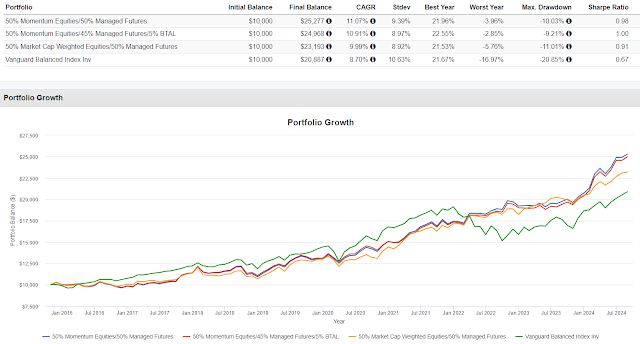
Another accounting for dispersion between funds might be funds that fully implement managed futures versus funds that replicate with just ten or so markets. 


I just chose funds that we blog about regularly and isolated the AQR and PIMCO funds simply because they are bigger fund companies than the others. The result is very surprising. Blending together four different managed futures funds as done in Portfolio 1 actually gave a higher standard deviation and lower Sharpe Ratio. The return of Portfolio 1 is slightly better but the idea is really about trying to diffuse risk which the diversified blend somehow does not do. 

There's probably a reference to Karl Popper to be made with this result but either way it is a surprising outcome. Putting 40% into one alternative strategy, regardless of the number of funds, is not something I am ever going to do but looking back it has never blown up. Managed futures has struggled over different periods, yes, but never blown up. I can't come up with a guess for what would cause managed futures to blow up but paraphrasing a quip we've a few times lately, there is no risk of it blowing up until it blows up. 

The information, analysis and opinions expressed herein reflect our judgment and opinions as of the date of writing and are subject to change at any time without notice. They are not intended to constitute legal, tax, securities or investment advice or a recommended course of action in any given situation.

Saturday, September 21, 2024

Hell Bent On Leverage?

The Stone Ridge ETFs that seek to annuitize income streams via a longevity pool have hit the market. They seem to be complicated and I have yet to dig in but it appears they switched formats from using traditional mutual funds that can't be sold once holders reached 80 to this ETF format that switches to a closed end fund for the distribution phase. Hopefully I can dig in soon but the first iteration, the mutual fund plan, seemed simpler. This might still evolve more, whether with Stone Ridge or competitors but annuitized, not annuities, is something to follow closely. 

Steve Sears' column this week in Barron's is a must read. 

Wall Street wants you to be a short-term event addict. If you are overly focused on daily happenings, you will often be confused, make suboptimal decisions, and likely lose lots of money because you don’t understand how to focus upon, much less find, the path that leads to consistent returns.

He goes on to say 

If you want to be a more successful investor, don’t waste your limited energy and resources on quotidian matters that lead nowhere. Instead, use your time to identify and continually refine enduring guiding principles for your investments. This is important. Investing is a multidimensional strategy game played over decades against people all over the world.

You might see some overlap in what we talk about here, at least I hope you do. The name of this blog, Portfolio Lab, is about the constant refinement of the portfolio process which is very much a "multidimensional strategy game."

Fidelity Institutional started a series of short videos titled The Search For The Next Great Portfolio, episode one was called Is 60/40 Dead? No link from me, I'm sure if it is ok to share given the target audience but you mind find it via Google. The first one was only eight minutes and was very thin but there was one little nugget from Matthew Miskin from John Hancock about whether to pull from equities or fixed income to allocate to alternatives. 

He said it depends on the alternative. We've talked countless times about about merger arbitrage and convertible arbitrage (there are others) being substitutes for fixed income or as we've said here, proxies, that should be pulled from the fixed income allocation. He said that other alts, he specifically said global macro, but again there are others, are closer to being equity-like and should be pulled from the equity allocation. So maybe 60% equities becomes 55% equities and 5% global macro (using his example) and 40% fixed income becomes 35% fixed income and 5% merger arbitrage, again I am using his examples. 

The following graphic is from AQR. Portable Alpha is older jargon that means the same thing as capital efficiency or ReturnStacking, using leverage to add some attribute to the portfolio and in the case of this graphic the attribute is alternative strategies. Adding Portable Alpha is the opposite of the previous paragraph about where to find room to add alternatives, you just leverage on top. 


If Portable Alpha can be done effectively in a fund, then AQR is one who can do it. They essentially are doing some version of it in various funds they manage. Beyond that, I think it is pretty difficult to pull off inside of a fund.


The three portfolios are all similar and I used RDMIX to benchmark since they leverage up about the same as the AQR slide. RDMIX appears to be currently leveraged up 62%. Portfolio 1 has 60% leverage, Portfolio 2 has no leverage inline with how I talk about how to do this as well as inline with Miskin's comments above and Portfolio 3 leverages up just 10% which is a little closer to how I think, still only putting 5% into two different alts, global macro and merger arb like Miskin said.

Portfolio 1 with 60% leverage did outperform by quite a bit with the tradeoff being a higher standard deviation. All three portfolios and RDMIX offered varying degrees of protection in 2022 compared to VBAIX which was down 16.87% that year.

RDMIX did have the lowest drawdown in 2022 but its CAGR is less than half the other portfolios. It's not quite apples to apples as I don't think it has 60% equities very often but it does have 50% so I think it should be closer than it is to the other portfolios. The standard deviation isn't so hot either and the portfolio stats are inferior by a wide margin. A fund that had 3/4 the upside of the others and a much lower standard deviation would be interesting but that's not where RDMIX is. 

As I said at the top of this section, pulling off inside of one fund is pretty hard to do. Even the way I backtested it is not something that would be easy to recreate in a brokerage account, certainly not in an IRA and I am so far removed from the brokerage world that I don't know if mutual funds are marginable. Yes there are plenty of leveraged equity funds and a handful of leveraged bond funds which we've looked at quite a few times for anyone hell bent on doing this. 

Barron's had two different articles, here and here, that made very similar points about bonds with duration surprisingly going down in price (up in yield) after the FOMC announcement on Wednesday. The implication maybe being that bonds were expected to go up in price? If there are more rate cuts coming and if the curve is going to normalize, it's not clear that longer term bond yields are going to go down. They might not go up, I don't know, but the path isn't necessarily down. Based on the Barron's articles, investors are then left trying to guess what to do now. The two articles this week seemed to be cautionary about buying the middle of curve and further out and as one of the comments pointed out, always read the comments, last week Barron's was positive on this slice of the bond market.  

I think the articles make the point that we have been making here repeatedly for ages which is that bond duration has become a source of unreliable volatility and is now far less effective at helping to manage equity volatility. 

The information, analysis and opinions expressed herein reflect our judgment and opinions as of the date of writing and are subject to change at any time without notice. They are not intended to constitute legal, tax, securities or investment advice or a recommended course of action in any given situation.

Wednesday, September 18, 2024

The Need For Portfolio Simplicity

If you've been reading these posts for the last few months or maybe longer, you know how intrigued I am with the concept of ReturnStacking or is it is also known capital efficiency. My interest goes back long before the ReturnStacked ETFs existed and I believe long before the term capital efficiency was common, to Nassim Taleb writing about barbelling returns where most of the risk is allocated to just 10% of a portfolio with the rest in very conservative things like T-bills. Even before that, a story I've told many times, when I was at Fisher Investments in 2002 there were a couple of guys who talked about getting a return equal to the S&P 500 by shorting Nikkei Futures with just 2% of the portfolio and 98% in cash. I don't know if those previous co-workers were correct about that, but it doesn't matter for this blog post it is just an interesting concept.

I've also though, been very skeptical of using the ReturnStacked funds and I still am but you can maybe tell that I've been fumbling around with how to articulate why I am skeptical, at least skeptical of going heavy in them anyway. 

When we talk about allocating a lot to simplicity and hedging with a little complexity, it is important for anyone needing normal stock market growth for their plan to work to have plain equity exposure. Whatever allocation to equities they think they need, most of it should be in very simple, very plain holdings. I am not saying index funds only, there are countless plain exposures ranging from index funds of course to individual stocks and all the narrow based ETFs in between. 

Buying a semiconductor ETF or individual name, may or may not work out but they are both plain vanilla, simple exposures. It just boils down to being right or wrong about the choice, there's no complexity that could potentially malfunction leading to a blow up like with the short VIX products in 2018. 


RSST is stocks and managed futures leveraged up in one fund, RSSY is stocks and carry leveraged up in one fund and SPY is plain S&P 500 exposure. If you wanted a plain vanilla S&P 500 index fund, SPY would be one of many choices. The chart is short because of how new RSSY is but do the two leveraged fund from ReturnStacked track close enough to the S&P 500 to be thought of as equity proxies? There are probably arguments on both sides and I am not saying what you should think. For you, are they close enough? I could envision a prolonged period where the equity exposure in the complex products gets offset by the more complex portion of those funds, the managed futures or carry portion of the respective funds. I think there is the possibility of kneecapping upcapture with heavy allocations to these funds. In 2016, SPY was up 12%, managed futures as measured by EBSIX was down 11% and an RSST replication using the two would have been flat which is what I mean by kneecapping upcapture.


The second chart looks at the ReturnStacked bond funds versus plain vanilla benchmark type funds, AGG and IEF which is 7-10 year treasuries. If you wanted traditional bond benchmark funds in your portfolio, I do not, but for anyone who does, are they close enough? Again that is for the end user but the first impression they are making is to be more volatile than the plain vanilla bond proxies. 

There are ways to make portfolios capitally efficient that go more a long the barbelling risk and volatility into a narrower slice of the portfolio than a full 60% into an index fund as we've looked at several times before. Here is some modeling we did on August 19th.


Looking back, a 26% allocation to Blackstone (BX) with the rest in iShares Treasury Floating Rate ETF (TFLO) had a lower standard deviation than VBAIX with higher returns. Obviously betting on one stock like that won't make a lot of sense but it makes the point. BX was chosen as a proxy for private equity even though it is more of an operating company than a portfolio of private equity investments. Putting 15% each into NOC, XLY and IYW, all of which are client holdings, with the rest in TFLO Had a CAGR 170 bp higher than VBAIX and the standard deviation was 1/3 less than VBAIX. That one is a couple of steps closer to reality in terms of spreading risk more. Consumer Discretionary and Tech both tend to go up more than the S&P 500 on the way up and down more on the way down. 

Regardless of how crazy or interesting you think the above two ideas are, BX, NOC, XLY and IYW are simple stock exposures. Going forward, they will either be good choices or bad choices but there's no leverage to break, there's no complexity that can malfunction, they'll just be good or bad choices (repeated for emphasis). Both portfolios would be forms of capital efficiency via barbelling as opposed to capital efficiency via leverage. 

We stumbled into a way to incorporate leverage for anyone believing that is the answer while managing to avoid the multi-strategy complexity that I think still needs to prove itself in the ReturnStacked funds. 


SPYB and SPYM are the new 2x S&P 500 ETFs from Tradr that we've looked a couple of times already. SPYB resets weekly, SPYM resets monthly and SSO is the long standing 2x fund that resets daily. Tradr should  have a quarterly reset fund coming out on October 1st. We've looked at SSO many times and while yes, it clearly is a daily reset and could absolutely deviate when held for longer periods but it tracks fairly closely to 2x the S&P 500 for longer periods far more often than not. Is it close enough far more often than not? That is up to the end user but the Tradr funds are a work around to the daily risk. 

The first portfolio is called Simpler Leverage and is built as follows.


QGMIX is a client and personal holding. The other portfolios are easily understood by how they are labeled.


The Tradr funds could be used instead of SSO once they prove themselves. Portfolio 2 is there to show how similar AGG and IEF can be. In 2022 they all performed as follows;


Despite all the work that went into thinking this through and the uptick in complexity with the leverage, the thing that mattered more than the capital efficiency was the simple decision to avoid fixed income duration. I'm not saying it was easy, but swapping out duration (AGG or IEF) in favor of floating rate involved simpler decisions that embedding leverage into the portfolio. 

If you know me well, you might push back and ask why I own Standpoint Multi-Asset Fund (BLNDX), what the difference between it and the ReturnStacked suite? I don't view BLNDX as any kind of equity proxy. It is an uncorrelated return stream that is weighted in the portfolio as an alt, not a core equity exposure and it is marketed as an all-weather exposure. So sure, maybe RSST or RSSY can be held the same way but the funds are marketed as core exposures with alts added on top. Additionally, harsh comment coming, I think Standpoint is a lot better at this sort of blend than ReturnStacked is, at least so far. Maybe I will be proven wrong on that. I'm inclined to give the similar, and very new, fund from AQR with symbol QNZIX an initial benefit of the doubt believing AQR is also better at this than ReturnStacked and if I am proven wrong I will own it here.

Summing up, I think portfolios should be mostly allocated to simplicity, hedged with a little complexity.

The information, analysis and opinions expressed herein reflect our judgment and opinions as of the date of writing and are subject to change at any time without notice. They are not intended to constitute legal, tax, securities or investment advice or a recommended course of action in any given situation.

Tuesday, September 17, 2024

Gone Hiking

 We've been in Moab, UT since Friday night. I wrote a couple of posts since we got here but regular blogging will resume over the weekend, maybe sooner.


The first picture is from Fisher Towers, 20 miles east of Moab on Utah 128.


And the second one is from Dead Horse Point State Park overlooking Goosenecks in Canyonlands National Park. That dirt road you see in the picture is where Thelma and Louise drove off the cliff.

And speaking of Thelma and Louise, a scene was shot from inside this store in Bedrock, CO. We stopped while driving to Telluride for the day. In the picture, my wife is talking to the owner, Anthony. We stayed and had a half hour conversation with him.


Saturday, September 14, 2024

Insane Portfolio Construction

Jason Zweig did a quick and entertaining hit titled What's Left to be ETF'd meaning what can be made into an ETF that hasn't already? It devoted a lot of space to a new fund that will hold names kicked out of broad indexes that has symbol NIXT. He also mentioned a filing for a new endowment style coming soon although I think Meb Faber from Cambria has a similar filing.

There was an odd suggestion to see single state, specific maturity (like the Bulletshares) muni bond ETFs. I say odd because I am pretty sure it would be very difficult to populate an ETF with enough muni paper from one state all dated 2029. 

I think there are other things to package into an ETF, plenty if we sat down and thought about it. I am all for anyone willing to try to list something going for it. Maybe they find a market or maybe not. There are funds that are crazy risky and crazy volatile and there will certainly be investors who either misuse them and get burned or they understand the risks, make a huge bet anyway and turn out to be wrong. That's going to happen. If you don't want that to be you, don't go all in with very high leveraged, single stock ETFs, don't put every nickel into a Bitcoin ETF and don't spend the entire dividend from a fund that yields 60%.

One ETF I've hoped someone would list is a fund comprised of global, publicly traded stock exchanges. I've owned one exchange for clients for most of my time in the business. When I first started there really weren't any domestic exchanges listed now there are several. The exchanges are like financial infrastructure and they tend to do very well.

There are two ETFs that are almost close, the iShares US Broker Dealers & Securities Exchanges ETF and the SPDR S&P Capital Markets ETF (KCE). Vettafi lists the top 15 holdings in IAI as adding up to 84.5% of the fund and the exchange stocks in the top 15 add up to 17.43% or 20.13% if you want to count Coinbase (COIN). KCE is equalweighted so looking through all the holdings, I count 7.62% allocated to exchanges or 8.64% if you include COIN.

Comparing both of them to the broader SPDR Financial Sector ETF (XLF), both IAI and KCE do quite a bit better. If you look at shorter periods of time IAI and KCE seem to trade off being the outperformer. If you look at the charts of foreign stock exchange companies, you'll see many of them do quite well. 

Looking at the four big domestic exchanges, three of them outperform XLF long term.


Note that client holding CBOE has periods where it deviates from the group which is one of the reasons I own it. A repeat idea here but because the VIX complex trades on the CBOE, I believe the CBOE is something of a proxy for the VIX, an increase in volume of VIX products like during some sort of crisis or panic, is good for CBOE and so the stock tends to go up during crises or panics quite often.

So some extreme modeling to to close out this post. ICE is essentially the New York Stock Exchange and Euronext and they may have acquired a couple of smaller players along the way. Portfolio 2 "hedges" ICE with CBOE. Portfolio 3 dials down the ICE/CBOE blend to target the same return as the S&P 500 but we don't even have to get it that low before the standard deviation drops well below the S&P 500 with a much better Sharpe Ratio. Portfolio 3 got a similar return to the S&P 500 with 25% in T-bills so it is a form of capital efficiency without using leverage. Obviously there are several hideous risks in Portfolio 3 but I think there is value in understanding how to blend volatility profiles to get a smoother result and the 25% to T-bills while it is a form of capital efficiency it is also a nod to barbelling risk into a narrower, even if just slightly, portion of the portfolio.

Finally dialing down ICE/CBOE/T-bills to equal the return of the Vanguard Balanced Index Fund (VBAIX) which is a proxy for a 60/40 portfolio.

Similar to the above, the results are much better and look at the worst year numbers, wow. 

It takes a little time to find and figure this stuff out. The mental barrier to entry is pretty low, you just need to spend the time....if you even believe in this at all which obviously I do but only in terms of influencing the portfolio's construction, I'm not running to put 65% of anyone's account into one stock.

The information, analysis and opinions expressed herein reflect our judgment and opinions as of the date of writing and are subject to change at any time without notice. They are not intended to constitute legal, tax, securities or investment advice or a recommended course of action in any given situation.

Friday, September 13, 2024

Pushing Back On A Big Fish

Dan Solin wrote an article for Advisor Perspectives titled It's Increasingly Difficult To Defend Your Complex Portfolio. Dan is a big fish but there are still things in the article that we can dig into and push back on. With regard to complexity, generally I hope that long time and frequent blog readers will recall my preference for a lot of simplicity hedged with a little bit of complexity. There is an element of relativity though. Simple to Cliff Asness is not going to be the same simple to most of the rest of us. 

Dan goes into detail about how two and three fund portfolios can get the job done and often outperform more complex portfolios over the longer term. The context with these is very broad equity and fixed income exposure. I say this in just about every post on this subject, those types of simple portfolios, just two or three funds, can absolutely get the job done. There will be times during the course of a full stock market cycle where simple, two or three fund portfolios will be painfully suboptimal. 

Any portfolio you could possibly derive will have drawbacks and the major drawback to one of these two or three fund portfolios is they will feel every basis point down during large declines. That should not be any kind of secret, it just how it is and depending on the nature of a given, large decline it could be very painful (repeated for emphasis).

Then Solin does something that might be kind of odd. He says

A simple, two-ETF portfolio – combining a total stock market fund like the Vanguard Total World Stock ETF (VT) with a short-term bond fund like the iShares 1-3 Year Treasury Bond ETF (SHY) or the Dimensional’s Ultrashort Fixed Income ETF (DUSB) – could be more than adequate for most investors.

If you are reading this blog, it's a good bet you do a lot of stock market reading. How many articles advocated  just T-bill exposure all those years as rates were going down? How many pundits, besides me, were talking about keeping duration very short and finding yield in other places? Maybe Dan was, just the T-bill part apparently, but there were very few doing so. Yes, calling myself out like that is probably not so cool but I've been doing that for ages and was clearly very early in terms of when duration became a problem. And if he has always advocated for nothing but T-bills for fixed income exposure, he had clients getting essentially no yield out of what was probably a large portion of the portfolio, figure most fixed income allocations range from 30-50%. When T-bills had little to no yield there were plenty of fixed income sectors that had yields in the threes maybe up into the low fours without taking on duration risk. 

If you know, whether he was calling for putting all the fixed income exposure into T-bills before 2022, please leave a comment but this doesn't sit right. It's either hindsight bias or he subjected clients to no opportunity for any return for their fixed income allocation for a long time. Some T-bills with no yield? Sure. Nothing but T-bills with no yield? Yeah, I don't know about that. 

He then pivoted to pick on alternatives. A lot of them are expensive yes. Many of them do not offer as much diversification as they are touted to do. As we try to sift through here frequently, many of them don't really "work" the way they are supposed to. 

Citing John Rekenthaler from Morningstar, Solin said "He (Rekenthaler) found that the returns of all alternative categories positively correlated with the bond fund, with seven of the 10 categories posting a high correlation."

I posted a similar table recently. I feel like with a little selectivity, the correlation can come way down. Maybe more important than the correlation stats is that worst performer in 2022 listed above was down 3.37% versus 13.03% for the iShares Aggregate Bond ETF (AGG) which tracks a much more likely bond benchmark for advisors than putting the entire fixed income allocation into T-bills yielding zero. 

Being skeptical about alts is important, while I enjoy studying them, I've said countless times that I study far more than ever make it into the portfolio. 

The information, analysis and opinions expressed herein reflect our judgment and opinions as of the date of writing and are subject to change at any time without notice. They are not intended to constitute legal, tax, securities or investment advice or a recommended course of action in any given situation.

Thursday, September 12, 2024

Are You Sure Your Diversifiers Actually Provide Diversification?

This will be fun. Meb Faber asked via Twitter for input on well known buy and hold strategies for some research or maybe to update previous work. He gave examples like Risk Parity, Permanent Portfolio, Talmud (never heard of that one), the Endowment Portfolio and there were comments for others including the Ivy Portfolio which is different from the Endowment Portfolio. There were more and Meb included 60/40 in his list too.

It's worth looking at the various portfolios listed, some might be new to you or to revisit ones you've looked at before and maybe do a little deconstruction. One thing you'll see overlap across quite a few of these are large allocations to REITs, like 20%. Twenty years ago +/- it was very popular to suggest 20% weightings to things like REITs and MLPs. On the first version of my blog I wrote regularly back than about what a bad idea that was in terms of thinking you were getting any sort of bear market or drawdown protection. 


The yellow highlights are big market events where REITs as measured by VNQ went down pretty much in lockstep with the S&P 500. The green highlights are some instances where REITs just turned down for whatever reason, maybe a little uptick in interest rates but either way. The overall lag in VNQ is a little misleading because Yahoo charts price only and VNQ has historically yielded quite a bit more than the S&P 500. The lag is big, just not that big. 

I'm not saying don't own any REITs but circling back to the title of yesterday's post, there's no reason to believe that large allocations to REITs now can help build robust and resilient portfolios. Maybe they used to, maybe something changed but I can't see how 20% could offer any zig when stocks zag. Portfoliovisualizer has the correlation between VNQ and the S&P 500 at 0.74 which is much higher than the S&P 500's correlation to utilities which comes in at 0.43. I wouldn't put 20% in utilities either. 

If the argument is that actual real estate offers true diversification benefits, sure. I don't know but I can't refute it and chances are the value of your home was not effected by any of the flash crashes, the mini crash at the end of 2018 or any other stock market events that proved out to be insignificant including The Great Dip Of August, 2024.

A lot of images coming, starting with modeling out the Ivy Portfolio, Talmud Portfolio, and a typical portfolio like we often create for blog posts. 

Ivy prepopulated by Portfoliovisualizer

Talmud

Typical Blog Portfolio


Plain vanilla 60/40 works most of the time even if it is far from optimal (my opinion) so the objective is not to look nothing like 60/40 but to have some resilience or protection when 60/40 gets hit. First, the long term result.

The low and negative correlation that some of the alts in the Typical allow for a slightly higher allocation to equities yet still that portfolio has the lowest standard deviation. I used ACWI instead of domestic equities to be a little truer to Ivy. The performance using the S&P 500 would have compounded about 260 basis points more with only a slight increase in standard deviation.

You can see by looking that Typical held up much better in 2022 because it has holdings that are fairly reliable in differentiating from stocks and bonds, something that I'm saying REITs don't do. In the mini crash in late 2018 the Typical did not stand out but BTAL went up and SHRIX, QSPIX and TFLO all went pretty much sideways. In the 2020 Pandemic Crash it didn't really stand out but again BTAL went up and SHRIX and TFLO went sideways. QSPIX felt that one a little more, it went down about 11% as the S&P 500 was falling 30%. I would note that QSPIX kept trending lower after the market bottomed in that event and I would also note that VNQ was down 38% in the 2020 Pandemic Crash. Despite the lousy year for QSPIX in 2020, the Typical was the second best performer of the four that year. In 2018, EBSIX went up until it's ex-dividend date and in 2020 it went up a little more. 


The year by year of all four isn't noteworthy other than 2022. Again, 60/40 "works" most of the time. The idea here is to build in some robustness when things go sideways as they do every so often. 2018 and 2020 were both fast events. The alts generally did what they're "supposed to do" but nothing can always be great. 

The point really is about having a basis to believe something you own to diversify equity volatility can actually do it when you need it most. I don't see how REITs can do that and if bonds used to do that, ok but I don't think they do anymore. That ended when the 10 year Treasury hit 58 basis points. 

The information, analysis and opinions expressed herein reflect our judgment and opinions as of the date of writing and are subject to change at any time without notice. They are not intended to constitute legal, tax, securities or investment advice or a recommended course of action in any given situation.

Wednesday, September 11, 2024

Robust & Resilient Portfolios

Bespoke Investment Group Tweeted out the following.


In the same period, the S&P 500 is up just under 11% so 15% looks pretty good. 

One big reason I avoid this part of the bond market is that it has equity like beta and I think the 15% gain supports that belief. The other reason is the vacillating correlation to equities. For the last couple of years I've been referring to all of this as unreliable volatility. 

If you want to trade duration products for capital gains, hell yeah, go and get some but that is equity beta. If you're trying to smooth out the ride versus being all in equities, duration is not the answer. 

Here's an interesting excerpt from Mark Rzepczynski.

Yet, if we are headed to a market slowdown or downturn, it may be worth looking at a subset of managers that may have timing skill at avoiding the downturn. Unfortunately, the sample size is very small for those managers. We just have not had that many bear markets. A middle ground approach is to add a strategy that does well in down markets. You are not directly investing in skill but playing the odds that the market will have characteristics that can be exploited by strategy action. For example, trend-following that is diversified across asset classes, investing both long and short, and follows trends that may be more likely to occur when there is uncertainty will likely do better in a period of downside transition.

This is what we talk about here constantly. If you read this blog regularly, you are already putting the time to understand the various strategies we talk about that do what Mark describes and so can draw your own conclusion on whether you believe in a given strategy, the appropriateness for your portfolio and whether you think it lives up to its billing. Not all of them do but one or two holdings that usually go up when stocks go down and a couple more that usually trade sideways with an upward tilt no matter what the broad market is doing can contribute to making a robust and resilient portfolio which is what all these posts are about, robust and resilient portfolios.

The information, analysis and opinions expressed herein reflect our judgment and opinions as of the date of writing and are subject to change at any time without notice. They are not intended to constitute legal, tax, securities or investment advice or a recommended course of action in any given situation.

Tuesday, September 10, 2024

The Trendiest Trend That Ever Trended

As we've looked at before, there is plenty of research to support going heavy into various forms of trend following. Meb Faber has talked about this quite a few times, the ReturnStacked ETFs exist because of this idea and here's another article that also talks about it by Optimal Momentum. The following was interesting, obviously citing Ray Dalio;


This is obviously a drum we've been banging for years for the most part. I disagree with them that holding equities for the long term is a bad idea but have gone through more adverse market events than I can remember at this point using strategies/exposures besides fixed income to help avoid the full brunt of large declines.

This led me down a little bit of a rabbit hole to look at using managed futures as a replacement for bonds. Here's a sampling of funds that do just that, they combine equities and managed futures in pursuit of a smoother result, there are probably other ones too. BLNDX is a client and personal holding.

Then I did a little DIY to blend momentum (trend) equities with managed futures (trend).  


Portfolio 2 uses BTAL as a hedge. BTAL is sort of anti-trend because it shorts high beta. The three versions in this backtest look like VBAIX almost all the time which is ok, VBAIX works almost all the time. They deviated in 2022 for the better and also in 2016 when they all lagged VBAIX.

To the excerpt above, the combination of trend and trend reduced risk and improved portfolio stats. Of course, there is no guarantee it will always work but then bonds didn't work in 2022. In the real world, 50% in managed futures is far more than I would consider but the study makes the point of how trend can play a crucial role in long term portfolio success. 

Matt Markiewicz from Tradr ETFs sat for a short podcast with ETF.com. This the is company that issued the 2x SPY ETFs with different reset periods. So far there is a weekly fund and a monthly fund and the talk during the podcast gave me the impression that the quarterly version is going to happen on October 1st. Again today, they were not too far off the mark. You can decide for yourself whether they are close enough to consider using but so far, no catastrophes. 


If you have any interest in learning about these, the podcast is worth listening to. 

Finally, a screen shot from a marketing email for a very low volatility mutual fund.


I circled the volatility. Obviously, this will be laid out to cast a favorable light on the fund but by and large it does well as a fixed income substitute. There are of course times where it lags all of those benchmarks listed. It has compounded at three times the rate of the iShares Aggregate Bond ETF (AGG) with half the volatility. On paper, who wouldn't want that but holding on to that type of strategy can be very difficult for trying patience. It goes for long stretches doing nothing or at least very little. It's a great example of the need for patience.

The information, analysis and opinions expressed herein reflect our judgment and opinions as of the date of writing and are subject to change at any time without notice. They are not intended to constitute legal, tax, securities or investment advice or a recommended course of action in any given situation.

Monday, September 09, 2024

Leverage Is Easy To Misuse

An update on the Tradr 2X Long SPY Weekly ETF (SPYB). The fund is 2x leveraged but unlike most leveraged funds, it does not reset daily, it resets weekly. SPYM from the same shop resets monthly. SPYB went through it's first weekly reset and while SPY was up 112 basis points on Monday, SPYB was up 218 basis points. So it didn't nail it to the basis points for perfect tracking but that is very close as a first impression. 

I mentioned the other day the possibility that the reset for these funds could be bigger than the daily funds. I'm not sure if that is simply wrong or hasn't come into play because of how the market did last week, almost straight down. Either way, it's a good first showing but it is still too early to draw any sort of conclusion. 

If you play around with the ProShares Ultra S&P 500 (SSO) which is a long standing 2x long fund with a daily reset, you'll see it is pretty close far more often than not. The potential for the new Tradr funds, especially the quarterly if it lists is a much simpler way to create a capitally efficient portfolio than with the multi-asset ReturnStacked suite. 

You wouldn't need to put your entire equity allocation into SPYB, meaning building a 60% weighting with a full 30% to SPYB, but maybe 50% into a plain vanilla ETF and 5% into one of the Tradr funds which gets you to 60% net long exposure leaving 5% left over for a little defense like client/personal holding BTAL which as we've looked at dozens of times has improved long term returns and lowered volatility. If somehow the Tradr fund malfunctions, you'd only be in for 5%

I think all of that lives up to the idea of a lot of simplicity hedged with a little complexity. 


Backtesting with SSO, the daily resetting fund, it does exactly what I'm talking about. Both versions with the leverage and BTAL look pretty similar long term with a small, but beneficial, impact on CAGR and a bigger impact on standard deviation. 

There may never be a consequence for these newer funds that use leverage or to the investors who misuse the leverage available via these funds, I have no idea and that is the point, it is not knowable. This is similar to what we talked about here and other places for many years about all time low interest rates that kept going lower. The risk was there all the way down and there may have never been a consequence, it turns out there was in 2022, but the risk was there. Same with misusing leverage. That has been a contributing factor to countless crises over the years and will be again at some point. 

The information, analysis and opinions expressed herein reflect our judgment and opinions as of the date of writing and are subject to change at any time without notice. They are not intended to constitute legal, tax, securities or investment advice or a recommended course of action in any given situation.

Sunday, September 08, 2024

AQR Uses Leverage, Should You?

What a great day. I got a good bit of outside work done this morning and it's the first day of NFL Redzone so why not dive into some portfolio theory on the blog?

Following up on yesterday's look at the Dragon and Sloth portfolios, I had a thought about what to do with Dragon's 21% weighting to long volatility and how trying to use a long VIX product creates a huge drag on the result, so huge that replicating the portfolio really isn't valid. 

We've noted more than a few times that client holding CBOE Global Market (CBOE), the exchange where VIX trades, has some of the defensive attributes that go with being long volatility. I believe the reason for that is a market crisis potentially causing more trading in VIX derivatives is good for CBOE which causes the stock to go up in quite a few different types of broad market drawdowns. I'd describe this as fairly reliable but certainly not infallible. FWIW, CBOE has a kind of low correlation to the S&P 500 at 0.34 and was only down 2% in 2022. 

Here's how we replicated Dragon;


Portfolio 2 as indicated just swaps out VIXM for CBOE and Portfolio 3 is "My Version" from yesterday but 10% to CBOE instead of VIXM.


Portfolio 3 with the highest weighting to equites (we're considering CBOE to be long volatility) doesn't have the highest CAGR but it was better than VBAIX, with a much lower standard deviation and the best Sharpe Ratio. The truer replication of Portfolio 2 was the best performer but that obviously is because CBOE outperformed the S&P 500 meaningfully over the period studied. CBOE might continue to outperform, I don't know but I think the defensive attribute we described above can persist as long as it continues to be home to the VIX complex.

Cliff Asness had a long writeup In Praise of High Volatility Alternatives. The meat of the post compares different weightings to stocks/bonds/alternatives building more and more leverage into the portfolio. Cliff focused on this exercise with a volatility target of 10%. I'm using his weightings for this exercise but the volatility targets don't quite get to 10%. That's ok, I think pull some interesting information. 


Portfolio 2 with 17% leverage has lowest CAGR. The trade off between no leverage and 51% leverage is interesting. 58 more basis points in CAGR with leverage but inferior standard deviation and Sharpe Ratio. 

The next version uses AQR Style Premia Alternative Fund (QSPIX) for the alternative. 


You might draw a different conclusion but the unleveraged version seems to be the most compelling combo. The argument is pretty strong at least. 

With AQR Diversified Arbitrage (ADAIX).


Again, unleveraged seems to be the best of the bunch but unlike the first two, the standard deviation of all of them exceeds the CAGR.


The last one we'll look at is the Catalyst Millburn Hedge Strategy (MBXIX) which a hedge fund-like mutual fund with sort of a high equity beta compared to most of these types of alts. With this one, the argument for unleveraged isn't as strong with the others. The CAGR is 108 bp lower than the version with 51% leverage but the standard deviation is 231 basis points lower. 

My tendency is to be very cautious about using leverage. I've talked countless times about leveraging down as opposed to what we're doing in this study of leveraging up. Anyone wanting to follow Cliff's lead with the leverage could use either ReturnStacked Global Stocks & US Bonds (RSSB) which gives $1 of exposure each of the two assets classes in the name of the fund for each $1 invested or the WisdomTree US Efficient Core ETF (NTSX) which leverages up such that a 67% weighting to NTSX equals 100% into a 60/40 portfolio. To buy either one though, you have to want Agg-like bond exposure. 

It would take some creativity and a high tolerance for tracking error to get to the 51% leverage in Portfolio 3, the 17% in Portfolio 2 would be pretty easy to get to or of course anyone interested in actually doing this would probably go with whatever number they found to be optimal. 

The information, analysis and opinions expressed herein reflect our judgment and opinions as of the date of writing and are subject to change at any time without notice. They are not intended to constitute legal, tax, securities or investment advice or a recommended course of action in any given situation.

Saturday, September 07, 2024

Defense Without Bonds

In 2022 we wrote a couple of posts about the Dragon Portfolio which an interesting idea inspired by the Permanent Portfolio which allocates 25% each to stocks, long bonds, cash and gold. Dragon is similar to the Cockroach Portfolio in that it is offered at a high minimum to sophisticated investors. Maybe. As I look at the Dragon website, pages are not populating correctly and I found some hits on Google that talked about outflows due to poor performance. I don't know what is going on but when we looked at it two years ago, our attempts to replicate it resulted in a CAGR below two. It can still be interesting to study and after two years could the allocation have started to pay off?

  • Equities 24%
  • Long Volatility 21%
  • Gold 19%
  • Bonds 18%
  • Commodity Trend 18%

This is how I tried to replicate it in 2022


Keep in mind that, like Cockroach, anything we might do with ETFs and mutual fund won't really capture what the actual fund can access to include in its portfolio. It's more like, the asset allocation idea is interesting, is there a way to get close? Whatever Dragon does/did, it's a good bet it is using a manager(s) that gets a result for long volatility that is much better than the manner in which VIXM bleeds. A small allocation to VIXM can be effective but 21% is a huge weight to something that goes down very frequently.

The last couple of years though improved the results slightly, the CAGR got above 2%.

Dragon was a decent place to hide in 2022 dropping about half as much is VBAIX but in 2023 it had literally no upcapture. While I am certain that the volatility sleeve was better than our backtest with VIXM, if the fund had trouble with poor returns, that huge of a weighting to long volatility is the first place I would look. 

I like the phrase too clever by half, I've used it here several times and some of these portfolios we look at seem like they could be too clever by half to actually implement but I would double down on the idea that studying them is beneficial. I used TLT which seems like a reasonable proxy for long bonds but that fund is down 50% from its all time high. Removing that money loser in favor of one of the floating rate funds we use for blogging would help the result as would greatly reducing the allocation to VIXM and putting that into equities.


Now Portfolio 2 has more equities, less VIXM and owns TFLO instead of TLT. The CAGR came up quite a bit, it still doesn't look too much like 60/40 for growth but the standard deviation is very low, lower than our attempt to replicate the Dragon Portfolio and the portfolio stats look better. When tinkering with these things, don't be afraid to have a normal-ish allocation to equities. 25% in stocks means having to get a lot of growth out of other asset classes that probably not as growthy. 

All of that is a preamble to today's post. Blogger Nomadic Samuel is do-it-yourself investor who writes a lot of very fun posts about some thought portfolio ideas that are very highly leveraged. While I think all the leverage is a Black Swan waiting to happen, it's still fun. He has a portfolio he calls The Sloth which he says is Dragon Inspired. 

He is big on the ReturnStacked Fund suite but they are all so new that backtesting with them doesn't tell us much but we can replicate them on Portfoliovisualizer and still capture the leverage. First up is the allocation of The Sloth.


BTAL is a client and personal holding. TAIL is the newest fund but goes back to 2017 so we get a decent backtest. Portfolio 2 is the same allocation but reduced proportionally to cut out the leverage so ACWI has an 18.75% weight, TAIL is 9.375% and so on. For Portfolio 3 (Roger's Version), I built the following.


It's a tweak on The Sloth but no bonds, less to TAIL and BTAL with more to equities. It's still not a normal allocation to equities but that's ok. 

None of them keep up with VBAIX' growth rate but the Sloth and my version are kind of close. The standard deviation to my version is about half that of VBAIX. The 2022 results are interesting.


You can decide for yourself whether there is any validity to any of this. The idea from me was to create a similar result without the added layer of risk from so much leverage as well as avoiding bond duration. The result from my version is not so far off that I'd conclude NFW like I would from the Dragon Portfolio, there's NFW with that one. My version is yet another example where the defense that people hope to get from bonds can be had without taking on what has become unreliable, equity-like volatility that now exists in the bond market. And repeating for emphasis, twenty something percent in something like tail risk or long VIX should be expected to create a huge drag on a portfolio. 

The information, analysis and opinions expressed herein reflect our judgment and opinions as of the date of writing and are subject to change at any time without notice. They are not intended to constitute legal, tax, securities or investment advice or a recommended course of action in any given situation.

Friday, September 06, 2024

The 5% Rule?

Barron's dusted off the retirement bucket playbook in an article while also arguing that a 5% withdrawal rate in retirement can now be considered safe versus the more common 4%. Before I forget, read the comments on this one. Always read the comments. 

First to the buckets. They suggest two years worth of cash invested in cash proxies (my word, not theirs), 5-8 years in income producing securities like bonds and then put the rest in growth like the stock market. Then do the work to maintain the appropriate balance in each. Later in the article, Christine Benz from Morningstar argued for yet another bucket, if you can, that would be untouched to replace buying long term care insurance for possible end of life care. 

For anyone to whom this appeals, they could obviously have different time frames in mind with the buckets. With the cash bucket, maybe one person would think 18 months is sufficient while someone else might want a longer period. I might argue longer than two years considering the bear market from 2000 took 30 months to find a bottom. Also the 2000's being a bumpy ride to nowhere for the S&P 500 might lead people to view this part more conservatively too. 

If someone likes this idea and can avoid repeating behavioral mistakes then it probably works out just fine, I can't knock it on that basis. It does feel like it adds a layer or three of complexity versus just maintaining a diversified portfolio (whatever that means to the end user) and some cash set aside to help avoid being done in by an adverse sequence of returns. 

I think the concept underlying that middle bucket of 5-8 years in fixed income can be replaced with a smaller allocation to holdings that will very likely be up when stocks are down or at the very least are likely to not go down with stocks. Starting with a hyperbolic example. If a portfolio has 50% in the S&P 500 and 50% in an inverse S&P 500 fund and then the market falls a lot, that inverse fund will likely be up a lot and selling some for income needs avoids selling anything low and at least partially rebalances back to 50/50. 

The example is absurd for quite a few reasons but now dial back the exposure in something that has attributes similar to an inverse fund to a small percentage and then maybe have some exposure to things that seem to always go up just a little bit (lagging bull markets, outperforming bear markets). These holdings can be a source of funds if some how the cash gets exhausted and stocks are still down. 

Pivoting to whether 5% is a sustainable withdrawal rate instead of 4%, yes it probably is. The way the math works out, 4% has a success rate in the low 90's based on simulations and has never failed looking backward. "Success rate" is defined as lasting for 30 years with a 50/50 split between equities and fixed income. At 5% the success rate drops to what I recall as being 88%. 

The difference is not dramatic. More important than the 100 basis points is building in some resiliency with something like adding a third income stream, the first two being Social Security and retirement savings, to bolster resiliency in case something crazy happens with one of the other two. By crazy, I mean like Social Security actually getting reduced or a longer than normal bear market for equities. 

Real estate is a simple first place to look but there is risk, it is capital intensive as far as a down payment, making upgrades every so often and fixing things. We've had mostly good luck personally with real estate beyond our house but while looking into this sort of investing is very worthwhile if you can find the right situation, I would be cautious around pie in the sky view points (read the comments in the Barron's article).

Creating an income stream by monetizing a hobby is one we've been talking about for more than 15 years. Is there something you've invested a lot of your time in doing? If so, you'd be able to figure out whether there is a path to monetization, there may not be, but if there is, get started now. 

The importance here is that an additional income stream can relieve some of the burden from your investment portfolio. In the random year or two that stocks are down a lot, having the flexibility to take less or maybe nothing from your savings as you ride out some sort of stock market calamity would lower stress considerably. As a reminder, just because you might have to take an RMD, you don't have to spend your RMD.

My own biases here involve not wanting to have to worry about money, that's pretty high on my list. Living below my means and creating some sort of additional income stream seems like the simplest path the financial underpinning I hope to achieve. 

The information, analysis and opinions expressed herein reflect our judgment and opinions as of the date of writing and are subject to change at any time without notice. They are not intended to constitute legal, tax, securities or investment advice or a recommended course of action in any given situation.

Time To Get Yieldy?

The other day I mentioned starting to think about how to gameplan having a lost decade for stocks. That's not an attempt to predict anyt...