Thursday, June 05, 2025

An Epic Day On Twitter

Twitter had one of its greatest days on Thursday over the fight between Elon and Trump. Ditto Bluesky. It was both hysterical and horrifying at the same time. Don't worry, this will not be an attempt at political analysis. There was a fight that played out publicly on Social Media, that's it from me. 

But this sort of high stakes argument is certainly not a normal thing for markets to try to sort through. Hopefully you'll grant me that much. After I hit the publish button on this post, I 've got two tabs from Barron's open to read about this news. One article includes the word disassembly and the other includes the word damaging. 

Many times this year, I've seen the following picture on Twitter and elsewhere. 


The meaning of course is that in environment like we have now, and we can throw in things like Fart Coin (that is a real meme coin BTW), all the important tenets or building blocks for how to invest have become much less important for the time being. Maybe we should qualify that to separate the short term (voting machine) from the long term (weighing machine). 

So it is that the current situation makes the capital markets not reliably analyzable. I have used that term at least one other time since April 2. Indiscriminate selling is absolutely the worst thing that a long term investor can do. 

If sequence of return risk is relevant to your situation, then that needs to be addressed regardless of what is going on in markets. Someone who is a long way from retiring doesn't really need to worry about sequence of return risk but someone retiring soon does and that would be true even if things were going great right now. 

Whatever your idea of a robust portfolio is, now is probably a good time to make sure you have robustness built in, while the market is kind of high if you haven't already done so. If you read this site regularly, you know my preference for small positions to several different alts, all of which should either go up or be flat when equities drop realizing that not all of them will work every time. Lately, even managed futures has shown some signs of life.

Dialing up a portfolio's beta to look more like the market or dialing it down to look less like the market has smaller consequences for being wrong versus the poor bastard who sold in early April and has watched the market rally for the last two months. Markets very frequently go up when they shouldn't. I feel like markets shouldn't be rallying but they are. The upmove can still be captured even with defensive holdings which is what the 75/50 (75% of the upside with only 50% of the downside) is all about and probably very helpful when markets are not reliable analyzable. 

The information, analysis and opinions expressed herein reflect our judgment and opinions as of the date of writing and are subject to change at any time without notice. They are not intended to constitute legal, tax, securities or investment advice or a recommended course of action in any given situation.

Wednesday, June 04, 2025

The Old Way Isn't Going To Work Anymore

Short post tonight. I was playing around with a couple of slight variations on the types of portfolios we typically look at and then I noticed that testfol.io has a bunch of preset portfolios like All-Weather and Permanent Portfolio (the Harry Browne original). The presets are mostly well known portfolios so below are two variations of what we talk about compared to three of the labeled preset portfolios


It doesn't even matter what's in Portfolios 1 and 2 although regular readers could probably guess. The point is that the old way of large allocations to bonds with duration is not going to work as well in a world where bonds with duration are no longer a one way trade down in interest rates. That ended in late 2021. Bonds now have a different volatility profile than they used to and the relationship to equities in terms of how they correlate has changed too.

The information, analysis and opinions expressed herein reflect our judgment and opinions as of the date of writing and are subject to change at any time without notice. They are not intended to constitute legal, tax, securities or investment advice or a recommended course of action in any given situation.


Tuesday, June 03, 2025

Can I Interest You In Lagging The Market By 5% Almost Every Year?

Phil Pearlman Tweeted out the following.


The bigger point is of course about how simple some things can be. That feeds into this from Rick Ferri.


We looked at something similar even if less extreme with an 18 fund model that maybe could have been replaced by a two fund model. I do not think a two or three fund portfolio is optimal but it is valid and I think it is hard to justify some sort of model with a lot of funds that results just like a 60/40 mutual fund like Vanguard Balanced Index Fund (VBAIX).


Portfolio 2 is plain vanilla 60/40. Portfolio 1 swaps out the aggregate bond fund and replaces it with two different funds, still quite simple but it changes the volatility profile dramatically. 


Obviously not everyone would be willing to give up the incremental return for a smoother ride and smaller drawdowns (I am not being snarky) but for anyone willing to make this trade off, I would describe Portfolio 2 as a simple buildout with a not so simple outcome. The blending accomplishes a sophisticated outcome. BTAL is a client and personal holding.

The following three ideas blend barbelling returns and the RISR/MBB pair trade we've looked at over the last few days.

As we looked at the other day, technology as represented by client holding IYW tends to go up more than the broad market and it also tends to go down more. The exposure to client/personal holding CBOE attempts to add in a mostly first responder defensive that will hopefully have less drag than BTAL. The small allocation to Bitcoin via BTCFX is an attempt to add asymmetry. I chose BTCFX because it has been around longer than the ETFs.

Portfolio's 2 and 3 try to diffuse the risk of loading up on what amounts to a long/short trade on mortgage backed securities by adding in floating rate and catastrophe bonds. 


In playing around with the different versions, I wanted to see if we could equity like returns with a lot less volatility. Regardless of anything else, there is differentiation between the portfolios and the index. I would argue that none of the portfolios are complex for complexity's sake as Ferri talked about with the 40 ETF portfolio. The results are of course compelling but as we've talked about a couple of times, what is the flaw or the thing to look for? 

I think the great results in 2022 are skewing the entire backtest. All three lagged by a lot in partial year 2021, lagged somewhat in 2023, lagged by kind of a lot in 2024 and this year has been slightly favorable. A 20% weighting to IYW over the last ten years has had 29% upcapture versus the S&P 500 while a 30% weighting had a 41% upcapture so the fund definitely punches above its weight in terms of trying to barbell returns. 

With a longer period to study, I think this idea could get close to being a 75/50 type of result which is a portfolio that captures 75% of the upside with only 50% of the downside. If you run those numbers, you'll see that sort of result would work out very well over the long term but it is very difficult to pull off. From 2010, through 2021, the S&P 500 only had one down year. And of those 11 full years, the S&P 500 was up more than 15% seven times. For a run like that, it might be very difficult emotionally to lag by 5, 6 or 7% year after year.

I think these are valid but they are not without their challenges. 

The information, analysis and opinions expressed herein reflect our judgment and opinions as of the date of writing and are subject to change at any time without notice. They are not intended to constitute legal, tax, securities or investment advice or a recommended course of action in any given situation.

Monday, June 02, 2025

Shorting The Short

David Orr who runs the Militia Long/Short Equity ETF (ORR) that we took a quick look at last week Tweeted out a stream of consciousness type of list that had some interesting opinions. The one that might be most relevant to the conversation we have here as follows.

Sample size is underappreciated. Any track record relying on 10 or fewer bets to have beaten the market is no track record at all.

Moreso than tackle that directly, I think there is an interesting offshoot to this point. We talk about this some but when you try to understand how well a holding has done or how well a portfolio has done, it is important to understand the track record. I don't mean just see and digest the numbers but when something looks eyepoppingly good, too good, I would try to understand why it was so good, or bad maybe, and try to assess whether that result has any reasonable chance of being repeatable. 

The Invenomic Fund (BIVIX) that we've looked at a few times is seriously skewed by two phenomenal years in 2021 and 2022 when it was up 61% and then 50%. There's nothing horribly wrong with the other years although the track record does look kind of short. I asked three different AIs why it did so well in 2021. If I had gotten a real answer I would have asked the same for 2022. The best answer of the three was pretty vague "The Invenomic Fund’s strong performance in 2021 can be attributed to its value-biased long/short equity strategy, which capitalized on the market’s shift toward value stocks, its disciplined and diversified investment process, and the experienced management of Ali Motamed. The fund’s ability to navigate sector rotations, leverage short selling, and adapt to a volatile market environment likely drove its significant outperformance, particularly for the Institutional share class (BIVIX)."

I think I was expecting AI to be able to find old commentaries and annual reports from that time but no luck. 

The bigger thing is not banking on some sort of great performance that can't be repeated. I think that sort of mindset can help minimize the extent to which investors chase heat. Things like volatility and correlation are more likely to be repeatable than some sort of scorching hot return. 

This might sound contradictory to the idea of certain sectors or industries regularly outperforming. Per testfol.io, tech as measured by simulated XLK has outperformed the S&P 500 by 134 basis points annually for the last 30 years. Tech outperformed 17 out of 31 full and partial years in that period and in nine of those 17, tech outperformed by more than 10% and in five of those nine, tech outperformed by more than 20%. 

The flipside is tech tends to go down more on the way down. Tech is a major sector with reliable tendencies versus a specialized strategy that relies on models being right. Those are different things. 

Circling back to Militia Long/Short Equity ETF, one of the things that intrigues me and that I believe is unique is that the fund shorts ETF structural inefficiencies like volatility drag and the erosion of the crazy high "yielding" derivative income ETFs. It also looks like it is currently short some business development companies (BDCs).

I am aware of one fund filing for a fund by Defiance that will short inverse and levered long MSTR ETFs. I mentioned that David Einhorn does a variation of this trade where he hedges that sort of MSTR position by going long the common. We backtested the idea and it works. I think there is something to this trade, that it can succeed (the hedge version that Einhorn reportedly does) and we may see more funds putting this trade on. 

So let try it with a 5% short position in SPXU which is the ProShares 3x Short S&P 500. In 17 full and partial years, it has only been up twice. It's down 99% in its lifetime. The history of these funds is they go down a bunch and then reverse split. SPXU has reverse split five times. To be clear, the following portfolios a short a 3x inverse fund. 


It doesn't really show up in the backtest but 2022 was the only year in the short period studied where shorting SPXU worked out badly. 


The volatility goes up some versus VBAIX but the gain in return seems to be worth it at least as far as the Sharpe Ratio is concerned. If we take out Portfolio 2 to get a longer look, we can see back to 2013 and the stats again look pretty good versus VBAIX.


Part of the blogging process is to circle back to previous topics to see if something has changed or maybe something changed for the better or worse. Over the weekend I thought about the Ultra Risk Parity ETF (UPAR). Risk parity generally leverages up on bonds to even out the risk allocation of a multi asset portfolio. RPAR is an unlevered risk parity fund and UPAR is 2x RPAR. I've never been a fan of either fund but they are interesting. Coincidentally, ETF.com included UPAR in a Tweet on Monday about alts that are doing well in 2025.


I think we've only looked at UPAR as a standalone holding, similar to how we look at Vanguard Balanced Index Fund (VBAIX). Maybe it is better thought of as a capital efficient piece of a portfolio instead. I built out the following, comparing the same portfolios with one using UPAR and the other using AQR Multi Asset (AQRIX) which used to be AQR Risk Parity. AQRIX still uses leverage in a manner that I'd say resembles risk parity. 


In 2022, UPAR was down 30%. Bonds got hammered of course and UPAR had 98% in bonds with duration plus some equity exposure. Despite that hit though, Portfolio 1 was only down 9% because it was a good year for SPMO and managed futures. Portfolio 2 was down less than 1%, AQRIX alone was only down 10%. 

For the limited time we can study because UPAR only goes back to early 2022, Portfolio 1 was able to keep up with inflation despite UPAR compounding negatively to the tune of 7%. The conclusion is not to buy UPAR, even in a smaller weighting but Portfolio 1 overcame UPAR's dreadful returns to still keep up with inflation. UPAR is working this year which is fine for anyone interested but the bigger takeaway is that we can be patient when something with a 5-10% portfolio weighting is struggling. 

I have not been tempted to throw in the towel on managed futures for example. It has been struggling for a bit of course although things may have turned a corner a couple of weeks ago, we'll see. 

When we take Portfolio 2 back to when AQRIX changed its name in early 2019, the portfolio outperformed VBAIX (now were talking just over six years of data) by 123 basis points annually with considerably less volatility. In 2022, Portfolio 2 was up less than 1% as I mentioned versus down 16.87% for VBAIX. 

The information, analysis and opinions expressed herein reflect our judgment and opinions as of the date of writing and are subject to change at any time without notice. They are not intended to constitute legal, tax, securities or investment advice or a recommended course of action in any given situation.

Sunday, June 01, 2025

This Fund Should Be Doing Better

The other day I mentioned the Cambria Trinity ETF (TRTY) in passing, noting that it usually looks like a tough fund to hold. Testfol.io shows that it has compounded at 3.89% versus 3.64% for inflation. It has also been pretty volatile in exchange for the low growth rate. Something with essentially no volatility that just keeps up with inflation might be a favorable tradeoff but the same return as inflation with a lot of volatility is tough. 

TRTY has had mixed results with crisis alpha. In 2022 it was only down 3.32% which is really good of course but in the 2020 Pandemic Crash it fell 20%. That might not be a useful way to look at though as the fund currently owns a lot of ETFs that weren't around in 2020. It's opportunity set might be much larger now than it was back then. Shortening the study where I am getting this data to the start of 2023 still shows the fund being relatively volatile for something with more of an absolute return type of result. In the two and a half year lookback, TRTY has compounded three basis points more than client/personal holding Merger Fund but with more than twice the volatility of the Merger Fund. 

So that is why I called it a tough hold. Nonetheless, the allocation strategy continues to fascinate me.

I looked at the holdings to try to figure out why it has lagged. I only have the current makeup so it might be difficult to nail it down. It currently has 7.77% in managed futures which has been a tough place lately but would have been part of the success of 2022 if it had that much in managed futures back then. Right now it has 23% in bonds with maturities greater than 5 years. Even five year duration fixed income got hit some when rates went up. It has a total of about 11% in VGIT and BND which have compounded negatively since the start of 2021, have each bottomed out with mid-teen declines but have been clawing their way back slowly over the last couple of years. 

TRTY has a little over 16% in its shareholder yield (buybacks plus dividends) suite of ETFs which have had varying results and varying lengths of time they have existed but they've been a mixed bag. One is way ahead of its corresponding market cap weighted fund, one has been a push, two newer ones far behind and SYLD which is the first one of these is currently behind by almost 200 basis points but at other times it has been ahead of its corresponding market cap weighted fund. There are also two older value funds totaling 14% of the fund that are far behind their corresponding market cap weighted funds which is consistent with value more broadly.

There's quite a bit allocated to commodities and commodity stocks and there are some other things too that take up smaller weightings including a little bit in Bitcoin and an infrastructure ETF.

The target allocation as we've discussed before is 35% in trend following, 25% in equities, 25% in bonds and 15% in alternatives. The trend following number appears to include a 7.94% weighting in Cambria Value and Momentum ETF (VAMO). I'm not sure where it gets the rest of the trend following exposure.

The following two replications.

And the result

I threw in PRPFX because I think of TRTY as being quadrant inspired. The Trinity concept clearly works which is an observation we've made before. Friday's post was titled Half As Long and focused on simplicity. I don't know if it is fair to say that TRTY has too much going on under the hood but the replications are clearly simpler and more straightforward. 

Lastly, I want to address why I added the RISR/MBB pair we've been talking about for the last few days in Replication 2. It turns out that RISR/MBB looks a lot like catastrophe bonds, at least I think it does. 


The big drop for SHRIX in October 2022 was fear that Hurricane Ian would be a triggering event. It wasn't. You can see the numbers and maybe why I draw that conclusion. I am not sure what to do with this yet, if anything, but it is interesting. 

Now, really the last thing as a disclaimer. Again, I would never want anywhere near 35% in managed futures as backtested in Replication 1. I wouldn't want anywhere near 17.5% for that matter but anyone so motivated to go above 10% (I have less than 10%), I would suggest using several different funds to diversify managers and maybe split exposure to replication and a full implementation. 

The information, analysis and opinions expressed herein reflect our judgment and opinions as of the date of writing and are subject to change at any time without notice. They are not intended to constitute legal, tax, securities or investment advice or a recommended course of action in any given situation.

Saturday, May 31, 2025

Panic Is A Bad Retirement Strategy

We talk regularly about people in their 50's or older having their hand forced into retiring earlier than planned due to something at work like a layoff or something with their health. Doing a quick Google search, Gemini gave three different numbers via different studies at 58%, 46% and 40%. Dialing in a precise number isn't so important as realizing the number is big which makes preparing for that outcome pretty important. 

Axios had a long read about AI taking jobs with the title including White Collar Bloodbath. Again, who knows about bloodbaths but AI is either a threat to jobs or for some people it can be a tool to help them perform more effectively and efficiently. Instead of rationalizing why your livelihood isn't threatened, I would suggest trying to figure out how it is threatened and then try to figure out how to adapt. There is no reason to get caught completely off guard by this. Hopefully it works out the way you want but odds of it working out the way we want are better by making the effort to stay current and adapt. 

Maybe at 60 or 65 you have enough money to retire if your hand is forced and that is your plan. That's probably valid but as a personal bias of mine, how financially resilient are you in case of something going wrong that is very expensive to fix? 

This from Yahoo has a couple of bad stories and plenty of grim numbers about medical expenses and lack of adequate coverage. If there is a path to a better healthcare system (here I mean the system, not the quality of care which is a whole other issue), I don't know what it is. This is why I go on ad nauseum about getting on the right side of the insulin resistance/insulin sensitivity spectrum and the importance of retaining the ability to bend down and pick up heavy things (like free weights). 

The more you can do to avoid the doctors' office and medications, the easier every other aspect of life will be. At 59, I am long past the age where things can start to go wrong. I've been lifting weights since junior high (that's right, I said junior high) and got much more dialed in on diet eight years ago. One thing that is abundantly clear is there there is no such thing as being too old to lift weights. There might be exercises that should be done with substitutes (deadlifting for example versus one of the many substitutes for actual deadlifting).

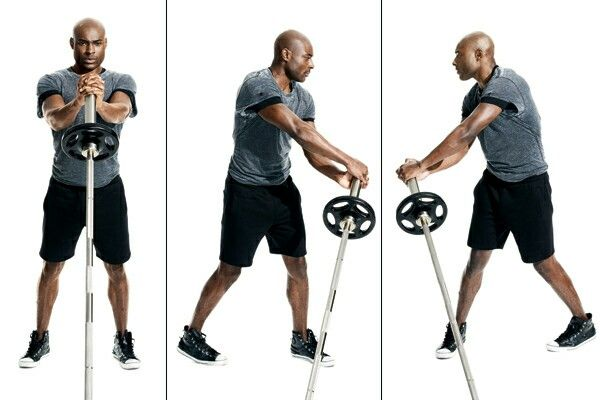
This morning I went down to the firehouse to do a mini, off day workout and ended up working in a little bit with another firefighter who is ten years older than me. He is able to packtest (timed, weighted hike to qualify as a wildland firefighter) and it's pretty clear his commitment to stay in shape is why. My mini workout consisted of jump rope, landmine rotations (I go down much further than the picture) and then without stopping, a set of landmine squats with a shoulder press at the top of each squat. At the end, I worked in with my buddy on the bench. This mini workout was partly about lifting weights but also about sucking wind, weightlifting with the right intensity is also a cardiovascular workout. 


You are not too old to do something weights even if you have to invest time to figure out the right workout for yourself. Quick note, the so called landmine exercises are new to me. The rotation exercise is great for your trunk and the odds of injury seem to be very low. Landmine squats are much safer than barbell back squats. There are quite a few other landmine exercises to go learn about. 

If your hand is forced into retirement but you're able to either avoid medical issues or even just push them off into the distant future, it can still be very challenging to starting withdrawing from your retirement assets, this can be true of any age. Barron's lists out several potential behaviors here. The article seems to focus on guilt which doesn't resonate with me. It makes the case and some of the comments validate the guilt response but the one that resonated more was a subset of of "inherited money scripts" related to not being able to cover some sort of medical catastrophe if we needed to. 

Everyone has their own idea about saving money, spending and so on but regardless of anyone's beliefs on saving and spending, money is optionality and money is a safety net. I think beliefs related to saving and spending come down to how we value optionality and having a safety net. It is also important to know ourselves well enough to know whether we might have any sort of hang up about taking money out. Like I said, my thing is having enough to pay for a horribly expensive medical thing. I am far less concerned about dying with too much unspent money. It's totally valid to view it the other way.

The last link to hit on is another one from Barron's about people not knowing what to make of the future of Social Security and essentially panicking into taking earlier than they planned. I am far from believing/saying everyone should wait or everyone should take it early but I do believe that at some age everyone should start to figure out when they think they should take it. Early, late, right at full retirement age, whatever, have some idea early and then revisit the belief and your numbers to dial in more precisely. There's a lot of nuance to claiming strategies though that make getting it wrong a high probability for people who don't invest the time to make informed decisions. 

Probably worse than making a mistake, is panicking into taking it earlier than planned. I am sympathetic to the concern that "strategic uncertainty" could spillover into Social Security but that is not where we are now. A reader left a comment citing Diane Swonk as saying so many boomers are now taking it early that it is moving the needle on government spending. As I replied, the rational assessment is that no one now over the age of maybe 50 or 55 will have to deal with a cut to Social Security and while I do believe that, I would suggest running your numbers a second time assuming there will be a cut or means testing or something else. 

The recurring theme in this post and many other posts over the years is trying to prevent or solve our own problems. Trying to get out in front of how AI will impact your work, figuring out what you'd do if you could no longer work, staying fit and investing time to learn about Social Security's nuances are all part of solving our own problems. Having a terrible diet of breakfast cereal and soda is an unforced error. Not understanding how Social Security works is an unforced error. Avoiding these mistakes will improve the odds for a better outcome. 

The information, analysis and opinions expressed herein reflect our judgment and opinions as of the date of writing and are subject to change at any time without notice. They are not intended to constitute legal, tax, securities or investment advice or a recommended course of action in any given situation.

Friday, May 30, 2025

Half As Long

The jumping off for this post is the scene from A River Runs Through It when the little boy is writing an essay. He comes downstairs to show the essay to his father played by Tom Skerrit. Skerrit reads it silently, marks it up a little, gives it back to the little boy and says "half as long." The little boy goes back up stairs, comes down a little later after he presumably shortened it by half. Skerrit again reads it in silence, marks it up a little and then repeats "half as long."

I think there is a lesson in there that could be applied to portfolio complexity. "Half as complex." 

Larry Swedroe, writing at Alpha Architect, wrote about a study by Goulding and Harvey called Investment Base Pairs. It is some sort of strategy that offsets exposures which could include long/short but doesn't necessarily have to be long/short. The Swedroe writeup wasn't that clear to be honest so I asked Claud.ai to create a portfolio using mutual funds and ETFs to replicate the Investment Base Pairs Strategy.


I swapped in URTH because Claude suggested a version of that fund that only trades in Europe and the weighting to BIL was split between two different cash proxies. The fourth portfolio is just VBAIX.


I don't know whether Claude had it right or not but its portfolio certainly produced a valid result that outperformed VBAIX with a similar volatility profile but not much differentiation. The Slightly Simpler Version of Claude did quite a bit better due primarily to SPMO and QLEIX. It all blends together pretty well and another contributing factor to its success versus VBAIX is that there are no bonds with duration. 

The Much Simpler Version of Claude was lights out. The CAGR was almost double the original Claude and almost triple VBAIX all with a small fraction of the volatility and it was up in 2022. I threw in the RISR/MBB pairing from yesterday. That was just coincidental timing between yesterday's post and today's post. So, should we just back up the truck on the Much Simpler Version of Claude?


The backtest is skewed by insanely good performance of QLEIX. It compounded at 27% for the period studied. I would not want to bet that it could repeat that same sort of growth going forward. I think the volatility numbers could stand up, I think it could be a source of crisis alpha when needed more often than not and I think the low correlation to the S&P 500 can persist but relying on that sort of growth will likely end up in disappointment. Not tears though. If it compounded at 1/3 that rate, I think the portfolio could be pretty robust in terms of more of an all weather approach and that is important. I would not have 40% relying on the RISR/MBB pair working though, I would cut the exposure to that trade in terms of thinking about any sort of real world application of this. 

The ReturnStacked guys launched the US Stocks & Gold/Bitcoin ETF (RSSX). "For every $1 invested, RSSX is designed to provide $1 of exposure to U.S. equities and $1 of a Gold/Bitcoin strategy." Digging in a little deeper, they are weighting the gold versus bitcoin by risk, in the neighborhood of a risk parity influenced strategy. Per testfol.io, it looks like RSSX would have 75% in gold and 25% in Bitcoin. Per Portfoliovisualizer it would be more like 95% in gold, 5% in Bitcoin. As of now, the positions aren't listed but I believe I am directionally correct. Tying in to Half As Long, it is hard to find the benefit to the added complexity of their funds but we'll see about this one.

While we're on it, the ReturnStacked guys maintain a suite of model portfolios that use their funds yes, but also funds from other providers. Let's revisit All-Terrain 12% Volatility Target, the names are great. It may not be ok to list out the holding and weightings but they use a lot of their funds and some other levered funds. The asset allocation shows 28.4% in equities, 49.7% in fixed income, real assets at 39.5% and 44.3% in alternatives for a total of 161.9%. The weightings are added up on a look through basis so for example a 20% weight in RSST would give the portfolio 20% to equities and 20% to alts (managed futures).

All-Terrain appears to be permanent portfolio/quadrant style inspired so the following comparison which is time constrained by a couple of funds in All-Terrain.


The previous six months have been a great litmus test for all sorts of ideas but not yet as useful as 2022. The shortness of the period studied does bring in some skews for how well gold did and 25% in cash helped as the market has chopped around so violently. The Permanent Portfolio Mutual Fund (PRPFX) is more complicated than Portfolio 3 to be sure but it is much less complicated than All-Terrain. The 25% allocated to long duration in Portfolio 3 creates some vulnerabilities that I think are better avoided but I would try to make the simplicity of Portfolio 3 work much sooner than I'd use Portfolio 1. 

I threw Cambria Trinity in because it is quadrant inspired and the allocation fascinates me but it always looks like a difficult fund to hold. 

The information, analysis and opinions expressed herein reflect our judgment and opinions as of the date of writing and are subject to change at any time without notice. They are not intended to constitute legal, tax, securities or investment advice or a recommended course of action in any given situation.

Thursday, May 29, 2025

A Portfolio No One Would Want Part 2

In the middle of the trading day on Thursday, Tidal ETFs hosted a spaces event on Twitter to shine a light on its FIRE ETFs which are funds of mostly Tidal funds. They had the manager of the Folio Beyond Alternative Income & Interest Rate Hedge ETF (RISR) and the Academy Veteran Impact ETF (VETZ). Those two funds are different sides of the same fixed income coin which we will get to in a minute. 

During the Spaces, Mike Venuto who is top guy at Tidal, said "buying a passive bond index fund makes no sense." Stocks are a different story he said but the basic idea with the generic bond indexes if you didn't already know is that they are debt weighted like the more debt a company issues, the larger weighting it will have in the index which may not be a great idea. 

I've never owned something like AGG or BND for clients (or personally). Recently, I started subadvising for a couple of other advisors and cleared out a lot (in percentage terms) of BND.

There are two FIRE Funds, one is Wealth Builder (FIRS) and the other is Income Target (FIRI). I own a few shares of FIRS as I have disclosed previously. I've known Mike for about 12 years, he is a sharp guy, he is where I got BTAL from in 2018 when he was on the first episode of ETF IQ. 

There are a couple of very sophisticated things going on under the hoods of FIRS and FIRI which is part of the reason why I own FIRS. 

The Spaces started with an intro to what RISR does which is that it owns IOs which are a mortgage based product. IO stands for interest only, they are the income stream off of mortgage backed securities. Mortgage securities have some different fundamentals because prepayment risk goes down when rates go up. And the way it works out, the IOs have negative duration so they function as a hedge against rising rates. Since the start 2022, RISR is up a lot because rates have mostly gone much higher in that period. I would imagine that RISR would go down a lot if rates fell a lot. 

I don't know whether rates will go down a lot but as we've said countless times, I don't want clients' portfolios vulnerable to my being correct about interest rates. 


When they were talking about RISR, I immediately ran the above backtest and then asked about it on the call. The backtest looks a lot like client holding BOXX but the CAGR is higher. I asked if that is an expected result or if it was a fluke...it could be a fluke after all. 

RISR manager Yung Lim (coincidentally, I worked with him on a different fund when I was with AdvisorShares) replied that pairing IOs with regular MBS was a common institutional trade. Yahoo Finance shows RISR yielding 5.61% and MBB yielding 3.98% which averages out at 4.795% plus a little price appreciation with less than half the volatility of AGG. The RISR/MBB blend strips out the volatility to become a horizontal line that tilts up to the right. 

I would not pair RISR with something like floating rate or catastrophe bonds. Those two niches don't really take interest rate risk making RISR the wrong hedge. RISR could work in offsetting treasury duration but that is not truly apples to apples. 


It backtests well with TLT but there are some volatility spasms along the way pairing RISR with TLT.

Mike also talked about the YieldMax funds, he is a fan and said he owns YMAX which is a fund of YieldMax funds. It owns 29 different YieldMax funds with the weightings being between 3.5%-4% each for the most part so no large bets on any one stock and not too much exposure to crazy CEO risk. FIRI uses four different YieldMax funds, totaling 13.5% of the fund to capture a...wait for it..."barbell" yield effect like we talk about here. 


I built the above to not reinvest dividends but it does rebalance every six months. The 45/45/10 yielded 8.1% versus 3.66% for AGG but did so with less volatility for 11 months of 2024. This year so far, 45/45/10 has yielded 2.3% through April 30 versus 96 basis points for AGG, but AGG is having a better year so far for total return.

The YieldMax funds have crazy high yields and the fund NAVs can't keep up so the expectation should be a lot of price erosion and then eventually the fund will reverse split. The Tesla YieldMax did a reverse split quite a few months ago and I would guess most of the others will too. When we talk about the YieldMax funds, we usually talk about reinvesting most of the distribution but the context for this portfolio is taking the distributions out but rebalancing frequently. 

Actually splitting 90% of a fixed income portfolio the way we looked at above would be overly reliant on things working the way they are supposed to which could come around and bite. It could be an effect to incorporate into a portfolio which is what FIRI does, it offsets RISR against VETZ which is a niche mortgage fund, both ETFs are weighted around 9% each in FIRI. 

Now, trying to incorporate the RISR/MBB trade with a little YMAX in more realistic weightings with what we usually do with fixed income. The following portfolio is backtested for total return and then price only, compared to AGG.


MERIX is a client and personal holding.


A lot of the decline this year in the price only version came from YMAX which price only, fell by almost 1/3. The overall mix is pretty docile but it might be difficult to watch something like YMAX drop by that much in such a short time. 

The information, analysis and opinions expressed herein reflect our judgment and opinions as of the date of writing and are subject to change at any time without notice. They are not intended to constitute legal, tax, securities or investment advice or a recommended course of action in any given situation.

Wednesday, May 28, 2025

A Great Portfolio That No One Would Want

Sitting for the Alpha Exchange Podcast, Corey Hoffstein said he's very rarely seen advisors use merger arbitrage which is part of the story of why they stack merger arb on top of bonds in the RSBA ETF.

FT Alphaville looked at recent trends in active share which measures the extent to which a mutual fund is or is not a closet indexer. They say that active share isn't terribly useful for market signals, it's more like noise but lately it has been very low (so a lot of closet indexing).


So maybe it is more noise but it does lead to an interesting conversation that ties in Corey's observation about merger arbitrage. How orthogonal are you willing to be? We talk about this a fair bit but I think it is an important idea to keep on the front burner. 


A little quiz. Which portfolio result would you rather have? I will give you a very small hint. Portfolio 1 is the only choice. Ok, I am done being snarky. The Portfolio 1 has the same longer term result at the S&P 500 but with only 58% of the volatility. 

Along the lines of the 75/50 portfolio that captures 75% of the upside with only 50% of the downside (run the numbers, they work), the result of Portfolio 1 is in the same neighborhood. Obviously if we wrote this post last December, the portfolio would have been behind the S&P 500 not equal to it but the result still would have been compelling. 

You can see just by looking that Portfolio 1 has actually taken a very different path to a similar result as the S&P 500. But orthogonality comes at a cost which is the anguish caused by the periods that deviate away from the index by the largest amount. In the partial year of 2020, Portfolio 1 was down 83 basis points while the S&P was up 18%. In 2021 it lagged the index by 12%. Portfolio 1 was way ahead in 2022, way behind in 2023 and 2024 but it was up nicely those years and this year it is way ahead. 

Portfolio 1 is comprised of two funds and it isn't an idea that I would suggest anyone hold. It has throw in the towel at the wrong time written all over it. It's a portfolio that no one would want.

But when we talk about orthogonality or being truly diversified with holdings that are negatively correlated to stocks or uncorrelated to stocks, small doses of those two funds or any of the other funds we talk about in this regard makes for more resilient outcomes. What we are trying to do is add the effect of Portfolio 1 into a diversified portfolio. 

Having a couple of holdings that look nothing like the S&P 500 should help with avoiding the full brunt of large declines. Stocks are still the thing that go up the most, most of the time which is why you don't want a portfolio of alts, hedged with a little bit of equity exposure.

The information, analysis and opinions expressed herein reflect our judgment and opinions as of the date of writing and are subject to change at any time without notice. They are not intended to constitute legal, tax, securities or investment advice or a recommended course of action in any given situation.

Tuesday, May 27, 2025

We'll Make A Macro Fund Out Of Your IRA Yet

Bloomberg had a quick writeup that tried to hold out hope for the traditional 60/40 portfolio of stocks and bonds with duration noting some recent signs of life. The article was a little thin I think because it read like they were hanging a hat on one good week. 

Josh Brown was quoted at Politico saying “We’re in a very different world where stock market reactions are not at all aligned with what more experienced people would think should happen. It’s baffling, and it’s actually one of the most interesting things I’ve ever seen in my time in the investment markets.”

The connection here is that things can change. This will be annoying but that doesn't mean things must change but just that they can change. The difference is a mindset of being on the lookout for change without finding things that aren't actually there. I appreciate the two handed economist nature of the comment but hopefully it makes sense. 

Being able to create a portfolio that has the attributes of what bonds used to offer is a change that obviously I think is important which is why we spend so much time on the topic and of course plenty of other advisors, product providers and many others in the ecosystem are doing similar work....I think.

Here's an interesting read from Bloomberg about a company that will allow people to design their own indexes. It's not radically new, maybe it's a little different from some other ideas but someone who can create a more useful index for themselves might be better off. I don't necessarily mean getting better nominal returns but more able to create something they can live with through rough times so they reduce the odds of making bad behavioral mistakes. 

The other day we had a little fun about turning your IRA into a global macro hedge fund. I don't actually think that is too realistic to create other than just buying a mutual fund with the word macro in the name of the fund or in the objective as stated in the prospectus but we look at countless ways to build portfolios that are macro light....very light. 

I wanted to circle back in that regard to Saba Capital Income & Opportunities Fund (BRW) which we looked at a few weeks ago and might be macro-ish. You can look for yourself but the construction of it is interesting if nothing else. I had a hard time finding correlation info for BRW related to Saba taking over for Voya in managing the fund but looking casually, it appears that at times BRW does correlate to equities and times it doesn't, kind of doing its own thing. If I am seeing that correctly then maybe it really macro-ish. And if it is macro-ish then the look throughs are simpler to understand than the typical macro mutual fund. 

BRW has a "yield" in the low double digits but much of that can be ROC. According to Claude.ai, 70% of BRW's April distribution was ROC. Here's data compared with AOR which is a proxy for a 60/40 portfolio from iShares.


Price only, BRW could not escape 2022, it did not provide crisis alpha. From 2023 on, it's been mostly able to keep up with the distributions which for a closed end fund is pretty good. BRW owns Bitcoin so it is possible that the growth in Bitcoin is what has allowed the market price to be stable against such a huge payout, sort of like a barbell approach to portfolio construction which we talk about here every so often. 

Some people think maintaining the distribution with ROC is a negative and while I certainly understand the argument but for someone with some sort of strategy of taking income, tax free income seems like a positive. Keep in mind that this ROC distributions lowers cost basis which would drift into the realm of higher capital gains tax but that rate should be lower than the tax rate on dividends. 


More than building a full macro strategy, we're probably more adding a little macro in with BRW if you'll grant me that BRW is a macro strategy. SPMO is plain vanilla equities, BLNDX is 50% equities so we're getting close to a normal allocation equities. CBOE is equity exposure too but also has one foot in the first responder defensive camp along with BTAL. Gold and managed futures are diversifiers, the portfolio gets yield from SHRIX and BRW while SHRIX along with ARBIX are low volatility holdings.


The return numbers for all are price only for anyone interested in taking the income out. The overall yield is close to 4% with a good chunk of that coming from BRW and SHRIX. With dividends reinvested, Version 1 compounds at 12.75%, Version 2 at 14.11%. PRPFX at 7.21% and AOR at 4.01%. 

Versions 1 and 2 had some crisis alpha in 2022 with returns of -4.01% and -5.31% respectively versus a drop of 17.38% for AOR, all of those price only. The reason to use AOR instead of VBAIX is VBAIX gets distorted every now and then from larger capital gains distributions. 

Back to the top and the Bloomberg article about 60/40, in kind of a reverse Karl Popper, there are countless ways to build a competitive portfolio that avoids duration. Part of the success of all of these studies we do comes from intentionally avoiding duration. Even if you believe the various things we regularly include in these offer no value, the takeaway can be to just avoid duration and the now unpredictable volatility that goes with it.

Because I couldn't work it in elsewhere, BLNDX, BTAL and CBOE are client/personal holdings. 

The information, analysis and opinions expressed herein reflect our judgment and opinions as of the date of writing and are subject to change at any time without notice. They are not intended to constitute legal, tax, securities or investment advice or a recommended course of action in any given situation.

Monday, May 26, 2025

A Fund That Shorts ETF Inefficiencies

After yesterday's post about long short equity, a reader Tweeted to me about a new (to me) fund, the Militia Long/Short Equity ETF (ORR) which listed earlier this year. Part of my reply was that as a kid growing up in Boston in the 70's, I might need to buy a few shares just for the symbol. 

There's not a lot of color on ORR's website but it is high turnover and the approach is fundamentally driven.


It came out right before things got squirrely so the first few months serve a useful test. That it has outperformed right out of the blocks is obviously better than the alternative but maybe more interesting is the differentiation captured in the two boxes I added. Using the jargon from yesterday's post, maybe ORR should be considered a variable biased fund. 

Depending on how much turnover there is, looking at the holdings may not be that helpful but I did see something very interesting. Part of the short book appears to be shorting volatility drag that often goes with leveraged ETFs and shorting the erosion that goes with crazy high yielding derivative income funds. We talked about this recently with a filing from Defiance that will short 2x long MSTR ETFs and short 2x short MSTR ETFs.


ORR is short a couple of those ETFs but to be clear, the above just borrows part of their idea, the actual fund has a lot more going on under the hood. The symbols I chose, allow for a long backtest as follows.


The results are of course interesting but don't account for the cost to borrow the shares. TNA appears to cost about 100 basis points per Fintel, SDIV is 60-70 basis points and XYLD usually ranges from 1.2%-1.4%. Those are annual costs. Where the backtest is total return, the expense of paying the dividends should be accounted for. 

I wanted to check in on the ReturnStacked Bonds & Merger Arbitrage ETF (RSBA). It started trading late last year. The idea is that each dollar invested gives $1 of exposure to US Treasuries of varying maturities and $1 of exposure to merger arbitrage. The fund's website shows AUM just under $19 million.

We talk about merger arbitrage as a proxy for how investors hope fixed income will trade. It usually have little to no volatility and tends to move upward very gradually. I've owned the Merger Fund (MERIX) for clients since the financial crisis. The fund is having a relatively good year in 2025, up 4.39% per Yahoo Finance. 


Portfolios 2 and 3 use ETFs from F/m to dial in the maturities that RSBA shows on its site. UST in Portfolio 4 is a 2x version of the iShares 7-10 Year Treasury ETF (IEF) but I would note that factoring in distributions, UST's total return lags IEF by 11 basis points.


When we look at results for any of the ReturnStacked funds, they often don't look so great. For someone who wants Treasuries with duration (I do not) as well as merger arbitrage (I do want that one), there appears to be better ways to build that combo. I will say that while the characteristics of merger arb are similar from manager to manager, the exact results can differ from manager to manager.

The information, analysis and opinions expressed herein reflect our judgment and opinions as of the date of writing and are subject to change at any time without notice. They are not intended to constitute legal, tax, securities or investment advice or a recommended course of action in any given situation.

Sunday, May 25, 2025

Put It All In.....Long Short?

NEPC posted a short paper about how to choose the right alternatives to diversify a 60/40 portfolio. The introduction covers the same ground we have been covering here forever.

Investors can count on a broad array of strategies to incorporate diversification into their portfolios. These approaches—often overlooked in an upmarket—help diversify away from equity risk which is the most prevalent risk in investment portfolios. They also help stabilize the portfolio over the long term and improve risk-adjusted returns. Gains originating from diversifying strategies can serve as a source of liquidity during/post a market downturn, serve as dry powder to reinvest following periods of stress, reduce volatility drag, and/or increase the terminal value of the portfolio. At NEPC, we think it is critical to establish clear goals and expectations when building a diversifying allocation. If investors are unclear on the goals of the allocation, they are more likely to abandon the strategy. In our view, a diversifying allocation is meant to complete portfolio construction, not compete with the return-seeking portion of the total portfolio. While many investors utilize a mix of strategies to create a diversifying allocation, we believe that the optimal approach should have two main characteristics: provide complementary attributes in various market environments and include strategies with a low correlation to each other and a portfolio consisting of stocks, bonds, and private investments. As a result, in this paper, we focus on global macro and trend following, fund-of-hedge-funds, multi-strategy, and event-driven approaches. We believe that when these five low-correlated approaches are combined and customized to meet the individual investment goals of our clients, they can efficiently achieve the required level of diversification while earning returns over a full market cycle.

The conclusions weren't new for what we've studied here other than sending me down a bit of a rabbit hole for long short equity. We've talked about there being different types of strategies within long short, well it turns out there are proper names for these types. Some of them below;

  • Market Neutral- Vanguard Market Neutral (VMNIX) as an example
  • Long Biased- AQR Long Short (QLEIX)
  • Variable Biased- Invenomic (BIVIX)
  • Event Driven- could include merger arbitrage
  • Quantitative/Statistical- I would include client/personal holding BTAL in this group

That got me to thinking that these could be the building blocks for a portfolio. Where some people have talked about putting it all in trend/managed futures, what would it look like to put it all in various forms of long short? Long biased could be a substitute for plain vanilla equity, market neutral and merger arb could be substitutes for plain vanilla fixed income and the use of BTAL is pretty similar to how we discuss it in other posts. For the record, putting it all in trend/managed futures is a terrible idea.


Portfolio 4 is VBAIX and Portfolio 5 is price inflation.


Portfolio 1 does not keep up with portfolios that have close to a normal allocation to equities but that portfolio was less volatile, did have an adequate real return and had much smaller drawdowns except in the 2020 Pandemic Crash. Another important observation is that Portfolio 1 is truly differentiated from 60/40. In the 11 full and partial years studied, it was plus or minus more than five percentage points from VBAIX five times. Sometimes that was a good thing and sometimes it wasn't. And it case it's not obvious, Portfolio 1 would be very expensive. 

Combining equity momentum and managed futures in Portfolio 3 is a step closer to putting it all into trend which is something we've looked at several times before and the backtests usually look pretty good. Portfolio 3 was plus or minus five percentage points from VBAIX six times and again, sometimes that was a good thing but sometimes it wasn't.

That was a pretty rough showing for the four managed futures funds. The choice was sort of limited for the number of funds that were around back then but it was a rough stretch for the strategy, pretty much just tracking inflation. 

Seeing a strong backtest is one thing but living through a year where you own Portfolio 1 and it was down 6% like in 2020 while VBAIX was up 16% that year would be very difficult to endure. 

The information, analysis and opinions expressed herein reflect our judgment and opinions as of the date of writing and are subject to change at any time without notice. They are not intended to constitute legal, tax, securities or investment advice or a recommended course of action in any given situation.

Saturday, May 24, 2025

Is Your IRA A Global Macro Hedge Fund?

Some very quick hits from this weekend's Barron's. 

A couple of good ones from Morgan Samet and then James Anderson from Lingotto. Samet said "you have to repeatedly think orthogonally." I love that word and we occasionally talk about orthogonality here. It is very important trait for portfolio construction. One example that we review constantly here is avoiding bonds with duration. That part of the market has gone from very high risk when yields were very low to a serious pain point with large declines and unreliably volatility. 

The various funds that are down 30-50% from their 2021 highs can never make their way back to those prices and if from here, yields move up from the 4-5% to maybe 5.5-6.5% range, those same funds might be very hard pressed to get back to today's prices. Many advisors and pundits never got off of bonds with duration and recommend it still but the risk reward tradeoff makes no sense to me.

Then Anderson, referring to a different colleague said "he was even more frustrated than I am that public-market investors haven’t adopted the view that outperformance is reliant on extreme winners." We talk about this point a few different ways including the barbell theory of concentrating risk into a narrow slice of the portfolio. 

Getting that right is not easy of course but in a normal bull market, you're probably not going to have a laundry detergent company double in a year. 

In the StreetWise column, Russ Brownback from Blackrock said "I’m like, guys, the range on the S&P 500 over the next 10 years is probably 5,000 on the downside and 10,000 on the upside. So you’re gonna be kicking yourself if you’re getting too cute about a hundred points now.” 

We talk about the natural inertia that lifts the market from the lower left to the upper right of the chart. That inertia is pretty dependable over the long term but we don't know the path. Using the number from the quote, there is no question that the S&P 500 will hit 10,000 at some point but we cannot know how long it will take or whether the path to 10,000 will be by way of 4000 first. We've also used the word ergodicity to describe this effect.

Lastly, an article for retirees about how they can navigate their portfolios through choppy markets. An advisor said "this is not the time to treat your portfolio like it’s a global macro hedge fund.” When would be the time to treat your portfolio like it's a global macro hedge fund? Ok, I am being snarky but there is some contrast with this comment and the idea of orthogonality discussed above. 

We talk a lot about using alts which I believe is one form of orthogonality but it is a stretch to think of our discussion (and my implementation) as being anything remotely similar to global macro anything. I'd be happy with just being resilient through market events like the one we are going through now. 

The comments on this last article we're discussing were very critical of the article for being way too basic, offering nothing new. What was the first article you read that said "have a years worth of expenses in cash in case the market drops?" Even if you now come at that a little differently, at one point you didn't know about that, you read that advice for the first time and then you knew. Some number of readers of that article learned today to set some cash aside for expenses in case the market drops a lot. 

The information, analysis and opinions expressed herein reflect our judgment and opinions as of the date of writing and are subject to change at any time without notice. They are not intended to constitute legal, tax, securities or investment advice or a recommended course of action in any given situation.

Consequences For Excesses?

Starting out with a quick follow up from yesterday as markets went down a lot again on Friday. Oddly though, the things I follow, more of th...