Monday, May 02, 2022

Retirement Is Really Complicated

 An in depth Random Roger investigation has discovered that retirement income is complicated. That's stolen from the TV show PTI.

The ink had barely dried on yesterday's post about fear of spending retirement funds in retirement when Michael Batnick and Ben Carlson had retirement expert Wade Pfau on their podcast talking about the same thing. This idea has been pinging around for the last couple weeks, beyond the Barron's piece that was the catalyst for my post. 

The most interesting part of their conversation was the recent revelation that Bill Bengen, the author of the 4% rule is not comfortable owning enough equities for his version of the rule to work. It takes 50% and he is at 20%. This hits on a couple of long standing themes on this blog to circle back to.

The simpler one is that you never know what the future you will want to do. The application here is, you don't know how your tolerance for equity market volatility will change, if it will change when you're older. What works at 60, might not work at 80 or some other age. A scenario where an investor retires at 60 pretty much on target for the number he needs, so not a huge margin for error, and keeps 60% in equities to maintain that stasis. Let's say this investor is now 77, very fit and healthy and just can't sleep with 60% in equities for whatever reason. He's needed 60% in equities to keep up. If he goes to 20% equities as Bengen has apparently done, how likely is it that he will continue to be able to keep up? If he's that fit, he's got to figure out how to make it work for many more years.

I've never been a fan of the 4% rule as widely adopted which is you start at 4% and increase it every year by inflation. It is silly on it's face that someone is going to increase their quarterly, portfolio paycheck by $275 or $415 or whatever, I just don't believe it. It is an extra layer of minutia. For years, I have been saying whatever you got, 4% . More specifically, 1% every quarter. Stock market growth will take care of the inflation math for you. Years ago, a reader quipped that if you do that, you'd never run out of money but he meant it as a criticism. It was a legit point taken in full context. The variable though is the one-off expenses. I think whatever you got, 4% allows for being better able to pay for large one-off expenses versus being 6 years in, your withdrawal rate is now 6%, stock market is down 20% and you need $30,000 to cover helicopter ride when you broke your leg skiing. You have a balance every quarter, whatever that is, you take no more than 1%. The downside of whatever you got, 4% is yes your paychecks will be lumpy.

I like the idea of building this backwards, starting with what your expenses are expected to be, is there any fat to be cut and to make sure you're not forgetting something in your budgeting process. For example, you probably don't need to save for retirement after you've retired. Your expenses are not some rule of thumb percentage of your income. That's a lazy approach. Take out a spreadsheet, input your numbers, what is the total? From there I would suggest padding it but some amount you think prudent for unbudgetable one-off expenses and add a realistic number for discretionary spending. 

In today's dollars our fixed monthly expenses ten years from now look like $3200. I doubled the cost of health insurance, and took a bunch of annual expenses like property tax and divided by 12. From there, I would add $1000 for one-offs and $1500 for discretionary. So we'd need $5700 which is a little higher than it was for us, five years ago. Where is that going to come from. What is your number and how will you cover it when you retire, if you retire?

First, if you don't like your number using this process, how can you reduce it? Now, how will you build an income from various sources to cover that number? What will you get from Social Security? Worried about SS solvency or a payout reduction? The number being thrown around on that front is 23%. Applying that haircut to your expectations seems prudent for this exercise. 

How much can you safely take from your portfolio? How much is 4%? How much is 3%? Is covering the gap between your need and SS payout, if there is one only, going to come from your portfolio? If so, do the numbers work? If they work, what is your margin of safety? If they do not work, what can you do about it? Can you spend less, save more, find a third source of income? 

A path that I think can solve portfolio shortages, real or perceived is that third source of income, whatever that might be for you. With enough time both in terms of time spend on the endeavor and time horizon needed to ramp up that third income source, the third one could actually be second income stream making your portfolio the third stream or supplanting your portfolio altogether at least for a time. 

We talked about this in yesterday's posts and I've been writing about it for ages as relieving the burden from your portfolio. Back to my personal numbers, if our investment portfolio needed to produce $2000/mo and I found some sort of gig that reliably brought in $500, in percentage terms, that is a big chunk of portfolio income I am getting somewhere else. 

The more of the burden you relieve and for longer then obviously your retirement finances are going to be a whole not easier. This is a problem for each of us to solve in whatever way can individually. Learn the difference between generic rules of thumb that border on useless versus building your own solution. Having built something from the ground up that you fully understand will also allow you to tweak it later if your circumstance dictates that you do so.

Sunday, May 01, 2022

Flexibility & Retirement Spending

Barron's had a couple of good reads this weekend. The first one was about The Great Resignation which I wrote about here in late March. Actually in the Barron's piece there was just one interesting point I would hit on as captured in this passage. 

In another global survey, “People at Work 2022: A Global Workforce View,” more than half of the nearly 33,000 workers we spoke with said they’d take a pay cut in return for more flexibility in when and where they do their jobs. In the U.S., the cry for flexibility is even louder—2 in 5 U.S. workers desire control over their own schedules. Nearly half would be willing to accept a 5% pay cut or more to get it.

I don't know that it proves it, but assuming it's not a woefully flawed study, it supports the idea that a lot of people value their time more than money, I know certainly do. If you want to hit the big time as a financial advisor, you don't move to Prescott, AZ when you're 36. I have no clue whether I could be making a million bucks or more in a big city, I suspect not, but I figured out that was not what I wanted when I was in my mid-20's. If you're in your 40's or 50's been living below your means the whole time then you have some money put away, there's probably no need to fight with your spouse about money and you can cover the unexpected things that come along then you're life is pretty easy. At least your financial life is pretty easy and if other things are challenging, at least your finances aren't compounding everything else.

A lot of people maybe started to figure this out about themselves due to the pandemic and while being one who did resign in the Great Resignation movement may not have been a great call for everyone, as a catalyst for some sort of change, maybe good can come from it. 

This reminds of the quote from our friend Bill here in Walker that I cite all the time, "you can figure it out now or you can figure it out later but you'll be much happier if you can figure it out now."

The second article to mention is one about retirees being reluctant to spend their money when they retire. I've blogged about this many times too because I've been seeing around the corner on this one about myself for at least ten years. 

There were a couple of retirees profiled and the answer for them both was that they both have more money than they thought. The article would have been more useful profiling two or three retirees on a spectrum ranging from a little bit ahead of where they need to be to a little behind where they need to be.

If you think you need $900,000 and you end up with $825,000, yeah some things might have to give but you're not automatically forced to take some job that would make you miserable. 

If you think you need $900,000 and you end up with $1,050,00 and you're a reluctant spender then you might think you're one medical emergency from being forced to take some job that would make you miserable. I understand the psychology and candidly I don't know sitting here today how I will overcome it so I think about and have been writing about how to work around it. 

I don't think my preference to never retire comes from this issue, I love what I do for reasons I've laid out before. I can't envision a scenario where I lose interest in any aspects of the capital markets that fascinate me. If you think about the now mostly pension-less, American retirement, it typically relies on two income streams, Social Security and portfolio income. We've looked at countless ways to create other income streams here all in the name of relieving the burden off of your portfolio for a time.

If you can create and manage passive income (real estate), derive income from a volunteer endeavor (for me firefighting), monetize a hobby (selling something you create or teaching a skill you have), figure something out on the internet (the list is endless) or filling some need in your community (here that could be snow removal in the winter or backhoe work) or better yet more than one of those, you might not need any money from your portfolio until you're 80. Do what you need to now to remain able bodied past that age plays a role here which is why I write about it so much. Think about being able to leave your portfolio alone for an extra 10 or 15 years or pull far less from it. Random 10 and 15 year periods can have dramatic price appreciation. The 10 or 15 years that would be relevant for you in this context may not but you'll still be better off with this optionality. 

Friday, April 29, 2022

Wildfires & Bear Markets Are Very Similar

 Hoo boy, I've had a jam packed couple of weeks. 

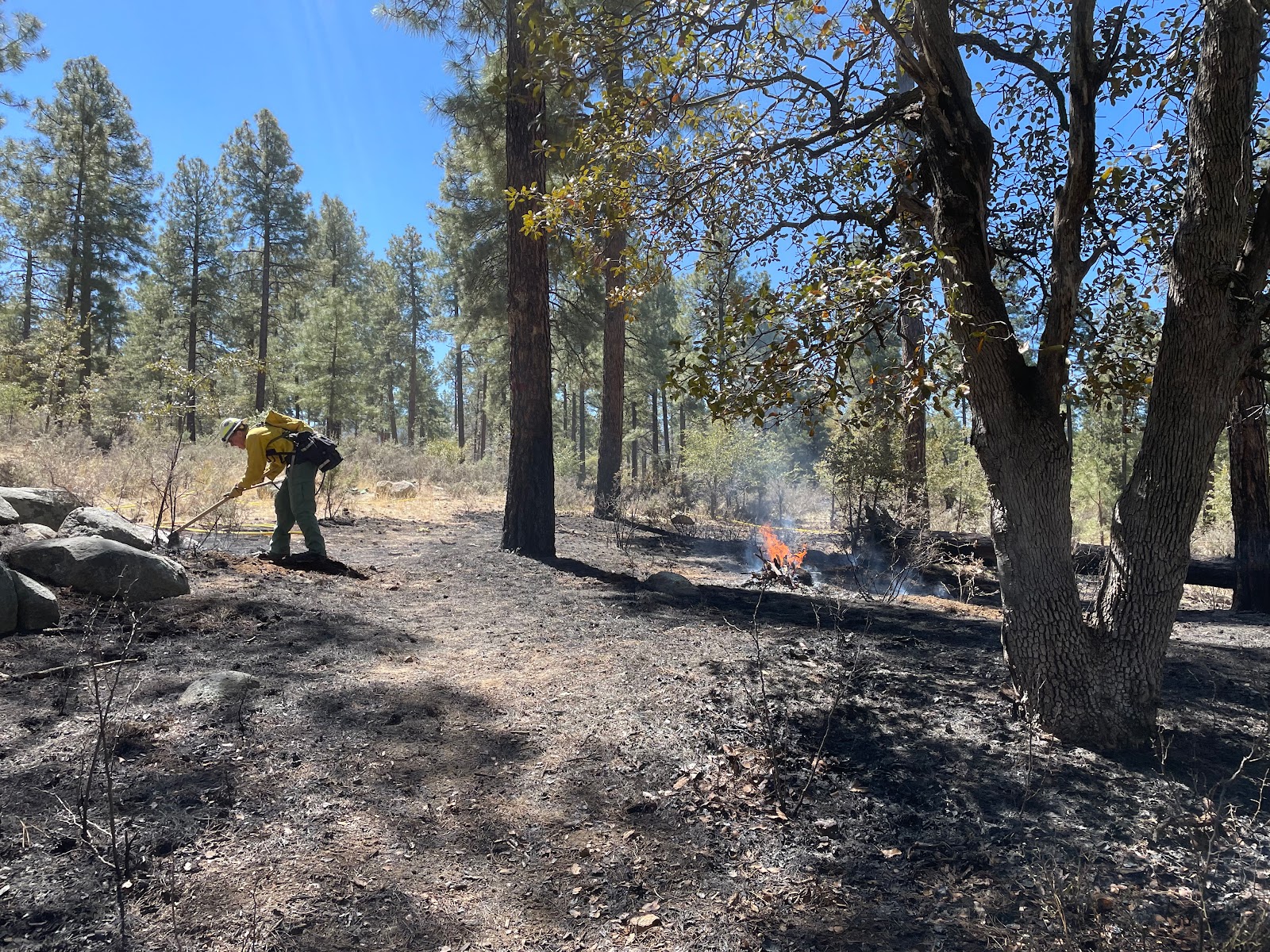
We've been dealing with the Crooks Fire which is the most serious wildland fire threat Walker's ever had for being so close and having some topography where it is very difficult to fight fire. The Goodwin Fire in 2017 was similar but I am quite certain this one is worse but I think were close to being able to talk about it in the past tense. Looking this way, the fire has been getting better to the point where as of 45 minutes ago, smack in the middle of the "burn period," there's maybe the lightest of haze to the right of the high point.

May be an image of nature and tree 


At the same time the stock market has been enduring something of a fast decline, having its own wildfire so to speak.

The large fires involve a lot of briefings (thank goodness for Microsoft Teams on this one), a lot of community communication, a lot of firefighter work and a lot of fire chiefing. The list of things for stock market panics is shorter in that I need to read, be ready to place a trade if need be, be prepared for client calls and proactively reaching out to clients with an update which I did earlier today. 

For a wildfire, where geographically relevant, you can mitigate your home by not having firewood under your deck, limbing up the bottom of trees, cleaning up forest litter on your property and raking pine needles away from your house, essential removing things within 25 feet of your house that can burn. A ground fire will stop creeping when there is no fuel to burn.

For a bear market you can assess when risks for certain negative outcomes are elevated and start to mitigate those risks by reducing or even eliminating exposure. For an investor, a ten year US treasury yielding 2% or less, I would say 3% or less, was never a good investment. Maybe a good trade for someone nimble enough to do that but not a good investment. 

We've been talking for years about interest rates being too low to invest in anything with interest rate sensitivity. We've been talking for a shorter period about the risk for price inflation increasing and about stock prices being vulnerable, wondering if an overly stimulative FOMC, grossly so, would cause problems. I had no idea when any of these things would matter or if they would matter but the risks were simple to observe.

Nate Geraci had a thought provoking Tweet, "*This* is the year active management outperforms, right? Right? If not now, when?" My answer was "A moderately competent will have some years of out performance, and some years of under performance but at the SPIVA level, it will always lag. As an RIA using an active strategy my goals are making sure clients capture the effect of big up years and making sure income needs are not disrupted in down years."

SPIVA is an annual survey (I think it's annual) that seems to always show active managers lagging. It will never show the majority of active managers outperforming. The idea of capturing is something I've written about often. If the S&P 500 is up 19% in a year, the equity portion of the portfolio, assuming there is one, regardless of the percentage allocated should be close. 15% offers participation I'd say, but 3% does not. I will note I have several clients who've wanted to position toward more of a game over allocation so that will play out differently. 

I have no idea how long this market event will last but making sure clients regular financial needs are met is a very high priority. We have cash set aside in most instances and if the market drops a lot, then the many volatility dampeners/diversifiers/hedge products I use should go up a lot and I'd be able to sell those for more cash if this things lingers.  

Monday, April 25, 2022

Reasons To Write

A lot of self help, guru-ish content tells people to write everyday. Blog, journal, make lists, whatever you call it but write everyday. If you're not writing, should you be? Well, I don't know whether you should write everyday or once a week or ever but I've been doing it long enough that I can share some observations. 

The first writing I did was back at Schwab in the mid 90's. At that point I was in the middle of a short stint in a trading group for active retail customers. Unsolicited, I just started writing about market mechanics and indicators and distributing it through TOSS which was a precursor to email. I have no idea if anyone read it but I was never discouraged from doing it and it helped me learn more about the subjects I was writing about. I remember writing about the TED Spread, VIX which was a new indicator back then, S&P futures fair value and then-Orange County CA treasurer Bob Citron. 

I did a little more writing at a different stop within Schwab, and just about every aspect of that was identical to the previous paragraph. In 2003 and into 2004 I did some writing for the Motley Fool and then I started my own blog, back at the original randomroger.blogspot.com and long story short while that site is essentially gone, most of that content is available at Seeking Alpha. Back then, there were very few stock market blogs so my site got a lot of media attention, was even deemed to be the top blog by Forbes in late 2004. 

There was a little ad revenue coming in but I never made serious money from blogging despite having some pretty big traffic numbers back then and a lot of reader comments. But I kept on writing. I felt like I was on to something even if I didn't know what the outcome would be. In the summer of 2005 I got what I would call a big break related to writing. I hired on as an outside contributor at TheStreet.com to write articles about ETFs. This gig lasted for eight years and in the context of a secondary income stream, it paid very well, probably close to what a blog that was successfully generating ad revenue.

My blog lead me to many appearances on CNBC Asia, more than I can count, at one point I was on every Sunday night and I also had a few appearance on Fox News.

A couple of years later, Jim Cramer mentioned one of my articles, one about water ETFs, on his show and soon after that I was on CNBC to say that solar stocks were not a bubble, they were a mania and if the whole group went to zero the next day, it would be meaningless for the market. It got to the point where I was being called all the time by CNBC but the novelty wore off for having to drive three hours roundtrip to Phoenix for my appearances. 

Then another big door opened with AdvisorShares, first taking a stab at running an actively managed ETF and then another side gig writing for them and being a secondary face of the firm after the CEO. This came as the Street gig was winding down. 

Then as AdvisorShares wound down, I moved my writing to The Maven which didn't work out the way I'd hoped. There's nothing negative there, my content just never gained any traction there. 

The constant was that I've kept writing throughout even if I write less frequently now. 

The biggest reason to write, IMO, is because it's fun. If it's not enjoyable then I don't know why you'd do it. Maybe one way to ease into could be the list method advocated by James Altucher primarily. 

Beyond being fun, with a long enough time frame, writing is a great way to track your thoughts on many subjects, see how they evolve, see how you grow. To get the most personal reward I think you just need to write whatever you want to write. When people would reach out for advice on how to start blogging, I always included the idea that if you have interesting things to say, people will find you and your content. I'm less confident in that idea now because there are so many blogs, I think the odds of being anonymous are pretty high but that's ok. I've become pretty anonymous with my blogging and I don't care, I enjoy it, it helps me in the ways I mentioned above and occasionally I get to help readers figure some things out. 

Maybe I will have another big writing opportunity again but if I don't, I still have the ability to continue journaling out the various arks I started on in 2004.  

Sunday, April 24, 2022

Just Here For The Ratio

If you don't engage on Twitter, there is a phrase "just here for the ratio" which is one someone Tweets a really bad take and they get flooded with negative comments, it's called a ratio. Humorously, people will reply "just here for the ratio" and it's kind of funny.

Barron's early on the weekend mornings will post retirement oriented articles. This week's article, sometimes there'll be two, was titled Buying The Dip Can Be A Retiree's Best Friend. Here's How Seniors Can Safely Shop written by an advisor named Debbie Carlson. I stopped reading after a sentence or three so I'm not going to comment on the article but the "ratio" had some interesting points.

One comment made fun about seniors thinking long term. You can be 80 and jacked or you can be 50, unable to move and on oxygen. Which would you rather be? Something that just came up this week is how ever so often on a large wildfire there will be someone qualified who's 80. Qualified means able to pack test (3 mile hike, 45 pounds, 45 minutes). Chances are someone like that should have been thinking long term at 65 and at 70 and probably now at 80. If he makes it to 95, well 15 years seems like kind of a long time, the stock market is up a lot in the last 10 years, it is up a lot in the last 15 years. Sadly, not everyone needs to really focusing on the long term when they're 60 or whatever but a senior thinking long term is not on its face, incorrect. 

Apparently, the article recommended Facebook which is actually called Meta Platforms but still has symbol FB. There were a couple of comments deriding the suggestion that seniors should be in FB. I have no opinion on FB specifically but the idea of owning a stock with the attributes that FB might have or that bulls on the stock think it might have; the potential for a lot of growth and a share price that they would hope would go up at a rate much faster than the broad market is valid. A diversified portfolio will include holdings with the types of attributes that FB bulls think that stock has. A diversified portfolio should include holdings with the types of attributes that FB bulls think that stock has. 

If you want to argue about whether or not anyone should try to include individual stocks (with enough time to do the work, I'm a yes) that's different, but if you think not, then exposure to funds with those attributes are appropriate for a diversified portfolio. Indexing is of course valid but there are many different approaches that are valid.

One comment asked why an article written by an advisor had nothing about how to hedge. Look at past posts on this blog for one way to go about hedging a portfolio.

I've never been a fan of "buy the dip." Dips are small declines. It makes much more sense to build an asset allocation that you stick with instead of chasing 3% moves in the broad market. I would differentiate buying a panic versus a dip. By panic I mean something like a 20% decline or 30% or whatever. If you think 3% or 5% is a panic, you might have too much in equities. 

Some personal news. We were due to take a road trip leaving last Monday the 18th. When we were halfway to where we were going to spend the first night, I got a notification of a small fire starting just south of Walker. Just south of Walker is the direction that threatens us. At first it was just a few acres and it's only mid-April, it'll be fine. Three hours later it was on its way to blowing up into a serious fire. The most serious wildfire threat we've ever had as it turns out because for all the big fires we've had down there, this one was the closest one.


We turned around, 7 hours from home, and drove back. I made this decision after talking with the Forest Service. On Tuesday, the fire, called the Crooks Fire, had transitioned to a Type 3 incident on it's way to a Type 1 on Wednesday. Type 1's are the most serious and for it to become a Type 1 in just 48 hours is insanely fast. 


Pretty much the entire fire world was on its way to Walker by Tuesday. An evacuation order was issued on Tuesday. The entire fire world got here on Wednesday...but actually even more apparatus and crews came on Thursday and then Friday. There were also more aircraft assigned to the fire than I've ever seen before. These things involve meetings, work at the fire house, keeping the community updated via our Facebook page, being a host to the outside resources staging at hour station house, functioning as the chief for our department and of course doing actual fire-related work.


We've been through several of these since I've been the chief and we have a pretty good game plan. We get a great turnout of volunteers every day, we essentially work a regular shift that any department might to. We do a little work around the station house, have a briefing on the fire situation and what we will be doing that day and then go do it. Typically we do structure protection which is to clear things that can burn away from people's houses. 


What makes fire south of us so dangerous is very rough, steep terrain and a very overgrown forest. As a borderline miracle the crews, and air operations where able to knock it down, essentially (but not totally yet) ending the danger before the fire was 96 hours old. Despite horrible wind earlier in the week, Friday was very cold, humidity went way up and it even snowed for a few minutes--not enough snow to put it out. 


We made the news when one of the homeowners whose house we mitigated sent in the video from his Ring Camera into the news. He was talking to us through his device. I'm in the video wearing the white helmet. A friend jokes "hey I saw Roger on TV stealing firewood."

Part of the equation for why the outside response was so huge and so fast is that the Hassayampa Fire Shed which is comprised of Walker, this area south of us and Groom Creek just to the west of us, is specifically named in the infrastructure bill as one of 10 national priority fire shed. Buried in there on page eight hundred and whatever, "put out the fire in Walker." That might not be the exact wording. I started hearing about this a couple of months ago and while I haven't read the bill, it seems like it might be true.

Being able to play role in trying to solve the community's problem is a huge gift. If that seems odd, I would encourage you to go volunteer at your local fire department if you're luck enough to live in an area that is served by a volunteer department. I'm on the left in this last picture. 


Wednesday, April 20, 2022

Retirement Done In By Inflation Already?

The Wall Street Journal had a rough article about the recent surge in price inflation pushing retirees back to the work force. We all heard about the so called great resignation whereby people, buoyed by gains in the stock market and concerned about catching Covid, retired or they thought they were retiring. I wrote a post about regrets/mistakes of the great resignation a few weeks ago. The wrinkle being added in this latest WSJ article is price inflation. 

It seems relevant to mention the book Multiple Streams Of Income by Robert Allen. I read this book almost 20 years and it had a big influence on my thinking about many subjects. Having multiple streams of income is a form of hedging against the unexpected. It's a form of resilience, optionality and it's a path to setting your own schedule which are all huge life priorities for me. 

Creating multiple streams of income avoids being overly reliant on everything going just right. Last summer I mentioned taking on a new gig as a "research volunteer" for an endowment that gives money through grants to non-profit organizations. You know how in life, you have plans or at least a framework for a particular outcome and then something comes up? I was having a conversation with the President of the endowment and in the conversation he said to the effect, you don't want to be in a situation where something can't come up meaning that the potential something at the wrong time could be ruinous.

If I wanted to retire and did so, and was forced back to work I didn't love because my retirement planned failed in less that two years despite the stock market being up a lot, well I might call that ruinous. Ruinous in terms of my happiness anyway. The context of my conversation was far less dramatic, I was busy with a big project that I was getting done very early so that I wouldn't be time crunched into 16 hour days, sweating getting it completed, a week before the deadline and then in that last week, we have a serious wildland fire here which would place huge demands on my time.

The basic blueprint these days for retiring is two streams of income; Social Security and portfolio income. That blueprint might be on shaky ground for society at large given all the data on how dismal saving rates are and have been for quite a while. Harsh comment comment coming but the reality  is that at some level of being undersaved for retirement, you have a pretty good emergency fund, not a retirement fund. Having $100,000 would hopefully cover many years worth of emergencies but assuming the 4% rule, that amount of money kicking off $4000/yr doesn't seem that robust. 

For years, I've been writing about things like monetizing hobbies, part time work at places like National Parks, state parks or other recreational areas or even seasonal work like many years ago I wrote about seasonal work for Amazon in distribution centers around Christmas time. As I recall that post, the work is grueling but only two months of the year and I seem to recall it paying pretty well. I don't know if that opportunity still exists or not but being able to do that brings in our past conversations here about health span and optionality. Two months of tough physical work and 10 months of not having to work might be appealing to some people's situations. I'd prefer to have to choice of saying yes or no as opposed to having terms dictated to me as a result of consequences from not having stayed fit when I was younger. That too is harsh but so is the reality of not having enough money when you thought you did and having to scramble to figure something out. 

The time to start solving a problem is before you have the problem. You can't always see around the corner of course but you know you're going to get older and at some point you're primary source of income will change as your career will eventually end. I've said countless time that I don't want to retire but I'm not counting on a thriving advisory practice when I'm 90. 

Solving a problem that for now is merely a threat provides the opportunity of being able to play a long game. If something you'd love to do as a fall back or Plan A for post retirement calls for many years of paying dues, well at 50 you probably have plenty of time to pay those dues. If you're desperate to retire at 50 then maybe you have a little less time. I will say that 50 and healthy can be very young, if you're desperate to retire at 50 but it takes two or three more years than you'd have hoped to line up all your ducks, that's ok. I can tell you first hand 56 and healthy (knock on wood) is very young. 

Examples of long term ideas for income streams that I've been cultivating include fire related work, I've made money writing before so maybe I can again, our Airbnb is already a viable income stream, there's a path to a small income stream unrelated to portfolio management at the endowment where I'm currently a research volunteer, income from my photography seems like a low probability but not impossible I suppose, I don't know whether there's a potential income stream to be had related to fitness and exercise as some sort of coach. I know I'm putting in a lot of time to learn and that's an important early step to creating an income stream

Having a long list of interests makes life more interesting as well and while I don't take the Malcom Gladwell idea of 10,000 hours to pertain to every person and every endeavor they might pursue, there's something to it. Immersing yourself into something you love is rewarding all by itself and if it turns into something you can monetize, all the better. 

A couple of weeks ago I joined James Altucher's new social media platform called NotePD. It's based on something James has been talking about for years, writing down 10 ideas everyday. The way I post is more like 10 points about one idea. My posts there relate to my blog posts here but are not pure duplication. Go to NotePD.com and search for @randomroger and let me know what you think. I think it's a great platform so far because it skews to development and productivity. Hope you'll join and engage.  

Saturday, April 16, 2022

Barron's Round Up

Some interesting stuff in Barron's this weekend.

Christine Benz sat for an interview and although I disagree with her on target date funds (my take is to run screaming from the room, waving your arms frantically to get away from them), she had a great comment about paying off your mortgage early, she called it a peace-of-mind allocation. For years, I've been saying that just looking at the numbers and nothing else, you probably shouldn't pay it off early but for some people, and I am one, there is huge emotional value paying down and then off the mortgage. We're almost 10 years in to a 15 year mortgage and our balance is down to $5074. It will be paid off this summer.

Hopefully we have many more years here, healthy and able bodied enough to do what needs to be done to stay here. For now, all signs point to that working out. Props to Benz for articulating this point so succinctly. 

One of the Trader columns looked at whether for 2022, investors should sell in May and go away as the cliché goes. "While the Fed tightens, investors should use seasonality to their advantage and be spectators to the drama this summer" the article said. It came early in the article and it's not out of context. That is insanely bad advice and indeed, it was walked back later in the article.

For a little history, the article noted that when the S&P 500 is down for the first four months of the year, it has gone on to fall between May and September 40% of the time, falling an additional 1.5% on average in that period. It fell 40% of the time, so it went up 60% of the time? Investors should try to trade around an average 150 basis point decline that may or may not happen next time and possibly pay taxes? Like I said, insanely bad advice and they did walk it back. 

My approach on this sort of thing has always been to add funds with negative a correlation to the stock market to try to reduce the portfolio's volatility as opposed to doing a lot of selling. In past cycles, I've done a little selling at points like now but on this go around, no selling thus far, just increased hedging. If the market goes down a lot, we're not there yet, then the hedges will grow relative to the portfolio to hedge more, in a sense they are dynamic. If the stock market rockets higher, then yes the hedges will be a drag but we won't miss a rocketing up. Part of the shift away from selling might be that there are many more choices for products that hedge. They shouldn't all be expected to work perfectly every time, but they work well enough for me to remain confident in them.

Finally, the cover story was about ESG investing and the funds that offer ESG exposure. Nate Geraci (a great follow on Twitter for ETF info) Tweeted that Barron's took ESG to the "woodshed" and he cited this line from a report by Ken Pucker and Andrew King from Boston University that said: “The logic and evidence for assurances of ESG-driven alpha are lacking. Indeed, it is our best guess that flows of money into ESG funds represent a marketing-induced trend that will neither benefit the planet nor provide investors with higher returns.”

I've never considered ESG funds. I think they are a marketing gimmick and a fee grab. Note, I am not against the concept of avoiding companies that you think are bad actors or that pollute the planet or any other issues important to you. Believing you should avoid cigarette companies can coexist with the idea that the ESG funds being cranked out are marketing gimmicks and fee grabs. The closest I've ever gotten to an ESG conversation was a client where the wife said I don't want to own an oil sands stocks. The husband didn't care and she was ok if the oil sands stock was in his IRA not hers. 

I want to stress, this disdain for ESG funds has nothing to do with my wanting a healthier planet, even if I'm not sure how to get there. I care about the planet, the funds are a racket. 

Here's a picture from a fun fire training we had today, simulating a wildfire out in the community. I'm toward the middle, by the door of the engine in the white helmet. 


Tuesday, April 12, 2022

Baseball Card Riches & Regrets

It's a fun thing for me when different "Twitters" that I follow or engage with intersect like fire service related Twitter and financial Twitter. And while there may not be a huge value add when someone in "critical thinking Twitter" weighs in on fitness, it is still interesting to me. There's an intellectual appeal to agreeing with someone on many points in one subject and disagreeing with them on many points in a completely different subject.   

Over the last few years, my childhood interest in baseball cards has been rekindled. There's a nostalgic aspect to this and I view the cards, many of them anyway, as little pieces of art. For purposes of this post, even if you don't get it, just remember that art is in the eye of the beholder, and that's how I think of many of  them as well as getting a kick out of it. 

I've been involved with Baseball Card Twitter to a small extent but got to do something very cool last summer, supporting the movement to have the MLB MVP awards renamed for negro league legend Josh Gibson. I entered a card art "competition" where a bunch of artists, and (ahem) one financial blogger had cards featuring Gibson made to raise money for the Josh Gibson Foundation and to raise awareness of Gibson's legacy. This is the card I had printed up. I still have a few available. You'd make a donation directly to the foundation, DM me proof on Twitter and your address and I will send you one. Note, I made no money from this, all proceeds went to the foundation. 


Earlier this week, baseball card Twitter intersected with personal finance Twitter as follows;


Hoping I could add value to the conversation I replied 

Slightly bigger picture is to live below your means. Have less house than you can afford, drive Toyotas for 20 years, don't carry CC balances. Related to cards, I buy inexpensive ones that I love. I can count on 1 hand the # $50 cards that I've bought, never more $$ than that.

It's of course basic common sense but I'm on board with repeating basic common sense. As I've followed the hobby along for the last couple of years I regularly see spending on cards that I cannot wrap my head around. Clearly, there are people who can spend hundreds or thousands a month or even a week on their hobby, on baseball cards, but that is far from the majority. 

Baseball cards have enjoyed a recent resurgence in popularity in part to money being cheap, people spending more time at home bored due to Covid and card provider Topps has been offering evermore cards and products to collect and financially speculate on including "art cards," first two years ago with Project 2020 and in 2021 Project 70. This is an example from Project 70. I think it's pretty clear it's art, even if it doesn't resonate with you at all.


Project 70 pushed out six "base cards" per day toward the end at $20 per card as well as artists proofs that ranged from $125 up to the high $200's from what I saw. Also mixed in there were autographed cards, some of which went for hundreds of dollars. All in, there were over 1000 base cards to buy and just as many artists proofs, although they were limited to a 51 card run versus several hundred or in some cases several thousand base cards.

I saw countless Tweets from people regularly ordering all the cards in a given day plus an artist proof or maybe two. This picture from the Topps website shows the difference between a base card on the left and an artists proof on the right. As best as I can tell, it's just the silver framing around the card.

I don't know why the silver framing would be worth $150 to someone. When you go to Starbucks for a latte, do you care if the Barista tells you it's $3.90 one day versus $4.05 another day? You probably don't care about the $0.15 and I can accept that there are people who don't care about $150.00 with the exact same logic but that's very few people, far fewer than the many people I saw loading up on Project 70 base cards and artists proofs. This seems like a different road to a similar bad financial outcome for a lot people. 

Hobbyists also buy new cards by the box or even by the case. Depending on how people buy, these too can costs hundreds of dollars and I get the sense that people buy a lot of new cards pursuing complete sets. There's also lots of money, hundreds again, on very limited cards with autographs or a swatch of clothing embedded in the card and so on. I just said hundreds. For certain cards of Shohei Ohtani or Wander Franco, make that thousands. 

Vintage have also gone up a lot in value. I think part of the overall popularity might be that it has become easier to learn about players from the past. I certainly feel like I know more about old time players, the negro leagues and so on and it's fun pairing that new found knowledge with a card or two or for some collectors, dozens and dozens of cards. Here's an iconic card, it's a 1953 Topps Jack Robinson.

If you look on eBay, you'll see these ranging from the mid hundreds at the low end to $3000-$4000 at the high end but if you pursued one with high grading through an auction house, they'd likely be much more. It's a neat card and I own a reprint of it that I spend less than $10 on, probably less than $5 but I don't remember. Hard core hobbyists might poopoo buying reprints but I don't care. I have four reprints, all in they were less than $20. Like with many (most?) hobbies there are inexpensive ways to engage.

Mel Daniels was an ABA legend (look him up), I've long been fascinated by the ABA. That card was about $12. Spriggs was a pretty anonymous player but the $5 card is stunning (to me) and the Henderson is a custom card which is a whole other thing, they're very cool, it cost $15. 

Tying in some things we talk about here all the time, someone making a fine living shelling out $1000/mo or even more for cards then turning 50 and getting a type 2 diabetes diagnosis resulting in $800 additional every month for insulin and then some other regular new expense and any margin for error disappears or worse someone goes in the hole because of a circumstance like this.

I can see where buying baseball cards can be addictive and accelerate into a more expensive hobby/habit. Back to the original Tweet that was the catalyst for this post, the time to prevent a problem is now, before there is a problem. 

Is there an investment angle to pursue? The argument in favor makes cards out to be an alternative asset class. It is, but my casual observation is that card price performance tends to be pro-cyclical which if correct means it correlates to the economic cycle and so also correlates to the stock market cycle. In that case it might just be a bet on outperformance. As an asset class, cards could certainly outperform but that to me is tricky. Do a search for "junk wax" to see what I mean. 

A few years ago I bought a 1970 Bobby Orr hockey card graded at 6.5 (the only graded card I have) for about $20. A few months ago I saw where a couple of them, with the identical grade curiously enough that sold in the $300's. I just saw one with a higher grade for sale for $550 on eBay. Sure, that's a great "return," better than stocks, kind of along the lines of Bitcoin from late 2018-early 2021 when it went up 10 fold. Even if I somehow knew that would happen (I didn't), was I somehow going to find 500 of them or 1000 of them to buy for that return? The answer is obviously no for several reasons.  

Fractional ownership of very high dollar value cards, almost like owning shares, is a possibility. It might be kind of fun to own a few hundred dollars worth of a multi-million dollar Mickey Mantle card or Lebron card (I don't understand 7 figure valuations on cards of current players like Doncic, Trout and so on). I would warn that fraud exists. I do not have to chops to assess a card as being a fraud but it should not be a black swan if some fractional ownership company or exchange is either the victim of a fraud or worse, perpetuates a fraud. 

For me, buying what I love (you'll see that phrase repeated in the common sense circles of the hobby) and keeping it cheap, I'm about the equivalent of a latte a day, is a safe way to engage, have fun, meet other people even if just virtually, learn and have fun (repeated for emphasis). 

Saturday, April 09, 2022

Simplicity Over Complexity

This morning we had a monthly board meeting for Walker Fire (this is the department where I've been  volunteering for last 19 years, the last 10+ as chief). Making idle chit chat, one of the board members asked me how our Airbnb rental is going, if we're getting a lot of bookings. 

We live at the end of our road, there's only one other cabin near us and it's kind of close. So the back story is that in 2017 we bought that neighboring cabin with the intention of renting it out on Airbnb. We did not want full time neighbors and we'd be just fine carrying the mortgage if renting it out failed.


The cabin is pretty neat and the views are epic, also the only reason anyone is driving by is because they're lost so it's a great getaway. Bookings were very good, then Covid hit and we benefited from get out of the crowded city demand so we're pretty much booked solid.  


Amusingly, we remodeled the cabin, bathroom and kitchen mostly, via a reality TV show on CNBC called Cash Pad. Part of the remodel and TV exposure was that we got better pictures for our listing and for several months our cabin was the first listing you'd see when you looked at Prescott on Airbnb, literally the first one. We are acutely aware of how lucky we are.

The board member at the meeting this morning was happy for us and half kiddingly said we should quit our jobs and buy a couple more to manage. We own the cabin next door on a little mountain that gets no traffic. We have one mortgage payment that's pretty modest and save for the occasional expensive repair, it's inexpensive to maintain. In short it is very simple.

When Covid ramped up a couple of years ago there were a lot of stories circulating about Airbnb hosts who owned dozens of properties, with mortgages of course, and how they were on the verge of bankruptcy after no time at all for having to make a bunch of mortgage payments. No matter how successful any of these were or were not, managing a dozen rentals, even half that, is a very complex enterprise. 

Two years ago, the 15 acre parcel next to us was put up for sale. The buyer, who saw our episode of Cash Pad before they bought which is kind of funny, planned to subdivide the parcel into approximately 3-acre parcels. We bought the 3 acre slice closest to us as a buffer, thinking it's not easily buildable although it looks like it would lend itself to a container house if we ever wanted to pursue that. If we did that and rented that out I think it would still be relatively simple, only modestly more complex.

As things are now, the income from the one rental is a lot, relative to our needs which are low for living below our means. It's a simple but robust fallback plan if we ever need it. 

I think this sort of simplicity should be sought out wherever possible. 

Let's talk about diet. There's nothing simpler than food with no ingredients like meat, fish, cheese and eggs. There's nothing to read. Compare that to the ingredients for Beyond Meat.


Seed oils, cellulose (which I'm pretty sure means paper) and an assortment of acids. There's no convincing me this is healthy. Seed oils, there's a bunch of them listed there, are obesogenic and promote inflammation. It's a complex amalgamation of chemicals. It may not be realistic to avoid all processed food but building meals around simple food with no ingredients is an easy way to reduce your exposure dramatically. 

This can be applied to just about every aspect of life, seeking simplicity when possible. Since this is an investment blog, it is common for people to make investing far more complicated than it needs to be. It can be as simple or complex as anyone wants to make it. I can believe that one person's complex is another person's simple so the way I would think about it is to say that for most people, they should think their investment portfolio/process is simple. I certainly think that of my process. 

Simple does not mean no engagement. In the context of a 60/40 equities/fixed income portfolio model, having 40% in some sort of aggregate bond fund has been a very risky position. Rates have been rock bottom for ages, I have no idea if this current spike is the big one but anyone who has bought an aggregate bond fund in the last however many years bought high and now the price is going lower. In the first quarter, bonds did worse than equities. I've been writing about this forever. The decision to avoid buying high is obviously an active one and can happen in a two or three fund, simple, portfolio. 

Two or three funds is a little simpler than I want to go but is absolutely valid even if not always optimal. If I wanted that simple of a portfolio, at my age or older I'd probably set two years of expenses aside to avoid sequence of return risk, I'd have most of the portfolio in a broad based based equity index fund, some in a an alternative that is a reliable bond market proxy but that doesn't take interest rate risk and a narrow slice in asymmetry, some sort of crypto is an easy example of asymmetry but not the only asymmetric investment out there. 

Again, that's not set and forget, it's merely simple. Like any portfolio, it needs to be combined with an adequate savings rate, suitable asset allocation and the learned ability to not panic. 

Thursday, April 07, 2022

A Blogger Looks At 56

Part of the history of my blogging is to say it’s a look over my shoulder for anyone whose interested at how I manage client portfolios and also the process of aging as I started blogging at the original site in 2004 when I was 38. I wrote similar posts at 40 and 50 and then thought I’d go every five years and wrote one last year at 55 but somehow now, it seems like a lot can happen in a year and so what to capture how my thoughts evolve either quickly or slowly on certain things. If anyone is interested in that and can learn anything, all the better.

Fifty-Six is well past the age where you should understand how on track you are or are not for retiring or whatever comes after your primary career, assuming you even want to retire. Not everyone can be on track at 50 or 55 or 60, I am saying though that you should know where you stand.

For the last few years I’ve thought about my readiness to retire (I have no desire to retire) as follows; if my hand was forced in some scenario that I can’t envision, could we last, financially until 62 before I could take Social Security? If the answer is yes, how much longer past 62 could I last in line with my preference to take Social Security as late as possible? A lot would have to have gone wrong for me to be in the position of trying to figure making it to 62 or 66 or whatever to take Social Security.

Julie Biel, a portfolio manager at Kayne Anderson said “you can’t predict, you can only prepare.” It’s a far more succinct expression of a point I’ve been making for years. I’m not trying to guess what might go wrong, just trying to be prepared if something goes wrong. If things go seriously sideways, how resilient are we? That’s what I care about, I’ve written about this countless times because I believe it to be a crucial component of financial planning. What is your Plan B? Should you have a Plan C?

If you’ve been following along for the last few years you may have noticed I care a lot more about health stuff. I’ve always cared about health, I have always lifted weights and stayed in shape but I knew nothing about diet as it turned out. At 50, I was prediabetic. It took me about 10 minutes to find out about low carb eating, I started the day I got my diagnosis, reversed the prediabetes right away and lost 30 pounds I didn’t know I needed to lose.

There is no malady that exists where low carb hasn’t been studied as a possible treatment or tool to better manage that malady. I’m not saying it cures everything but if you do the research, it cures a lot and again, if you have some condition, I promise low carb has been studied. The odds of things going wrong medically go way down when you build muscle mass and lose fat around your mid-section. There’s too much here to go into greater detail but I am glad to talk to anyone about this, I’ve also created a list onTwitter that you can follow but I am convinced that low carb is a miracle.

But there is a financial planning aspect to this that I connect to in posts all the time, which is the money you’re not spending on prescriptions and doctor’s visits. On your insurance, how much would you have to pay for insulin? For some people it’s hundreds of dollars/mo. Someone in one of my circles takes a medication for seizures (there’s research on low carb for seizures). As I understand his insurance, once he exhausts his benefit, he has to pay out of pocket and it’s a little under $1000/mo for what I think is 9 months of the year.

How much money do you make? How much can you afford to spend on new “age-related” prescriptions? Someone making $10,000/mo, a fine living I think, might net somewhere between $7000 and $8000. Having to shell out $1500 for prescriptions sounds like a lot of money to me, it sounds problematic to me. We can’t be assured of the outputs we want but we can control the inputs, do what we have to in order to have the best chance of the outputs we want. Lift weights and cut carbs. I know most people will not do these things but they are making their lives much more difficult. At 56 and 50 we have no prescriptions and save about $1000/mo going with crappy health insurance because thankfully we can get away with crappy health insurance.  That’s real money we’re not spending all through our 50’s…hopefully longer. I see more and more advisors getting on the bandwagon with me trying to promote healthy habits because it absolutely is a financial planning issue. Circling back above, if my hand was forced out of my work, having to spend $1500/mo on health insurance and another $1500 on prescriptions would be a serious financial threat. And then what are those $1500 items going to cost in two years or four years? Poor health is a serious financial threat.

Quite a few of my followers on Twitter follow me for health stuff. Here’s an accountability thread with a little more detail if you’re interested.

I’ve come to care more about optionality and resilience over the last few years, writing about them more frequently. The world seems like it’s gotten crazier and I want to be less vulnerable to whatever craziness ends up meaning. The financial implication is a newfound willingness to invest in convenience. The simplest example of this was putting our house on solar with battery backup not because we fear some sort of post-societal outcome but the grid infrastructure where we live is old, like hard-to-find parts old, and it is not clear when or if they are going to spend the money to modernize it. The problem with a propane generator is that the propane company can’t drive up our road to make a delivery when there’s snow/ice and in the right (or wrong) circumstance, we could use all our propane running a generator for a week or so. We’ve applied that mindset to other things, other conveniences too.


I continue to cultivate my Plan B of working on large fires in incident management. I’ve kind of thought this door was open to me. It turns out that is probably is open, better odds than I thought is fair to say. If I do have that opportunity, it is for reasons I’ve been writing about for ages. I’ve given my all to the volunteer endeavor that I love doing for many years. I’ve been very involved in the Prescott fire community since before I became chief, I’ve been the chief for a little over 10 years now.

When I’ve written about monetizing your hobby, I talk about taking a long runway and that’s what I’ve done with the fire department. It’s important to walk the walk.

The last thing I’ll hit on is investment philosophy. For personal accounts, I have come to have a greater appreciation for the stock market’s ergodicity, that no matter how much or how little we do, the stock market will continue to work from the lower left of the chart to the upper right. Maybe at a slower rate, maybe at a fast rate but either way that will continue. For clients, many holdings have been in the portfolio for more than ten years which is a nod to ergodicity but I am also focused on reducing their volatility so that their income needs are not disrupted when the stock market does something crazy.

The world may continue get even crazier. All of the above priorities could maybe be summed up as knowing when to be orthogonal to what everyone else is doing, trying to do all I can to navigate to all of the outcomes we want for ourselves. 

The picture is from last weekend, I'm mopping up at drill that had live fire. 

Sunday, April 03, 2022

Miserable Underperforming Managed Futures Had A Banner Quarter

RCM Alternatives posted a quick note highlighting the strong quarter put in by the managed futures strategy. Very simply, managed futures is a trend following strategy that usually involves commodity futures and can also involve currency futures, financial futures, not usually equity futures and I believe it is correct to say not quite yet for Bitcoin futures but maybe that will come.

I've been interested in and writing about manage futures since before the Financial Crisis. Back then the only fund I was aware of was the Rydex Managed Futures Fund (RYMFX). That fund still exists but has had a name change or two and is now known as the Guggenheim Managed Futures Strategy Fund and still has it's old Rydex symbol. 

I was first attracted to the fund because the strategy has the tendency to have a negative to low correlation to equities. So when equities go down it should hopefully go up. If that's true, and it has been, then when equities go up, managed futures could very well go down which it has most of the time. During the raging bull market that started after the Financial Crisis, managed futures' performance in nominal terms has floundered. I saw quite a few articles over the years bagging on the strategy saying it no longer worked. Several times I wrote about or Tweeted that if you understand correlations, something that is supposed to have a negative to low correlation to equities is going to do poorly when equities do well so it's pretty much done what it's supposed to do the vast majority of the time. That sort of reliability is a fantastic attribute even if it's a suboptimal holding. 


So after a rough quarter for equities, checking in on managed futures makes sense and not surprisingly, when equities went down, managed futures went up. It's no better than it was, it has continued to maintain it's negative to low correlation to equities. 

This background allowed me to immediately understand BLNDX (client and personal holding) that I've been writing about for a little over two years and to immediately have faith in the strategy which is to blend equities and managed futures in one fund. 

One wrinkle that could give a boost to managed futures is interest rates on T-bills. The nature of a fund that uses futures contracts is that it will have a lot of cash in T-bills. Part of the long term performance going into the Financial Crisis came from T-bill yields that no longer exist but might be coming back. Go to Morningstar's year by year returns for the fund and then (sort of) counterfactually add another 200 basis points or 400 basis points whatever you think could be coming from T-bills when the tightening cycle ends. While simple extrapolation is too simple it likely adds basis points to the return every year. I should note though that while I believe there is something to this idea, the two or three experts I've asked about this over the years have all said they didn't think this was noteworthy. I disagree but I could be wrong. 

I threw gold into the chart because it should go up when equities go down and while it does not always do that, it did in the first quarter. I always say gold tends to go up in down markets more often than not and often enough for me to believe in it. Bitcoin is in there too, showing IMO there is nothing reliable about it in a down market for equities. Not that you shouldn't speculate on it just that for now it doesn't really hedge anything.  

Thursday, March 24, 2022

The Mistakes Of The Great Resignation

Barron's looked at the reversal of the Great Resignation that appears to be underway. The Great Resignation was the pandemic-induced phenomenon where people quit their jobs or retired early for feeling scared of the pandemic, emboldened by stock market gains and motivated to reassess their priorities as many people were getting sick and even dying. 

Toward the end of the article was an anecdote about a now 50-year old who had "retired" in February, 2021 but found himself bored after a while and feeling some financial stress after seeing his portfolio go down in value. It turned out to be a one year sabbatical, going back to his job in February of this year. He was quoted in the article "it's nice not having to go to work but what are you going to do?"

I say this a lot, you don't want to wake up on day one of...in this case, retirement and say to yourself, "ok, now what am I going to do?" There's a natural tendency for people to make things too complicated and a blind spot of mine might be that I make things too simple but what do you enjoy doing, what does your ideal day look like? How much of that ideal is embedded into your typical day already? If there's not as much overlap between your ideal and your regular routine, what can you do to change that? Building more of your ideal into your regular routine is a way to more easily transition into whatever comes after you move on from your primary career even if moving on just means doing the same work part time. 

One part of the Barron's anecdote was the implication that the guy played a lot of golf. I don't golf so I don't know how much green fees are these days. When I google "average green fees" $61 comes up as the first result. Is that realistic? How many rounds per week is the typical retiree going to get in at $61 per? I know clubs are expensive too. I might be cheap but this seems like an expensive hobby for a retirement plan that causes stress from a portfolio decline of some magnitude during an up year for the stock market--presuming 2021 since he was back at work as quick as February.

How old are you? If you want to retire, when do you want to do it? That's how much time you have to figure it out if you haven't already done so. I get that many people don't love what they do for work and want to retire from it at some point. What do you love? What would you want to learn about as something new? Learning new things is critical to successful aging and there are plenty of outlets to go learn new things. What are you passionate about that needs volunteer help? Hopefully any planning like this leaves time for exercise too.     

I said many times before, and I think the Barron's anecdote is a reiteration, that retirement planning isn't just financial. Knowing yourself and what you want to do and what will make you happy are key to getting retirement, or whatever you call it, right. This is why I write so often about the non-financial aspects of retirement so frequently. 

Tuesday, March 22, 2022

Gameplanning For Crazy Inflation

Two weeks ago, I put gas in our Tundra for $3.94/gallon. A couple of days later my wife filled her 4Runner for $4.19/gallon. This past Sunday, I took our gas cans to fill them up--we keep 12 gallons on hand for our ATV and to have in a pinch--and paid $4.34. Gas in Prescott tends to be a little lower than the national average.


In the context of preventing/solving problems and connecting to my comments the other day about the crazy cost of insulin, would $10 gas be a problem for you? If so, how much of a problem? Would it be a problem so big that you'd need to make changes to some part of your routine? 

I don't think $10 gas is a serious threat as an average but what about $6 as a national average (that might take California close to $10)? My Tundra holds 26 gallons and if I typically fill it when it is only 1/4 full then that would work out to $195 to top it off at $10 per. My wife drives out to the United Animal Friends (the animal rescue she's the President of) ranch a couple of times/wk and that is on our nickel. She doesn't need to fill up that often but more than I do.

At $200 a pop and having a regular commute, that could easily be very problematic for a lot of people. I maybe fill once a month thanks to working from home and using a fire department for most, not all, trips into town. I also take the FD vehicle when I go work out at the fire house believing that if I am at the fire house for any reason, I should be immediately available to respond to a call as opposed to going home first and then responding. 


I am acutely aware how lucky we are on this front. If the price of gas became problematic, my wife could cut back to once/wk and we could both be strategic on grocery runs. So we've thought about it, assessed how much of a problem it is or is not and have a couple of thoughts on what we could do differently if we had to.

Not everyone is that lucky.

What about price inflation for food? I can't envision the scenario where we'd cut back on meat, eggs, fish, cheese or coffee. Those items, well maybe not the coffee, are crucial for good nutrition as we see it. We could cut other stuff...painfully...if it came to that. The fiat food that I wrote about the other day, as crazy as I might have thought that was 10 years ago, I'm not sure now but either way filling up on flour and corn products is insanely unhealthy and we'd sacrifice other things before food.

How vulnerable are you to increases in healthcare costs? The more visits to the doctor and the more prescriptions you take the more vulnerable you are obviously. We talk all the time about behavioral changes to try to reduce reliance on the healthcare system beyond what has happened to all of us over the last 15 years or so with the cost of health insurance. If my wife and I went with "good insurance" we'd be shelling out $1500/mo, we are lucky that we can get away with lousy "insurance" for a little over $500/mo. 

What other things do you spend money on that you have to? Can you cut back if you had to? What about discretionary spending like cable/satellite TV? Many people have moved on to streaming through their ISP. That doesn't quite work for us due to limited choices where we live but we could cut Directv if we had to but probably not internet service....unless I spent all day, every day at the firehouse. 

I have no idea what will happen. $10 gas as well as similar prices increases for other things seems like a crazy outcome to me but what if it happens? Or what if people get subsidies to help with those costs but you make a little too much to qualify for those subsidies. 

Do not wait until gas is at $10 to figure out how you'll handle gas at $10.

Monday, March 21, 2022

Alternative Expectations

David Tracey opined that "this is the worst market in my life that I've ever seen at pricing in risk." 

Is the equity market mispricing risk? Aren't markets efficient at pricing in all known information? A while back I quipped the markets are efficient except when they aren't. It's funny but it's kind of useless in terms of relying on rational actors in markets. It is useful in terms of pointing out we should not rely on markets always being efficient. Once you can accept that markets will behave irrationally, especially in times of headline stress, it gets easier to keep your cool, to not submit to emotions you might feel.

This contributes to my belief in and use of alternatives to try to manage portfolio volatility. I first learned about this concept back in the late 90's reading about then Harvard Management CEO Jack Meyer investing in timber land, actual timber land not some sort of exchange traded product or REIT, because of its low volatility and low correlation to equities. 

Everyone draws their own conclusions of course but I think alternatives, the right alternatives, properly sized can go a long way to helping smooth out the ride in times of market turmoil like we've been experiencing lately. Maybe for now it's not so much the market that's in turmoil, it's not really down that much, but the world, the headlines, the nature of the unknowns are the source of turmoil. 

I spend a lot of time learning about new (to me) funds and strategies that might help with client portfolios. It's a lot of fun for me but as I have mentioned before, I learn about way more funds than I ever use. For example, I have bee intrigued by risk parity since I first learned about it. I can't quite come around though to being confident in a strategy that balances out risk by levering up on bonds to balance out the risk, to create the parity of risk. With rates so low, even if they stay low the strategy calls for using leverage to buy high. 

This morning I stumbled across a portfolio of alternatives called Return Stacked 60/40 Absolute Return Index. Here's a summary of what they're trying to do: "The Index is designed to preserve exposure to core stock and bond allocations, while bolstering expected risk-adjusted returns with non-correlated return streams like trend following, global macro, and tail-hedging strategies. The Index targets a volatility and drawdown profile similar to a U.S.  balanced portfolio. Of course, there is no guarantee that the Index will meet this objective."

I'm not going to be critical but I don't exactly get what they are trying to do but they have good transparency on the alternatives that comprise their index. Here is a chart of the alternatives in their index YTD compared to the S&P 500 that is down 7% in the red circle.

Some of the alternative strategy funds are up and really don't look like the stock market this year (that's a good thing for an alt) and some are down like the S&P 500, or worse, and have offered no protection. Interesting to me is that TYA, a fairly new risk parity ETF, is down the most at 15.8%. Of course, yields have gone up so a risk parity ETF going down makes sense. But then, what is the value of it as an alt? Maybe there's a better argument for it as a portfolio proxy instead?

Generally, a three month sample size it pretty small but give or take, that's how long the current event has been going on. Zooming the above chart out to four months, the S&P 500 shows down 4.8% with only three of the alt funds charted outperforming and five underperforming. I would note that at four months, the chart for RDMIX appears to be distorted for a large annual payout. 

I disclose the alt funds I use all the time, regular readers know the names. I've lucked out maybe in this event as only one alt fund in my ownership universe has been acting funky, it's not a catastrophe, just not really doing what I'd hope. I don't want to say picking alts is complicated. I mentioned that I spend a lot of time studying these which gives confidence in figuring which ones will meet the expectations they set. There've been a few funds that I have test driven before using for clients, some I end up using like BLNDX and some I don't like SPYC. SPYC is in the Return Stacked index. It owns the S&P 500 with a long strangle overlay (options terminology) to try to smooth out the ride and when I owned it and any time I've looked at it since it just looks like a proxy for the index. I can't see the strategic benefit. 

Taking time to learn and understand does not equate to complexity in my mind but portfolio construction is my primary job so I can give it the time. 

I will close out with what role Bitcoin could play as a diversifier in the context we've been discussing. As someone who owns a little Bitcoin, I would tell you that for now it does nothing. Sometimes it correlates with stocks (risk on) and sometimes it doesn't and there doesn't appear to be any discernable pattern to when it will or will not correlate with stocks or hedge inflation or do anything else but its own thing to eventually either go to a bazillion or go to zero. YTD, Bitcoin has taken a path that at times looks like stocks and other times not and done so with more volatility to arrive at a similar decline as the S&P 500. Of course tomorrow, or any given day, it could be up or down 10% for any reason or no reason. 

This is not an anti-Bitcoin comment, again I own some, but it sets no reasonable expectation for anything in a portfolio. I own it in case the touts turn out to be correct and it does go to a bazillion. 

Sunday, March 20, 2022

Fiat Food Is Here, What Are You Going To Do About It?

Teresa Ghilarducci wrote an article for Bloomberg about ways to reduce spending in the face of our recent inflation problem. The Tweet promoting the article bullet pointed taking the bus, not buying in bulk, eating lentils instead of meat and in the article she talked about thinking twice about expensive medical care for pets. This got torched on Twitter.

I like to read Ghilarducci's articles even though I disagree with where she is coming from philosophically. As best as I can tell, she puts no stock in self-sufficiency or taking action to prevent/solve problems. I take her as believing the government can solve a lot of our problems for us. Teresa, if this makes your radar and my take is wrong, I'd love to hear from you.

The Barron's cover story this week was about food inflation. The first paragraph included an anecdote about a 29 year old single mother who "is cutting back on fresh produce and meat in exchange for less-nutritious but cheaper items while often unable to find inexpensive staples like pasta."

Saifedean Ammous, author of The Bitcoin Standard and The Fiat Standard, wrote about this exact thing referring to it as fiat food. When I first heard about fiat food I just thought it was a reference to high carb food that is unhealthy, so pervasive in the standard American diet and making us so sick. It sort of is that but with a more insidious underpinning. The basic idea is that government policy, the Fed has a seat at this table too, is inflationary, it erodes our purchasing power on purpose forcing people to food choices like mentioned above, being forced to switch to unhealthier food that is cheaper in nominal terms but will make us sick and require we start taking medication to treat these fiat diet-induced chronic maladies. 

The idea of not buying in bulk because it is not cheaper? Is that anyone's experience? I couldn't put my finger on it but Joe Norman took that as Ghilarducci saying not to prepare for anything. That resonates with me. I've been saying since before the pandemic started that we're not accumulating a year's worth of food or anything like that but want to keep a couple of weeks ahead of our needs to avoid the type of hassle that goes with empty store shelves and other disruptions. 

It sounds conspiracy theory-ish, doesn't it? Of course it does but it is happening. Arguably the push many years ago for more seed oil consumption is also part of it. Drug companies supposedly were involved in the creation of the food pyramid many decades ago pushing more grains and other carby foods. Statins are part of all of this too, they definitely lower cholesterol but cholesterol is not what is clogging us up and killing us, it's the sugar (carbs). Statins are a huge money maker for the drug companies, huge money maker with some lousy side effects and that don't prevent heart attacks. 

Does this sound crazy to you? Maybe it does but look at where we are. Do your own research on carbs, statins and the rest to draw your own conclusion but this is where we are. We are sicker, poorer and not taught or even encouraged to solve our own problems. It has continued with Covid. Vitamin D, Pepcid, Oil of Oregano, low dose aspirin, Vitamin C and a few others provide plenty of protection (look for it online) against Covid and can coexist with anything else you've done for yourself in regard to Covid. I am not making an anti-vax argument, I am saying that where so many of us are sick with chronic maladies that make up more vulnerable to Covid being serious, why wouldn't you do more?

All this is essentially ground zero for how I've come to live my life and what I've been writing about almost 16 years now, the importance of preventing or solving your own problems. 

Someone close to me got very sick with Covid last year and had to stay in the hospital. In the process of getting treated they learned they have Type 2 Diabetes and had to start taking insulin. I don't know how much they make but I believe they make a fine living, not a ton of money but a fine living. I don't know how much, if anything, they need to pay out of pocket for insulin but some people are paying hundreds of dollars per month. Think about that new expense combined with now paying 30% more for food, 40% more for gas, I don't even know how much natural gas/propane has gone up for heating your home and so on. 

This link had insulin costing $450/mo back in 2016. It's gone up since then of course and it depends on your insurance coverage, how much you actually pay. Could there be scenarios where people are paying $800/mo now? And their food bill just went up and all the rest. Ammous might refer to this as a form of slavery, fiat slavery. Could all of these things add up to an extra $1000/mo in expenses? More? Where is your limit on what you can afford?

Back to Ghilarducci suggesting lentils. According to WebMd, lentils have 12 grams of protein in a 140 calorie serving. That same serving also has a whopping 23 grams of carbohydrates. According to Very Well Fit, a 218 calorie serving of red meat, that's only 3 ounces, has 24 grams of protein and no carbohydrates. You'd likely eat more than 3 ounces of meat, maybe you'd eat about half a pound? For simple math, 9 ounces of meat would have 72 grams of protein. To get the same amount of protein from lentils you'd need to eat 4.6 times the amount of that original serving amount. Hold on though, protein bioavailability in beef is 92% compared to 70% (which is pretty good for a legume) for lentils so you'd need to eat even more lentils. If you want to try this, make sure you don't have immediate plans to leave your home. And eating that much lentils would be a carbohydrate festival making you a different kind of sick. She is promoting fiat food even if she is oblivious to the concept.

The realistic outcome of fiat food is eating less protein and more carbohydrates and seed oils. Given the history of the food pyramid and all the rest, there's an argument that this conspiracy theory may not be a theory. Best case, we've gotten to this point because of incompetence. 

Regardless of whether it's conspiracy or incompetence, we cannot rely on the people who got us here, politicians, government, food companies or drug companies, to fix it. It is up to us to fix it for ourselves, to prevent our problems from happening or solve them for ourselves when they do happen. No one will care more about our outcomes than us. 

Back to Ghilarducci again, her suggestions are reactionary to what is happening. Paraphrasing myself, you don't want to wake up on day one of a crisis and say "ok, now what am I going to do?" 

Living below your means and taking care of your health and fitness are both low hanging fruit in this conversation, I've been writing about that forever and living it even longer. All of the problems people, including my friend above, might be having now are a little easier when you are under mortgaged, or no mortgage, don't have car payments, aren't drowning in credit card debt and not shelling out $X00/mo for insulin. 

And the thing is, it's not too late. Here is information about a study that showed people can reverse T2D by fasting for 72 hours. Of course, anyone for whom that is successful would then need to change their habits. I'm not saying that would work for everyone with T2D, but why the hell wouldn't you try it? A slower path to the same outcome can be just cutting carb consumption significantly. Again, won't work for everyone but why the hell wouldn't you try? Lifting weights and skipping breakfast will give you more bang for your low carb buck. The body is very forgiving and it doesn't take long, you just need to do it.

Don't rely on politicians or anyone else to come up with the solution.    

Retirement Planning Stream Of Consciousness

Yesterday, I mentioned the webinar for distributing ladder ETFs from Northern Trust. At one point the conversation talked about go-go retire...